Key Highlights
- Operation Sindoor: China’s state media (CCTV) revealed that direct technical aid was provided to Pakistan’s Air Force during active hostilities.
- On-Ground Support: Engineers from the Chengdu Aircraft Design Institute were deployed to maintain and repair J-10CE fighter jets under combat conditions.
- Intelligence Sharing: The admission corroborates claims by Indian military leadership regarding Chinese satellite surveillance and data relay.
- Marketing Strategy: Analysts believe the revelation is a calculated move to showcase Chinese hardware to potential buyers, including for the new J-35 stealth bomber.
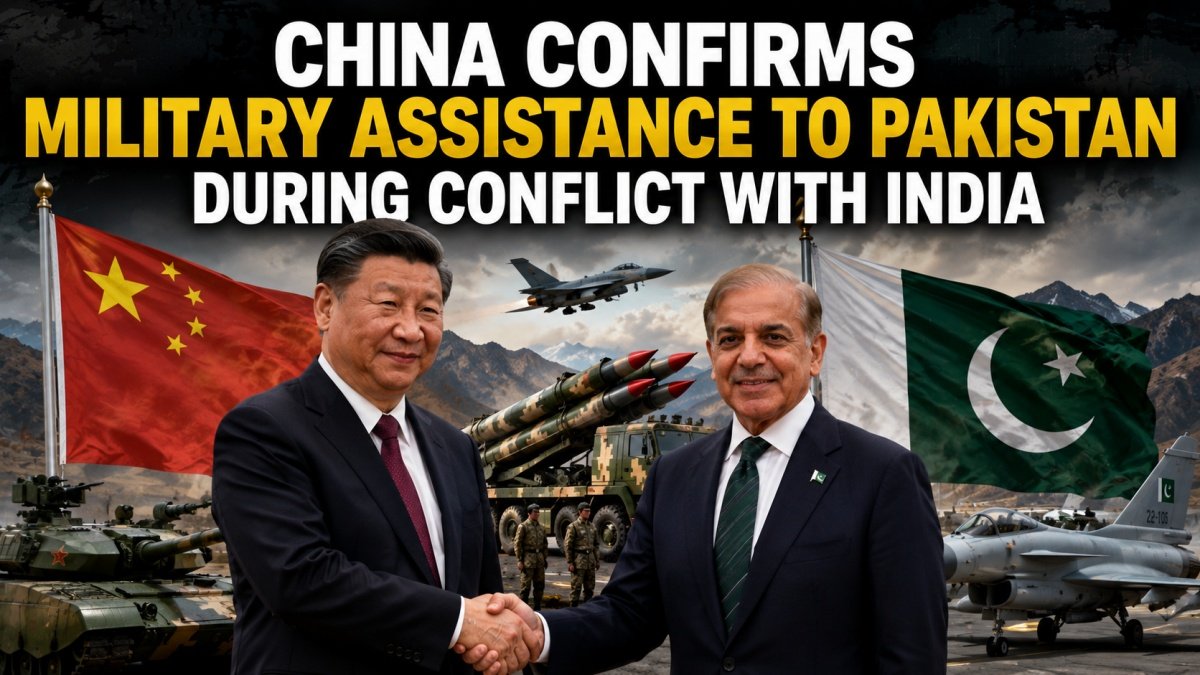
In a significant shift in regional diplomacy, China has for the first time publicly admitted to assisting Pakistan during the brief but intense four-day conflict with India. Through a report by the state-run outlet CCTV, Beijing revealed the existence of “Operation Sindoor,” a mission where Chinese technical teams provided crucial support to ensure the operational readiness of the Pakistan Air Force (PAF). This admission has laid bare China’s complex diplomatic maneuvers, often described as a “dirty game,” where it maintains a facade of neutrality while actively bolstering its strategic allies.
The report highlights that a dedicated technical team, specifically trained for the J-10CE fighter jet platforms, remained in Pakistan throughout the conflict. These teams were reportedly stationed near the front lines to conduct immediate repairs and ensure that the advanced combat aircraft remained airworthy despite the rigors of high-intensity warfare.
Testimony from the Front Lines
Further details were provided by Zhang Heng, an engineer at the Chengdu Aircraft Design Institute, who recounted his experience in a recent interview. Zhang revealed that he arrived in Pakistan in early May, facing extreme environmental challenges including temperatures reaching 50 degrees Celsius. He described a high-pressure environment characterized by the constant blare of air-raid sirens and significant psychological stress as his team worked to provide full-spectrum technical support for the Pakistani fleet.
Another engineer, Xu Da, echoed these sentiments, comparing the J-10CE aircraft to a child he had “nurtured and raised.” He expressed satisfaction with the performance of the jets during the conflict, suggesting that the results were a testament to Chinese engineering.
Validation of Indian Intelligence
These admissions provide direct corroboration for assertions previously made by Lieutenant General Rahul Singh, Deputy Chief of the Indian Army. General Singh had earlier stated that Chinese satellites were monitoring Indian troop movements in real-time and relaying that intelligence directly to Pakistani command centers. While Beijing initially ignored these claims, the recent statements from its own state media and engineers confirm that China was a silent, technical participant in the hostilities.
Despite the technical assistance, the conflict saw significant setbacks for the Pakistani side. Reports indicate that several terrorist headquarters and key airbases were neutralized by the Indian Air Force. Notably, the much-touted Chinese radar systems reportedly failed to intercept or adequately track Indian aerial maneuvers, highlighting a disparity between Chinese marketing and battlefield performance.
The Strategic Sales Pitch
Defense experts suggest that China’s decision to go public with this support is not merely a diplomatic slip, but a calculated “sales ploy.” By highlighting the role of their engineers and the J-10CE’s performance, China aims to prove the reliability of its defense technology to the global market.
Pakistan currently operates a fleet of 36 J-10CE “4.5-generation” fighters, acquired in a 2020 deal that included 250 PL-15 long-range missiles. Beijing is now reportedly leveraging the “combat-proven” status of its hardware to facilitate a new, massive deal involving the sale of J-35 stealth bombers to Pakistan, further tilting the regional balance of power.