





























Key Points
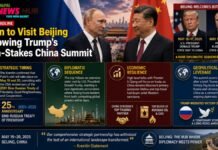
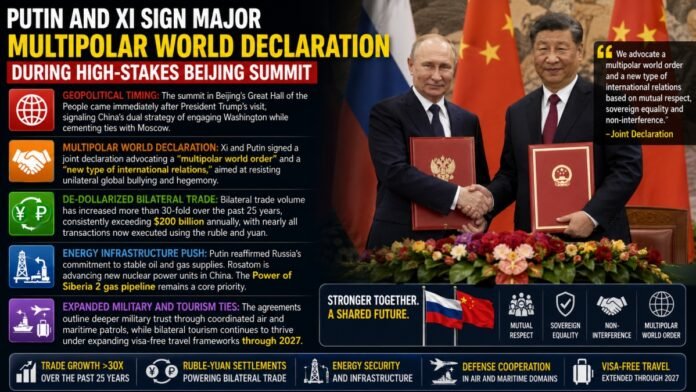
- Geopolitical Timing: The summit took place at Beijing’s Great Hall of the People immediately following U.S. President Donald Trump’s high-profile visit, signaling China’s dual strategy of engaging Washington while cementing ties with Moscow.
- Multipolar World Declaration: Xi and Putin signed a joint declaration advocating a “multipolar world order” and a “new type of international relations,” aimed squarely at resisting unilateral global bullying and hegemony.
- De-Dollarized Bilateral Trade: Bilateral trade volume has increased more than 30-fold over the past 25 years, consistently exceeding $200 billion annually, with nearly all transactions now executed using the ruble and yuan to bypass external pressure.
- Energy Infrastructure Push: Putin reaffirmed Russia’s commitment to stable oil and gas supplies, while state nuclear corporation Rosatom advances new power units in China. Long-running negotiations for the Power of Siberia 2 gas pipeline remain a core priority.
- Expanded Military and Tourism Ties: The agreements outline deeper military trust through coordinated air and maritime patrols, while bilateral tourism continues to thrive under expanding visa-free travel frameworks extended through 2027.
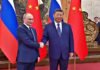
A high-stakes diplomatic summit concluded in Beijing on Wednesday as Russian President Vladimir Putin and Chinese Leader Xi Jinping signed 20 comprehensive cooperation agreements spanning technology, trade, and regional security. The meeting, which marks Putin’s 25th official visit to China, carries immense symbolic and strategic weight. It coincides with the 25th anniversary of the landmark Treaty of Good-Neighborliness and Friendly Cooperation, which both leaders formally extended during the talks.
The timing of the summit sent a powerful signal to international observers. Held just days after U.S. President Donald Trump completed a three-day tour of Beijing, the rapid sequencing highlights China’s calculated effort to project itself as a premier global broker capable of engaging Washington and Moscow simultaneously. While Trump departed Beijing without securing definitive trade breakthroughs, the Putin-Xi talks immediately yielded concrete, sweeping pacts.
Confronting Western Monopolies and Unilateralism
In their joint address from the Great Hall of the People, President Xi called the partnership a model for relations between major powers, warning that the world is in danger of regressing into the “law of the jungle” due to rampant unilateralism.
“China and Russia should firmly play the roles of responsible great powers, protect international justice, and oppose all unilateral bullying and actions that reverse history,” Xi stated.
Echoing these sentiments, Putin noted that the close coordination between Moscow and Beijing acts as an indispensable stabilizing force during a period of heightened international friction. The center point of their engagement was a signed joint declaration supporting a fairer, more democratic world order that fragments the traditional Western-dominated financial and political architecture.
De-Dollarization and Energy Dependencies
The economic ties underpinning the alliance have grown structurally insulated from Western sanctions. Putin highlighted that bilateral trade has expanded 30-fold over a 25-year timeline, reliably anchoring itself above the $200 billion threshold in recent years. To fortify this trade channel against external regulatory crackdowns, both nations have transitioned almost entirely to national currencies, processing virtually all major commercial transactions in rubles and yuan.
Energy remains the locomotive of this financial ecosystem. Since the escalation of international isolation against Russia, China has transformed into Moscow’s absolute economic lifeline, purchasing over a quarter of all Russian exports. During the meetings, Putin guaranteed uninterrupted crude oil and gas flows to satisfy Beijing’s industrial demands.
Progress was also reported on civil nuclear infrastructure, with Russia’s state-owned nuclear corporation, Rosatom, entering the final stages of constructing new power units at Chinese nuclear facilities. Concurrently, behind-the-scenes negotiations progressed regarding the highly anticipated Power of Siberia 2 gas pipeline via Mongolia, a project that would definitively redirect Siberian gas reserves from European networks directly into the Chinese heartland.
Heightened Defense and Shared Mobility
Beyond commerce and commodities, the newly signed protocols map out an intensive trajectory for the Russian and Chinese armed forces. The declaration formalizes intent to deepen mutual military trust, expand joint operational exercises, and execute highly coordinated air and maritime patrols to defend regional security boundaries.
The summit also prioritized soft power and societal convergence. Driven by expanded visa-free policies, over two million Russian nationals visited China in 2025, while more than one million Chinese travelers crossed into Russia. To sustain this momentum, the Chinese Foreign Ministry announced alongside the summit that the visa-free travel framework for citizens has officially been extended through December 31, 2027, ensuring deep people-to-people ties continue alongside their broader macroeconomic integration.