Key Points
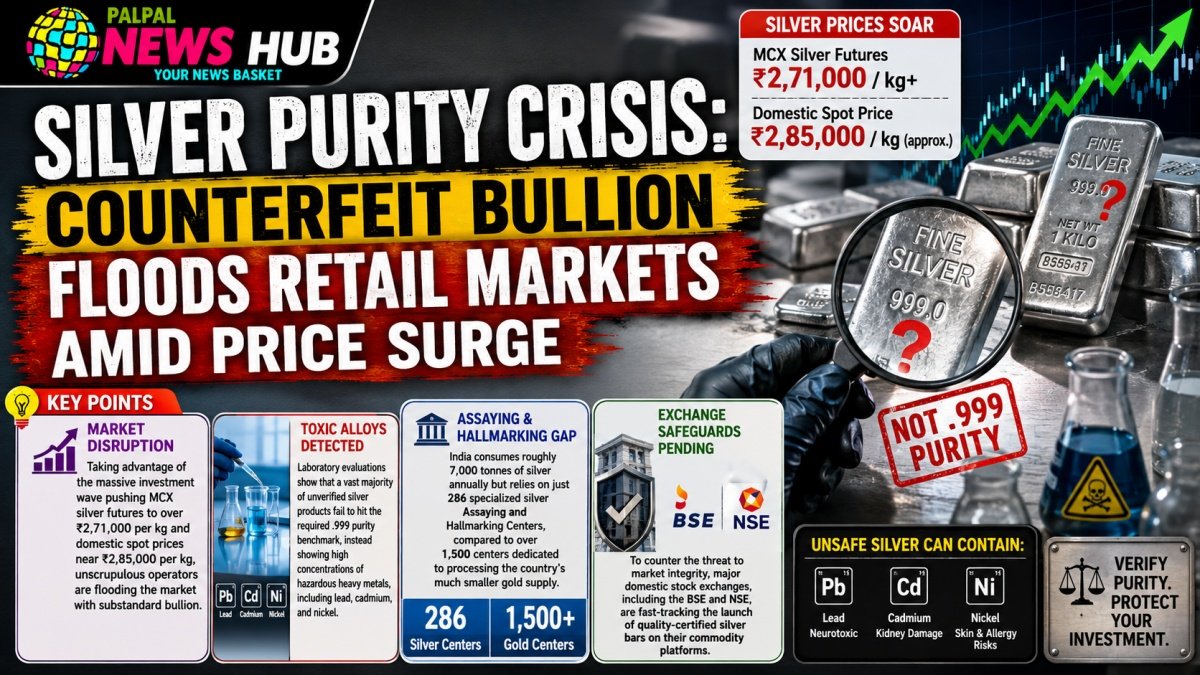
- Market Disruption: Taking advantage of the massive investment wave pushing MCX silver futures to over ₹2,71,000 per kg and domestic spot prices near ₹2,85,000 per kg, unscrupulous operators are flooding the market with substandard bullion.
- Toxic Alloys Detected: Laboratory evaluations show that a vast majority of unverified silver products fail to hit the required .999 purity benchmark, instead showing high concentrations of hazardous heavy metals, including lead, cadmium, and nickel.
- Severe Infrastructure Deficit: India consumes roughly 7,000 tonnes of silver annually but relies on just 286 specialized silver Assaying and Hallmarking Centers, compared to over 1,500 centers dedicated to processing the country’s much smaller gold supply.
- Exchange Safeguards Pending: To counter the threat to market integrity, major domestic stock exchanges, including the BSE and NSE, are fast-tracking the launch of quality, certified silver bars on their commodity platforms.
The dramatic structural rally in precious metals has triggered a severe secondary-market crisis across India’s jewelry hubs. Financial data reveals that domestic spot silver prices have surged nearly threefold from their late 2024 baselines, trading at premium levels between ₹2,60,000 and ₹2,85,000 per kilogram. This rapid appreciation has incentivized an underground trade in which unrefined scrap silver is hastily melted down and mixed with raw bullion to meet basic visual finish lines without proper chemical purification.
According to warnings from the Precious Metals Refineries Forum, field studies show that the vast majority of retail silver articles in circulation do not conform to purity claims. The issue has severely compromised key production clusters, such as Jaipur, Agra, Rajkot, Kolhapur, Salem, and Cuttack.
“At present, much of the new silver jewelry is manufactured from scrap silver without adequate refining. A certain quantity of purified silver bullion is mixed with the scrap merely to achieve the required fineness level,” stated James Jose, president of the forum, noting that even religious artifacts and temple offerings are routinely found to be below acceptable grades.
Structural Comparison: The Gold vs. Silver Regulatory Disparity
The unchecked proliferation of counterfeit silver highlights a significant oversight gap within the Bureau of Indian Standards framework. While gold hallmarking has been under a tight, mandatory legal regime since 2021, silver hallmarking regulations introduced in September 2025 face major structural bottlenecks.
| Precious Metal Metric | Gold | Silver | Structural Deficit |
|---|---|---|---|
| Annual Indian Consumption | ~800–850 tonnes | ~7,000 tonnes | Silver volume is over 8x higher |
| Assaying & Hallmarking Centers | ~1,622 centers | 286 centers | Silver is ~65x under-resourced per tonne |
| Regulatory Enforcement Status | Strictly Mandatory | High non-compliance among retailers | Weak field-level enforcement |
Industry experts argue that this massive infrastructure mismatch makes it exceptionally easy for substandard goods to escape detection, as the 286 operational centers are incapable of tracking a 7,000-tonne domestic demand profile.
Policy Push for Dedicated Refinery Licensing and Exchange Deliveries
To arrest the erosion of retail consumer confidence, organized refinery networks are lobbying the Union Government to replace the existing loose setup with a mandatory, institutional licensing system specifically tailored for silver refining units. Currently, several BIS-licensed gold refineries handle silver as a secondary product but lack an independent statutory standard to verify their processes.
Concurrently, India’s premier financial market infrastructures, including the Multi-Commodity Exchange (MCX), BSE, and NSE, are completing pilot setups to introduce exchange, grade, and certified silver bars directly on their trading dashboards. This mechanism will allow investors to buy, hold, or trade physically backed, vault-stored silver units, bypassing the retail market entirely to secure verifiable 999 fineness.
Until these systematic rollouts materialize, the BIS has advised retail buyers to look exclusively for the unique six-digit alphanumeric HUID (Hallmark Unique Identification) laser markings on items and verify their purity using the official BIS CARE smartphone application before final settlement.