
































Key Points
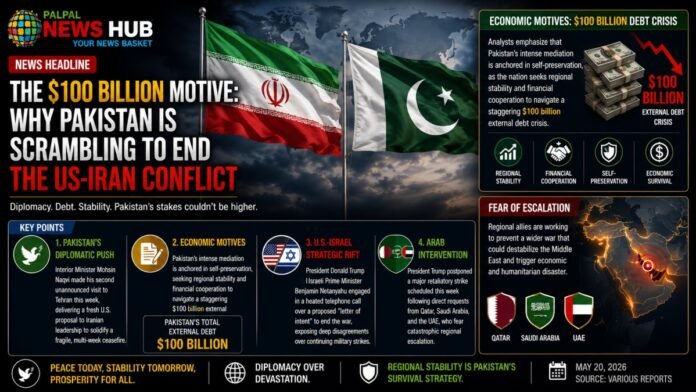
- Pakistan’s Diplomatic Push: Interior Minister Mohsin Naqvi made his second unannounced visit to Tehran this week, delivering a fresh U.S. proposal to the Iranian leadership to solidify a fragile, multi-week ceasefire.
- Economic Motives: Analysts emphasize that Pakistan’s intense mediation is anchored in self-preservation, as the nation seeks regional stability and financial cooperation to navigate a staggering $100 billion external debt crisis.
- U.S.-Israel Strategic Rift: President Donald Trump and Israeli Prime Minister Benjamin Netanyahu engaged in a heated telephone call over a proposed “letter of intent” to end the war, exposing deep disagreements over continuing military strikes.
- Arab Intervention: President Trump postponed a major retaliatory strike scheduled this week following direct requests from regional allies, including Qatar, Saudi Arabia, and the United Arab Emirates, who fear catastrophic regional escalation.
High-stakes diplomatic maneuvers have entered a critical phase in the Iranian capital as Pakistan and Qatar lead a coordinated regional effort to de-escalate severe military tensions between the United States and Iran. The frantic mediation comes at a momentous juncture, following weeks of low-intensity warfare that erupted in February, which disrupted global energy shipping through the Strait of Hormuz and sparked retaliatory strikes across the Middle East.
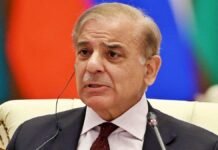
On Friday, Pakistan’s Interior Minister Mohsin Naqvi met with Iranian Foreign Minister Abbas Araghchi in Tehran for the second time within 24 hours. Naqvi, a close ally of Pakistani Army Chief Field Marshal Asim Munir, arrived on an unannounced visit to deliver a revised U.S. proposal offering slightly better incentives regarding Iran’s frozen global assets.
According to regional intelligence reports, Pakistan has established a reliable backchannel to convey messages based on an initial 14-point framework. Under the current proposal, Washington is pushing for a formal “letter of intent” to institute a 30-day negotiation period. However, diplomatic friction remains acute; Iran’s Supreme Leader has reportedly ordered that the country’s enriched uranium stockpile must not leave Iranian soil, directly challenging a core demand from the Trump administration.
Financial Survival Dictates Islamabad’s Peace Brokerage
While Islamabad frames its extensive shuttle diplomacy around regional peace, international observers note that Pakistan’s underlying motivation is fundamentally economic. Suffocating under an external debt burden exceeding $100 billion, Pakistan’s fragile economy is highly vulnerable to energy price spikes and shipping blockages caused by regional warfare.
By positioning itself as an indispensable diplomatic bridge between Washington and Tehran, Islamabad hopes to guarantee regional stability, preserve cross-border trade, and secure financial concessions and energy cooperation from oil-rich Iran. Pakistani government sources indicated that if Naqvi’s current round of talks successfully finalizes a framework agreement, Army Chief Asim Munir will personally fly to Tehran to close the deal.
Escalating Friction Between Trump and Netanyahu
As mediators attempt to construct a diplomatic off-ramp, a severe strategic rift has emerged between the United States and its primary regional ally, Israel. A tense, difficult phone call took place between U.S. President Donald Trump and Israeli Prime Minister Benjamin Netanyahu regarding the future of the conflict.
Leaked reports of the conversation reveal that Netanyahu was deeply displeased with Washington’s willingness to pause hostilities, arguing that halting operations weakens Israel’s position and fails to permanently dismantle Iran’s military infrastructure. Trump, conversely, is eager to secure a swift diplomatic victory, reduce global economic fallout, and avoid a prolonged, costly ground conflict. The American leader reportedly told Netanyahu that his absolute preference remains “to do a good deal.”
Arab Gulf States Mobilize to Halt Total Escalation
The diplomatic shift in Washington was heavily accelerated by a coalition of Arab Gulf states. President Trump publicly confirmed that he called off a massive, highly destructive military strike against Iran that had been scheduled for earlier in the week.
The decision to abort the attack followed direct, urgent appeals from the leaders of Qatar, Saudi Arabia, and the United Arab Emirates (UAE). These nations warned that a full-scale war would unleash catastrophic economic and structural devastation across the Gulf region. The urgency was underscored when a rogue drone strike caused a fire near the UAE’s sole nuclear power plant, a stark reminder of how quickly localized operations could expand into a regional disaster.
To capitalize on the postponed U.S. strike, Qatar and Pakistan have jointly drafted a revised peace memo, incorporating feedback from Egypt and Turkey. The collective goal of these regional powers is to transform the temporary April 8 ceasefire into a permanent security architecture before the highly volatile diplomatic track collapses back into open warfare.