






























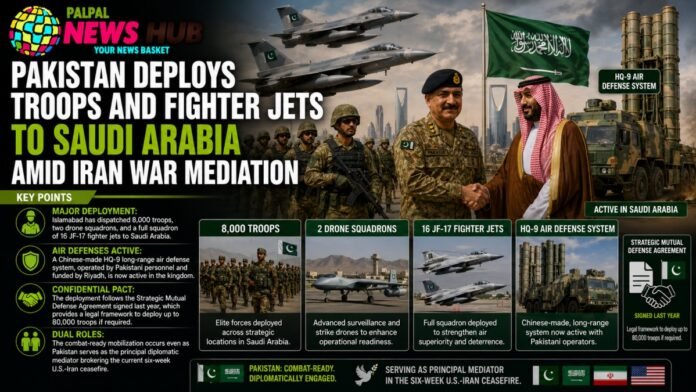
Key Points
- Major Deployment: Islamabad has dispatched 8,000 troops, two drone squadrons, and a full squadron of 16 JF-17 fighter jets to Saudi Arabia.
- Air Defenses Active: A Chinese-made HQ-9 long-range air defense system, operated by Pakistani personnel and funded by Riyadh, is now active in the kingdom.
- Confidential Pact: The deployment follows the Strategic Mutual Defense Agreement signed last year, which provides a legal framework to deploy up to 80,000 troops if required.
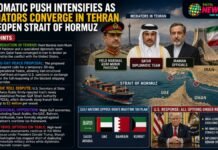
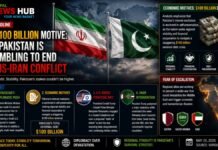
- Dual Roles: The combat-ready mobilization occurs even as Pakistan serves as the principal diplomatic mediator, brokering the current six-week U.S.-Iran ceasefire.
In a significant escalation of military alignment in the Gulf, top Pakistani military sources have confirmed the deployment of 8,000 troops, a full fighter jet squadron, and advanced anti-aircraft systems to Saudi Arabia. The deployment, confirmed by multiple security officials and government sources, represents a substantial, combat-capable force designed to fortify Saudi Arabia’s defenses against potential regional escalations.
This dramatic expansion of military cooperation comes at a highly sensitive time, as Islamabad simultaneously acts as the principal diplomatic mediator attempting to de-escalate the broader conflict between the United States and Iran. While the official terms of the security pact remain confidential, both Islamabad and Riyadh have confirmed that the agreement mandates mutual defense obligations in the event of an armed assault on either nation.
Fleet of JF-17 Jets and HQ-9 Air Defenses Transferred
According to detailed intelligence reports, Pakistan transferred a full squadron of approximately 16 aircraft, primarily Chinese-co-developed JF-17 Thunder fighter jets, to Saudi airbases in early April. This aerial contingent is bolstered by two specialized squadrons of military drones sent to monitor regional airspace.
To shield the kingdom from potential missile or drone incursions, Islamabad has also deployed a Chinese-made HQ-9 long-range surface-to-air defense system. The heavy hardware is being fully operated on the ground by Pakistani military personnel, while the financial logistics and operational costs are being entirely funded by the Saudi government.
Historical Context and the Nuclear Umbrella
The legal foundation for this deployment was established in September 2025, when both nations signed the Strategic Mutual Defense Agreement, a sweeping bilateral pact that mirrored NATO’s collective defense framework. The agreement was catalyzed after a series of regional flashpoints, including missile strikes affecting neighboring Gulf nations that Iran accused of acting as U.S. allies. Pakistani Defence Minister Khawaja Asif has previously indicated that the agreement effectively extends Pakistan’s nuclear deterrence capabilities over Saudi territory, placing Riyadh under Islamabad’s nuclear umbrella.
While the 8,000 newly arriving personnel will initially assume advisory, training, and strategic defense positions, they join thousands of combat-ready Pakistani troops already permanently stationed in the kingdom under legacy security agreements. According to a senior government source who has reviewed the classified text of the pact, the document provides the legal framework for the eventual deployment of up to 80,000 Pakistani troops to secure Saudi borders alongside domestic forces.
The Diplomatic Tightrope of Mediation
The scale and composition of this deployment, featuring frontline combat aircraft and high-end air defenses, demonstrate that Pakistan’s involvement goes far beyond a symbolic mission. This robust military reinforcement occurred just before Islamabad successfully emerged as the principal diplomatic bridge in the region, helping broker a vital ceasefire between Washington and Tehran that has successfully held for the past six weeks.
As geopolitical tensions threaten to disrupt the fragile regional truce, Pakistan continues to walk an extraordinarily narrow tightrope, functioning as an indispensable neutral peacemaker in high-level talks while simultaneously guaranteeing the territorial integrity of its closest economic and strategic ally in the Gulf.