Key Takeaways
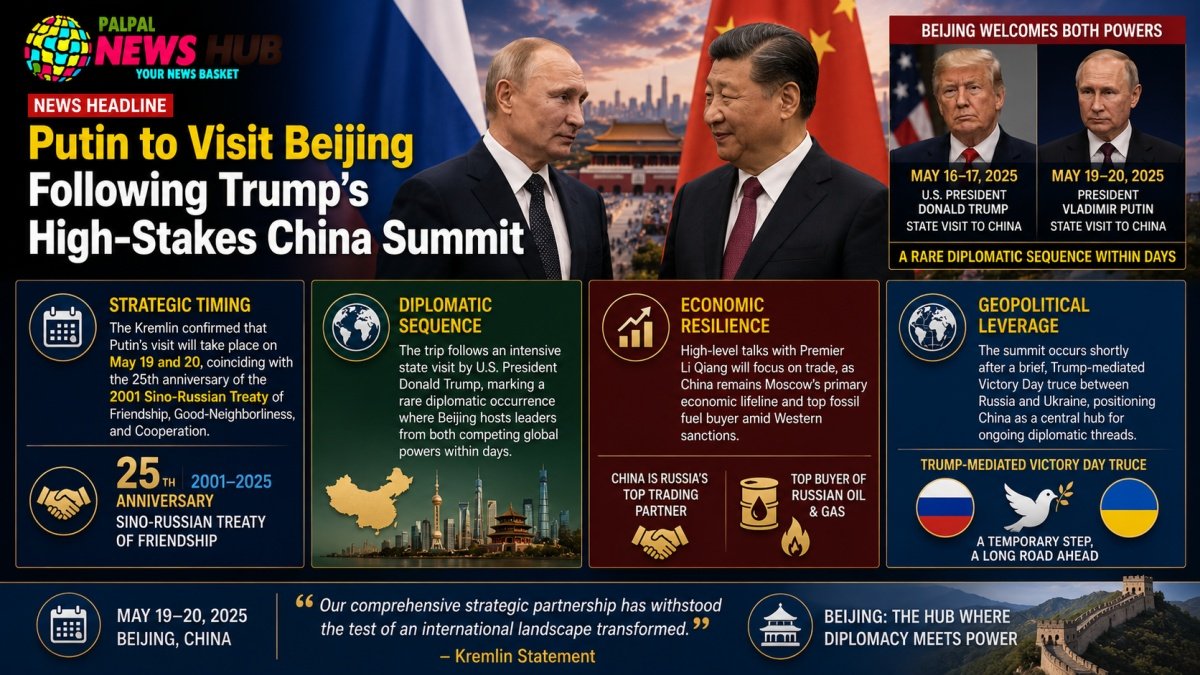
- Strategic Timing: The Kremlin confirmed that Putin’s visit will take place on May 19 and 20, deliberately coinciding with the 25th anniversary of the 2001 Sino-Russian Treaty of Friendship.
- Diplomatic Sequence: The trip follows an intensive state visit by U.S. President Donald Trump, marking a rare diplomatic occurrence where Beijing hosts leaders from both competing global powers within days.
- Economic Resilience: High-level talks with Premier Li Qiang will focus on trade, as China remains Moscow’s primary economic lifeline and top fossil fuel buyer amid Western sanctions.
- Geopolitical Leverage: The summit occurs shortly after a brief, Trump-mediated Victory Day truce between Russia and Ukraine, positioning China as a central hub for ongoing diplomatic threads.
The Kremlin announced on Saturday that Russian President Vladimir Putin will embark on a pivotal two-day state visit to Beijing starting May 19, 2026. This high-profile announcement comes less than 24 hours after U.S. President Donald Trump concluded his historic state visit to China, signaling an unprecedented period of intense diplomatic maneuvering in the Chinese capital.
According to an official statement from the Kremlin press office, Putin’s trip was scheduled to coincide with the 25th anniversary of the 2001 Sino-Russian Treaty of Friendship. However, the immediate sequence of hosting the executive leaders of both the United States and Russia within the same week highlights Beijing’s unique position as a central gravity well for global geopolitics.
Deepening the Strategic Partnership
During his stay, President Putin will engage in comprehensive bilateral talks with Chinese President Xi Jinping. The primary objective of these sessions is to further fortify the comprehensive strategic partnership and cooperation that has increasingly bound Moscow and Beijing together over the last four years.
The two leaders are expected to review pressing global and regional security matrices, culminating in the signing of a sweeping joint declaration. In recent years, this deepening alignment has drawn sharp criticism and concern from Western nations, which view the partnership as a coordinated challenge to the existing international order.
Trade Resilience Amid Ongoing Sanctions
Beyond high-level security frameworks, President Putin will hold specialized working sessions with Chinese Premier Li Qiang to address bilateral commerce. Confronted by severe Western economic sanctions since launching its military offensive in Ukraine, Moscow has increasingly leaned on Beijing as its most vital economic partner.
| Economic Sector | Role of China-Russia Bilateral Trade (2026) |
|---|---|
| Fossil Fuel Exports | China remains the largest global buyer of Russian crude oil, providing vital capital. |
| Market Ingress | Chinese consumer goods and automotive lines have filled retail vacancies left by Western firms. |
| Financial Security | Bilateral clearings are predominantly processed in Yuan, bypassing Western banking systems. |
This critical trade volume has successfully insulated the Russian domestic economy, allowing Moscow to sustain its long-term operational expenditures despite extensive global asset freezes.
Shadow of the Trump-Xi Summit: Taiwan and Iran
Putin’s arrival follows a momentous summit between President Trump and President Xi, which marked the first visit by a sitting U.S. executive to China in nearly a decade. The American delegation focused its agenda heavily on international trade imbalances, technology controls, and the volatile security situation surrounding the conflict in Iran.
During those sessions, President Xi issued an explicit warning to the American president regarding the status of Taiwan, defining the island’s governance as the single most sensitive, non-negotiable threshold in U.S.-China relations, and warning that mismanagement could push both superpowers toward direct conflict. Following the meetings, Trump announced that Beijing had agreed in principle that Iran must be prevented from developing nuclear weapons, while also discussing mutual assurances to keep the critical Strait of Hormuz open to international energy shipping.
The Ukrainian Theatre and Diplomatic Threads
The timing of Putin’s trip is equally crucial for the shifting architecture of the war in Ukraine. The visit follows a successful, short-term Victory Day ceasefire from May 9 to May 11, 2026, which was facilitated through international mediation efforts involving President Trump. This temporary cessation of hostilities paved the way for a major phase-one prisoner of war swap on Friday, where both sides successfully exchanged 250 detainees, a development widely viewed as a tangible step toward structured dialogue.
While China has consistently maintained a public posture of absolute neutrality, it has steadily refused to condemn Russian military movements and has accused Western powers of artificially extending the conflict through defensive arms shipments. Analysts suggest that Putin’s upcoming consultations in Beijing will serve as a vital link connecting these fractured diplomatic threads, potentially charting either a path toward structured peace frameworks or an intensified phase of global alignment.