






























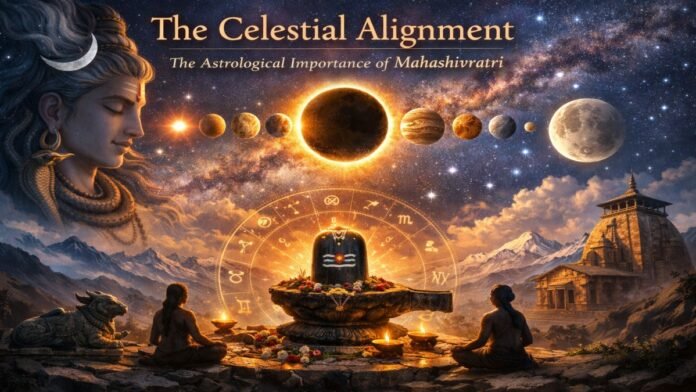
Mahashivratri, the “Great Night of Shiva,” is not merely a religious festival or a cultural celebration; it is a profound astronomical and astrological phenomenon. While many festivals in the Hindu calendar are tied to the solar cycle or harvest seasons, Mahashivratri is uniquely governed by the specific positioning of the Sun, the Moon, and the Earth, creating a “metaphysical portal” for human consciousness.
In 2026, as we observe this sacred night, understanding the mechanics of the cosmos helps us appreciate why this specific date is chosen for spiritual intensification.
1. The Lunar Mechanics: The 14th Day of the Waning Moon
Every month, the night before the New Moon (Amavasya) is known as Shivratri. However, the one that falls in the Hindu month of Phalguna (February/March) is designated as Mahashivratri.
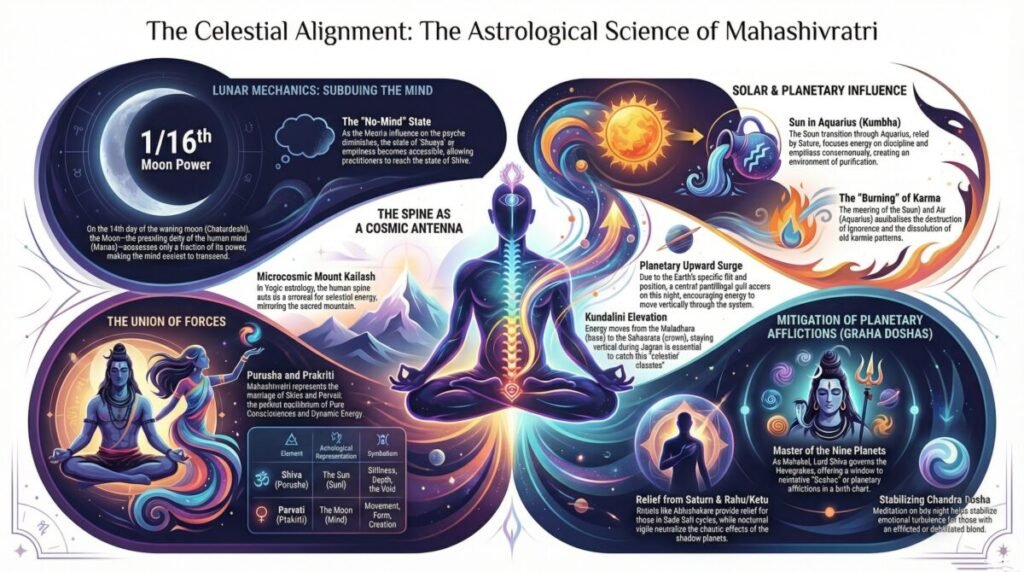
From an astrological perspective, the Moon represents the Manas (mind). During the Krishna Paksha (waning phase), the Moon’s visible surface diminishes, and so does its influence on the human psyche. On the 14th day (Chaturdashi), the Moon is almost invisible, possessing only about 1/16th of its power.
- The Subduing of the Mind: Since the Moon is the presiding deity of the mind, its near-absence on this night signifies a rare opportunity. When the mind is weak, the “no-mind” state or the state of Shiva becomes accessible.
- The Transition to Emptiness: Mahashivratri is the night when the mind is most easily transcended, allowing the practitioner to experience the “Shunya” (emptiness) that Shiva represents.
2. The Solar Influence: Sun in Aquarius (Kumbha)
During Mahashivratri, the Sun is typically transitioning through the sign of Aquarius (Kumbha Rashi) and moving toward Pisces (Meena Rashi).
- Aquarius (The Pitcher): This sign is ruled by Saturn (Shani), the planet of discipline, karma, and asceticism. The Sun’s placement here brings a focus on the “higher self” and collective consciousness.
- The Meeting of Fire and Air: The Sun (Fire) in Aquarius (Air) creates an environment of purification. Astrologically, this alignment supports the “burning” of old karmic patterns, mirroring Shiva’s role as the Destroyer of Ignorance.
3. The Planetary Upward Surge
One of the most significant physical aspects of Mahashivratri is the natural upsurge of energy in the human system. Due to the specific tilt and position of the Earth relative to the Sun and Moon on this night, there is a natural centrifugal pull.
The Spine as the Antenna
In Yogic astrology, the human spine is viewed as a microcosmic Mount Kailash. On Mahashivratri:
- Vertical Energy Flow: The planetary positions encourage the movement of Kundalini energy from the base of the spine (Muladhara) toward the crown (Sahasrara).
- The Importance of Vigilance: This is why the tradition of Jagran (staying awake and keeping the spine vertical) is so vital. If one lies down, they miss this natural celestial “elevator” that pushes energy upward.
4. The Union of Purusha and Prakriti
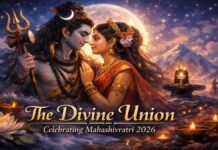
Astrologically, Mahashivratri marks the marriage of Shiva and Parvati. In celestial terms, this is the perfect integration of Purusha (Pure Consciousness) and Prakriti (Nature/Energy).
| Element | Astrological Representation | Symbolism |
|---|---|---|
| Shiva | The Unmanifest / The Sun (Soul) | Stillness, Depth, the Void |
| Parvati | The Manifest / The Moon (Mind) | Movement, Form, Creation |
When these two forces align on the 14th night, the “static” and “dynamic” energies of the universe reach a point of perfect equilibrium. For a practitioner, this balance helps neutralize the “Doshas” or planetary afflictions in their birth chart.
5. Mitigation of Planetary Afflictions (Graha Doshas)
Lord Shiva is known as Mahakal, the one who is beyond Time and the master of the Nine Planets (Navagrahas). Worshipping Shiva on this night provides specific astrological remedies:
- Sade Sati and Saturn Influences: Since Shiva is the Guru of Saturn, those undergoing difficult Saturn cycles find immense relief through the Abhishekam (ritual bathing of the Lingam) on this night.
- Chandra Dosha: For those with a debilitated or afflicted Moon in their horoscope, the meditation on Mahashivratri helps stabilize emotional turbulence and mental health issues.
- Rahu and Ketu: As the lord of the serpents, Shiva controls the “shadow planets” Rahu and Ketu. The nocturnal vigils help in neutralizing the chaotic effects of these lunar nodes.
6. The Science of the “Great Night”
Why is it called the Great Night? Modern researchers often look at the geomagnetic activity of the Earth during this period. The alignment of the Sun and Moon on the 14th day of the waning phase creates a unique gravitational pull that affects all fluid bodies—including the tides of the ocean and the fluids within the human brain.
The “Darkness” of Mahashivratri is not a lack of light; it is the Ur-darkness—the source of all creation. Astrologically, while the Full Moon (Purnima) represents the peak of the external world, Mahashivratri represents the peak of the internal world.
7. Rituals and Their Astrological Significance
The rituals performed on this night are designed to harmonize our biological rhythms with the celestial ones:
- Bael Patra (Wood Apple Leaves): These leaves are trifoliate, representing the three Gunas (Sattva, Rajas, Tamas) and the three eyes of Shiva. Offering them signifies the surrender of our ego and planetary influences to the Divine.
- The Four Prahars: The night is divided into four quarters (Prahars). Each Prahar corresponds to different planetary energies, and specific Mantras are chanted to align with the changing vibrations of the Earth’s rotation.
Conclusion: A Night for Evolution
Mahashivratri is not a day for mere prayer; it is a day for alignment. The cosmos does most of the work for us on this night; our only job is to remain awake, upright, and aware. By syncing our consciousness with the lunar-solar positioning, we can accelerate our spiritual evolution in a way that might otherwise take years of effort.
As the Moon fades into the shadow of the Sun, the mind fades into the soul, and for one night, the individual becomes the Infinite.