
































Key Points
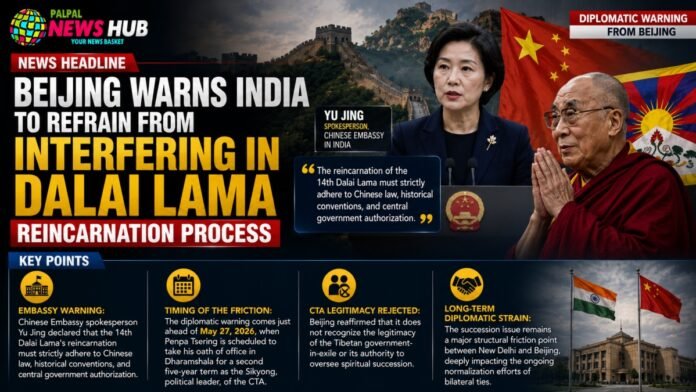
- Embassy Warning: Chinese Embassy spokesperson Yu Jing declared that the 14th Dalai Lama’s reincarnation must strictly adhere to Chinese law, historical conventions, and central government authorization.
- Timing of the Friction: The diplomatic warning comes just ahead of May 27, 2026, when Penpa Tsering is scheduled to take his oath of office in Dharamshala for a second five-year term as the Sikyong, political leader, of the Central Tibetan Administration (CTA).
- CTA Legitimacy Rejected: Beijing reaffirmed that it does not recognize the legitimacy of the Tibetan government in,exile or its authority to oversee spiritual succession.
- Long-Term Diplomatic Strain: The succession issue remains a major structural friction point between New Delhi and Beijing, deeply impacting the ongoing normalization efforts of bilateral ties.
In a renewed diplomatic confrontation, the Chinese Embassy in India has asserted that the selection of the successor to Tibet’s spiritual leader, the Dalai Lama, is entirely an internal affair of China. The statement, issued by Chinese Embassy spokesperson Yu Jing, warned New Delhi to steer clear of the reincarnation process and firmly fulfill its past diplomatic commitments regarding the status of Tibet.
Beijing’s sharp warning is strategically timed ahead of May 27, 2026, when the political leader, Sikyong, of the Central Tibetan Administration, Penpa Tsering, is set to be sworn in for a second term in Dharamshala, Himachal Pradesh. The current 14th Dalai Lama is expected to attend the event. China has requested that India refrain from providing a public or political platform for organizations and figures advocating for Tibetan independence, indicating that respecting these parameters is essential for the constructive development of bilateral relations.
“`html| Entity | Declared Position on Succession |
|---|---|
| Chinese Government | Must follow historical rituals, golden urn drawing, and Beijing’s final seal |
| Dalai Lama / Gaden Phodrang Trust | Sole authority lies with the Gaden Phodrang Trust, candidate may be born in a free, democratic nation |
| Government of India | Upholds religious freedom, officially treats the issue as a matter of faith |
Beijing Insists on Central Government Sanction
The core of Beijing’s argument rests on historical precedent and legal jurisdiction. According to Yu Jing, centuries,old religious rituals and historical conventions dictate that the reincarnation of Living Buddhas, including the Dalai and Panchen Lamas, must receive explicit validation from China’s central government. Chinese state media and diplomats emphasize that the 14th Dalai Lama himself was recognized through this established process.
Furthermore, China completely dismissed the political standing of the Central Tibetan Administration. Beijing points out that the CTA is not recognized by any sovereign nation under international law and, consequently, holds no legal authority to manage, dictate, or interfere with the complex succession system of Tibetan Buddhism.
The Underlying Geopolitical Trigger
The friction over succession has intensified because the 14th Dalai Lama has made it clear that Beijing will have no valid spiritual role in finding his heir. He has formally designated the Gaden Phodrang Trust as the sole institution authorized to recognize his future reincarnation. The spiritual leader has previously stated that if his succession continues, his next incarnation will likely be born in a free, democratic country outside the territory of the People’s Republic of China.
Past Diplomatic Rub: Relations between the two neighbors faced similar friction previously when Union Minister Kiren Rijiju publicly supported the stance that the Dalai Lama should choose his own successor based on his followers’ wishes. While India’s Ministry of External Affairs (MEA) later clarified that New Delhi takes no official political position on matters concerning core religious beliefs, India continues to grant asylum to the Dalai Lama and nearly 70,000 Tibetan refugees, maintaining a sensitive point of leverage.
As both countries slowly navigate a delicate post, Ladakh normalization process, including the recent resumption of the Kailash Mansarovar Yatra pilgrimage, Beijing’s latest warning underscores that the Tibet issue remains a volatile threshold in India-China border relations.