


































Key Points
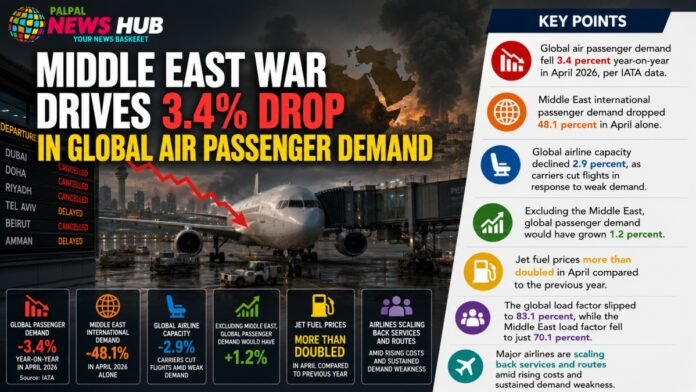
- Global air passenger demand fell 3.4 percent year-on-year in April 2026, per IATA data
- Middle East international passenger demand dropped 48.1 percent in April alone
- Global airline capacity declined 2.9 percent, as carriers cut flights in response to weak demand
- Excluding the Middle East, global passenger demand would have grown 1.2 percent
- Jet fuel prices more than doubled in April compared to the previous year
- The global load factor slipped to 83.1 percent, while the Middle East load factor fell to just 70.1 percent
- Major airlines are scaling back services and routes amid rising costs and sustained demand weakness
The Middle East conflict has delivered a significant and measurable blow to global aviation. Data released by the International Air Transport Association for April 2026 paints a stark picture of an industry under pressure, with passenger numbers, capacity, and load factors all declining sharply against the backdrop of ongoing regional warfare and escalating fuel costs.
Measured in Revenue Passenger Kilometers, the standard industry metric for passenger volume, total global demand fell 3.4 percent compared to April 2025. Simultaneously, Available Seat Kilometers, which measure total airline capacity, contracted by 2.9 percent, indicating that airlines are not merely responding to fewer passengers but are proactively reducing the number of flights they operate.
The Middle East: An Industry in Freefall
No region has been hit harder than the Middle East. International passenger demand across the region collapsed by 46.6 percent on a year-on-year basis, with April’s month-specific figure reaching an even steeper 48.1 percent decline. Regional airline capacity fell by 38.4 percent over the same period, as carriers suspended or sharply curtailed operations on routes affected by conflict and airspace closures.
The scale of the regional disruption becomes even clearer when isolated from global figures. If the Middle East were removed from the calculation entirely, global passenger demand would have actually recorded a modest increase of 1.2 percent, underscoring how heavily one conflict zone is distorting the overall picture for world aviation.
The Middle East load factor, the share of available seats filled by paying passengers, fell to just 70.1 percent, compared to a global average of 83.1 percent, itself down 0.4 percent from the prior year.
Jet Fuel Costs and Rising Fares
Beyond the demand shock, airlines are also contending with a dramatic surge in operating costs. IATA Director General Willie Walsh noted that jet fuel prices in April more than doubled compared to the same month last year, driven by volatility in global oil markets linked directly to the regional conflict.
The knock-on effect for travelers has been immediate. Rising fuel costs have pushed international airfares significantly higher, placing long-haul travel beyond the financial reach of many passengers and further suppressing demand on key routes.
A Volatile Outlook
Walsh cautioned that the aviation sector should expect conditions to remain highly uncertain in the months ahead. With weak demand and elevated fuel costs converging, several major airlines are already reducing the scope of their networks, cutting both the frequency of flights and the number of routes served.
The IATA report also notes that air traffic continues to be disrupted by the conflict involving Iran. While the pace of decline has eased modestly following the implementation of a ceasefire, a full recovery for the region’s aviation sector remains a distant and uncertain prospect.