





























Key Points
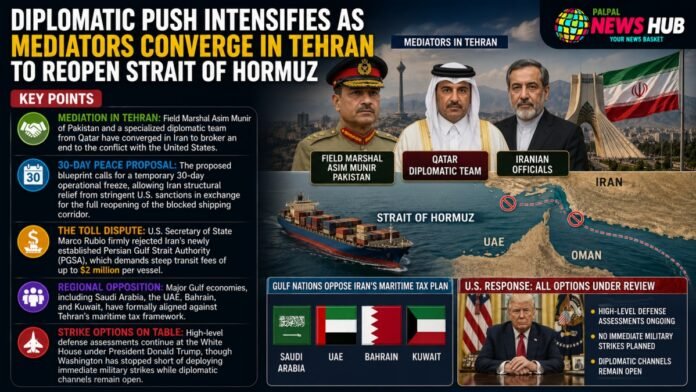
- Mediation In Tehran: Field Marshal Asim Munir of Pakistan and a specialized diplomatic team from Qatar have converged in Iran to broker an end to the conflict with the United States.
- 30-Day Peace Proposal: The proposed blueprint calls for a temporary 30-day operational freeze, allowing Iran structural relief from stringent U.S. sanctions in exchange for the full reopening of the blocked shipping corridor.
- The Toll Dispute: U.S. Secretary of State Marco Rubio firmly rejected Iran’s newly established Persian Gulf Strait Authority (PGSA), which demands steep transit fees of up to $2 million per vessel.
- Regional Opposition: Major Gulf economies, including Saudi Arabia, the UAE, Bahrain, and Kuwait, have formally aligned against Tehran’s maritime tax framework.
- Strike Options On Table: High-level defense assessments continue at the White House under President Donald Trump, though Washington has stopped short of deploying immediate military strikes while diplomatic channels remain open.
International efforts to avert a wider war and resolve the multi-week blockade of the Strait of Hormuz reached a critical juncture on Friday as regional mediators arrived in the Iranian capital. Following extended baseline talks managed by Pakistan, Qatar has officially dispatched a specialized team of diplomatic intermediaries to Tehran. The combined diplomatic offensive aims to build a viable compromise between Washington and Tehran, reversing a global shipping lockdown that has frozen nearly a fifth of the world’s daily energy transit.
The central pillar of the active draft proposal revolves around a synchronized, 30-day de-escalation window. Under this framework, the United States would grant Iran immediate, substantial relief from a targeted selection of its most stringent economic and financial sanctions. In return, Tehran would be required to completely stand down its maritime restrictions, ensuring the unhindered, safe resumption of international commercial shipping through the narrow chokepoint.
U.S. Rejects Iran’s “Strait Booth” Taxes Amid Gulf Backlash
A massive diplomatic hurdle remains the creation of the Persian Gulf Strait Authority (PGSA), an entity established by Iran’s Islamic Revolutionary Guard Corps to formalize its maritime control. The PGSA has begun demanding steep transit fees, running as high as $2 million per ship, settled exclusively in Chinese yuan or cryptocurrency, from vessels attempting to cross the corridor.
U.S. Secretary of State Marco Rubio addressed the geopolitical gridlock directly, categorically stating that the United States will not tolerate the unlawful levying of arbitrary toll taxes on international maritime vessels traversing a natural, global strait.
This position is strongly backed by neighboring Arab capitals. Fearing long-term erosion of freedom of navigation laws, Saudi Arabia, the UAE, Bahrain, and Kuwait have jointly issued formal declarations opposing the Iranian transit regime.
While Qatar handles the current multilateral talks, the White House continues to review its strategic leverage. President Donald Trump canceled a series of public engagements to chair emergency national security sessions. Reports from Washington confirm that while finalized orders for retaliatory military strikes have not been signed, comprehensive tactical strike options remain fully active on the President’s desk if the 30-day diplomatic framework collapses.
The Strategic Ledger: Core Demands and Positions
The current round of talks reveals deeply entrenched positions, with international mediators attempting to bridge wide operational differences.
| Stakeholder / Nation | Primary Demands | Key Geopolitical Stance |
|---|---|---|
| Iran | Immediate ceasefire, permanent non-aggression guarantees, and sweeping U.S. sanctions relief. | Asserts sovereignty over the passage corridor via the newly formed PGSA transit regime. |
| United States | Unconditional reopening of the Strait of Hormuz and absolute termination of maritime transit fees. | Refuses to negotiate broader nuclear adjustments until freedom of navigation is restored, keeping military options open. |
| Pakistan & Qatar | Implementation of an immediate 30-day freeze, utilizing China as an institutional guarantor for compliance. | Serving as official diplomatic conduits, seeking to prevent a catastrophic regional economic collapse. |
| Gulf Cooperation Council | Full, untaxed restoration of international oil trade routes. | Strongly opposes Iranian transit levies, while remaining cautious about a full-scale regional war. |
Islamabad and Beijing Seek to Underwrite the Deal
Pakistan continues to hold a prominent position as the primary official mediator between the two hostile powers. Pakistan’s military chief, Field Marshal Asim Munir, arrived in Tehran directly following extensive rounds of preliminary diplomacy managed by Pakistani civilian ministers.
According to security sources, Islamabad’s broader strategy involves locking down a dual-layered security architecture, with Pakistan actively working behind the scenes to bring China into the final text as an official international guarantor. Because Beijing has a vested interest in stabilizing its primary energy supply chain, Chinese backing could provide the necessary enforcement mechanism to keep both Washington and Tehran compliant.
The economic urgency underpins every hour of the current talks. Because the primary state revenue of major Arab producers relies almost exclusively on the seamless export of crude oil, the prolonged eleven-week closure has triggered profound economic anxiety across the Middle East, threatening to tip global energy markets into a structural recession if a breakthrough is not achieved.