Key Highlights
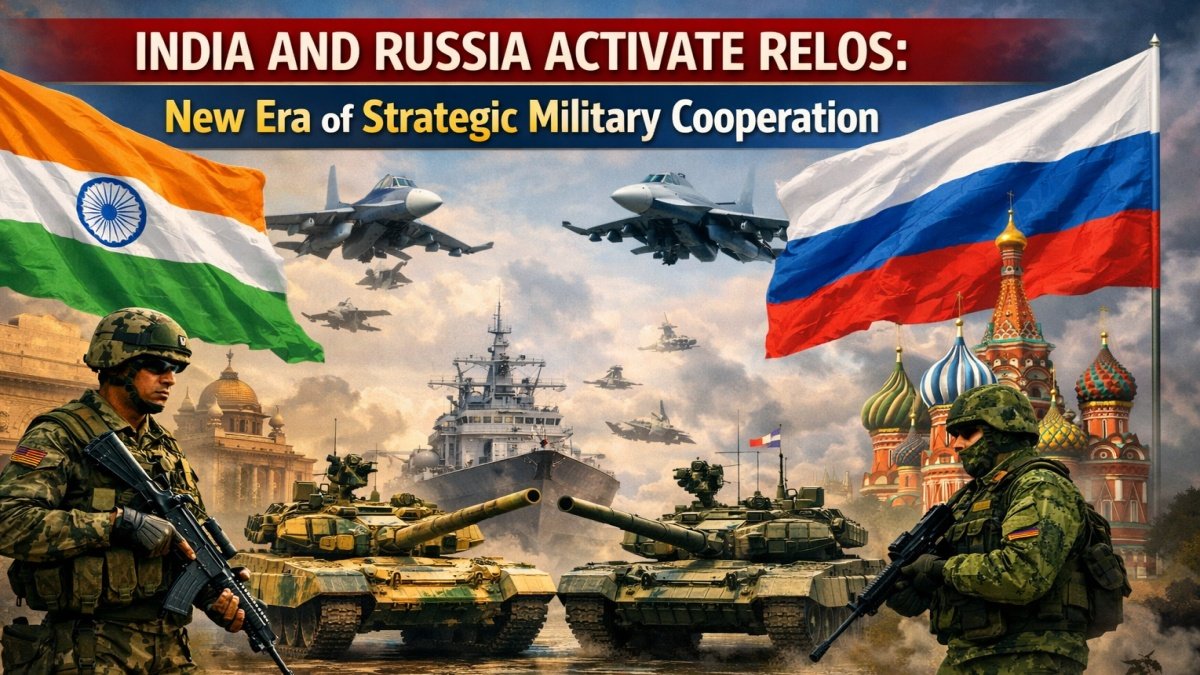
- Deployment Limits: Each nation can deploy up to 3,000 troops, 10 aircraft, and 5 warships.
- Effective Date: The agreement entered into force on January 12, 2026, following Russia’s ratification in late 2025.
- Strategic Access: India gains potential access to Russian Arctic ports, while Russia utilizes Indian infrastructure.
- Maintenance Support: Streamlines the servicing of India’s vast inventory of Russian-made military hardware.
- Duration: Initial five-year term with provisions for mutual extension.
The enduring partnership between New Delhi and Moscow has reached a new milestone, as the Reciprocal Exchange of Logistics Agreement (RELOS) transitions from a signed treaty to an active operational framework. Effective as of January 12, 2026, the pact marks a decisive shift in how the two nations manage regional security, especially amid heightened volatility in West Asia and the Indo-Pacific.
The agreement, which was initially signed in February 2025 and ratified by the Russian Parliament in December 2025, formalizes the presence of military assets on each other’s soil. Vyacheslav Nikonov, Deputy Chairman of the International Affairs Committee of the Russian Parliament, confirmed that the deployment is set for an initial five-year duration. This timeframe allows both militaries to integrate logistics and planning, with the option to extend the term through mutual diplomatic consent.
Infrastructure and Technical Logistics
For India, the agreement is a practical necessity. With a significant portion of the Indian Armed Forces’ equipment being of Russian origin, the ability to house Russian technical teams and access specialized spare parts locally will drastically reduce downtime for maintenance. Under the specific terms of the pact:
- Maritime Support: Warships are entitled to port services, emergency repairs, and essential supplies, including food and water.
- Aviation Services: Military aircraft will receive air traffic control support, navigation assistance, and dedicated parking facilities at designated airbases.
- Financial Framework: Fuel, technical services, and specialized equipment repairs will be provided on a transparent, payment-based system.
Strategic Geography: From the Arctic to the Indian Ocean
Beyond simple logistics, RELOS provides a geopolitical advantage that was previously unavailable. India is now positioned to gain a footprint in the strategically vital Arctic region, where Russia maintains extensive military and resource-gathering infrastructure. Conversely, Russia gains streamlined access to India’s military ports and airbases, allowing for a more consistent presence in the Indian Ocean Region (IOR).
Collaborative Training and Disaster Response
The scope of the agreement extends beyond the hardware. It creates a permanent legal framework for joint military exercises and high-level training programs. By sharing bases, both nations can conduct more frequent drills in diverse terrains, from the high-altitude regions of the Himalayas to the frozen landscapes of Siberia. Furthermore, the pact includes provisions for coordinated disaster relief operations, ensuring that both nations can respond rapidly to humanitarian crises in their respective spheres of influence.
This activation of RELOS, occurring at a time when global security architectures are under strain, underscores a deep level of institutional trust. It transforms a traditional buyer-seller relationship into a sophisticated, reciprocal defense partnership that is likely to influence the balance of power across Eurasia for the remainder of the decade.