Key Highlights
- Strategic Justification: Putin labels the Ukraine conflict a “right” and “just” struggle against NATO influence during the 81st anniversary of the WWII victory.
- No Heavy Armor: For the first time in two decades, the Red Square parade featured no tanks or missile systems, with hardware reportedly diverted to the front lines.
- International Presence: North Korean troops marched in the procession, joined by leaders from Belarus, Laos, and Malaysia.
- Ceasefire Strains: The event occurred during a Trump-brokered three-day truce, though both Moscow and Kyiv have already traded accusations of localized breaches.
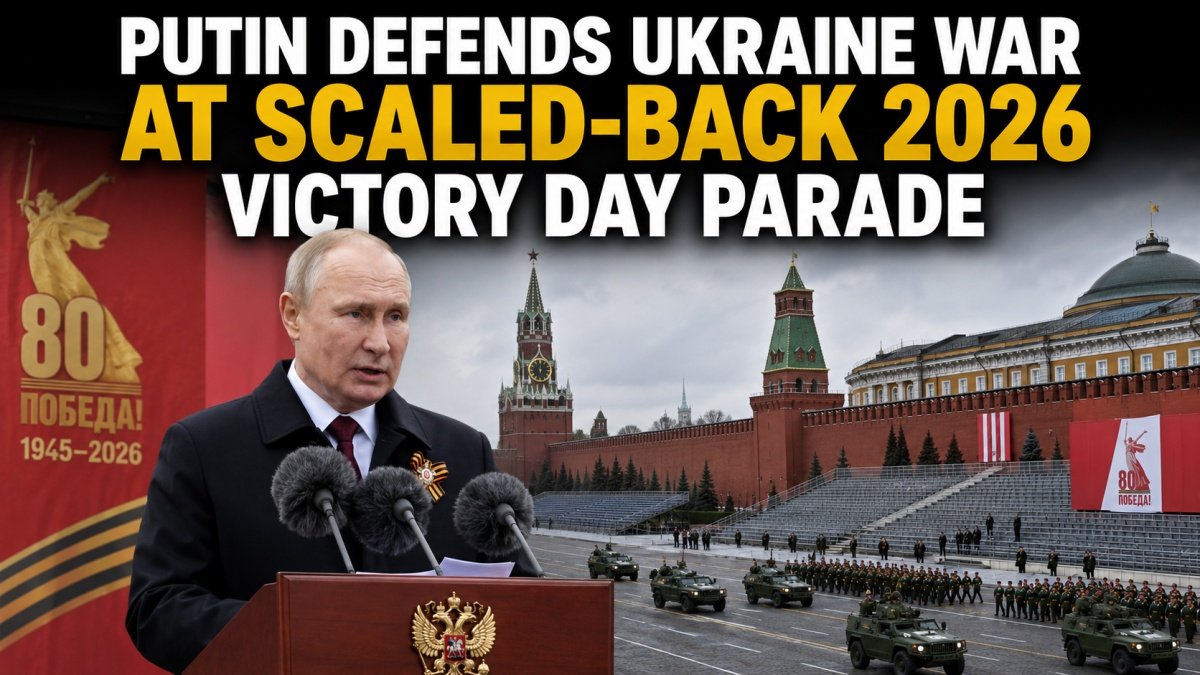
President Vladimir Putin utilized the annual Victory Day celebrations on May 9, 2026, to launch a fresh rhetorical assault on Western nations and the NATO alliance. Speaking from a heavily fortified Red Square, Putin commemorated the Soviet Union’s victory over Nazi Germany by drawing direct parallels to the ongoing invasion of Ukraine, which is now entering its fifth year.
Addressing the gathered military contingents, Putin described the current military operations as both “right” and “just,” alleging that Ukraine has become a proxy for NATO’s expansionist goals. He urged modern Russian soldiers to channel the “unbreakable spirit” of their forefathers from the Second World War, asserting that Russia remains resolute in confronting what he termed “existential threats” from the West.
A Parade Stripped of Modern Hardware
In a stark departure from the grandeur of previous years, the 2026 parade was significantly scaled back. For the first time in nearly twenty years, the procession did not feature modern battle tanks, advanced missile batteries, or heavy armored vehicles. Instead, the display was limited to marching personnel and historical units.
Russian lawmaker Yevgeny Popov addressed the absence of modern armor, stating that the nation’s tanks are currently “occupied” on the battlefield where they are critically required. Analysts suggest that the lack of hardware in the capital is a pragmatic reflection of the intense resource demands of the prolonged conflict in Ukraine, as well as a security measure to minimize high-profile targets in Moscow.
Deepening Alliances and Foreign Participation
The ceremony featured a notable shift in international attendance. While the number of global leaders was lower than in the pre-war era, Putin was joined by Belarusian President Alexander Lukashenko, Lao President Thongloun Sisoulith, and the Sultan of Malaysia, Ibrahim.
A significant development during the procession was the active participation of North Korean soldiers, who marched alongside Russian troops. This inclusion highlights the deepening military and strategic partnership between Moscow and Pyongyang, which has become a cornerstone of Russia’s wartime diplomacy. The event was held under unprecedented security, reflecting the heightened threat environment within the Russian capital.
The Fragile State of the “Trump Ceasefire”
The Victory Day celebrations took place under the shadow of a high-stakes diplomatic experiment. US President Donald Trump recently brokered a three-day ceasefire, scheduled from May 9 to May 11, intended to facilitate a massive prisoner exchange and provide a window for peace negotiations.
However, even as the parade was underway, the truce appeared increasingly fragile. Both Russian and Ukrainian officials have issued statements accusing the opposing side of violating the terms of the agreement with localized shelling and drone activity. While the world remains hopeful that this brief cessation of hostilities could lead to a permanent resolution, the rhetoric in Red Square today suggested that Russia is prepared for a long-term struggle if its strategic demands are not met.