



































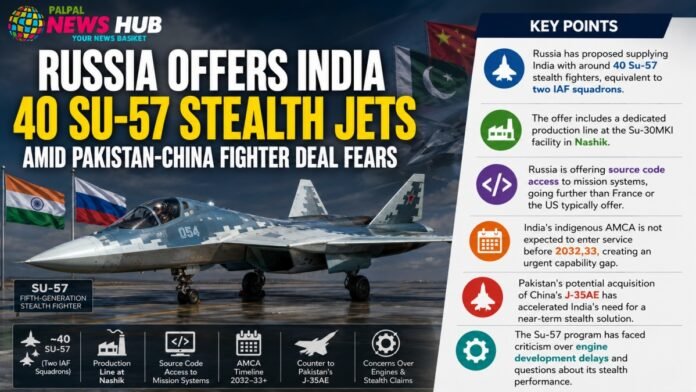
Key Points
- Russia has proposed supplying India with around 40 Su-57 stealth fighters, equivalent to two IAF squadrons
- The offer includes a dedicated production line at the Su-30MKI facility in Nashik
- Russia is offering source code access to mission systems, going further than France or the US typically offer
- India’s indigenous AMCA is not expected to enter service before 2032,33, creating an urgent capability gap
- Pakistan’s potential acquisition of China’s J-35AE has accelerated India’s need for a near-term stealth solution
- The Su-57 program has faced criticism over engine development delays and questions about its stealth performance
India’s defense calculus is shifting rapidly. With Pakistan reportedly in talks to acquire China’s fifth-generation J-35AE stealth fighter, India faces mounting pressure to close a growing air power gap before its own homegrown solution arrives. Russia, sensing the urgency, has stepped forward with a concrete and strategically significant proposal.
Moscow is actively persuading New Delhi to procure approximately 40 Sukhoi Su-57 stealth fighter jets, a number that would constitute roughly two full squadrons of the Indian Air Force. The offer is being positioned as an interim but powerful bridge capability while India’s indigenous Advanced Medium Combat Aircraft (AMCA) completes development. The AMCA is not projected to enter service before 2032,33, with mass production unlikely to begin until after 2035, leaving a critical window that Russia believes the Su-57 can fill.
The Deal on the Table
According to a detailed report by The Wire, the Su-57 proposal was a central topic during Russian President Vladimir Putin’s visit to New Delhi in December 2025. Russia has gone beyond a straightforward arms sale, offering to establish a dedicated production line for the Su-57 at the existing Su-30MKI manufacturing facility in Nashik.
Critically, Moscow is also offering a level of technology transfer that it claims surpasses what Western suppliers such as France or the United States are willing to provide. This includes direct access to the aircraft’s source codes governing onboard mission systems and sensor integration, an offer that carries significant long-term strategic value for India’s defense self-reliance goals.
Meeting India’s Twin-Engine Requirement
The Indian Air Force has long maintained a firm requirement for a modern twin-engine stealth combat aircraft. In what is widely interpreted as a direct response to India’s specifications, Russia recently conducted a successful test flight of a twin-engine Su-57 variant. The timing strongly suggests the test was designed to demonstrate the aircraft’s suitability for Indian operational needs.
The Su-57 program is not without its critics, however. Analysts have repeatedly raised concerns over delays in the development of its next-generation engine and lingering questions about the effectiveness of its stealth profile compared to American fifth-generation jets. For India, inducting yet another aircraft type into a fleet that already includes the Jaguar, Mirage, Rafale, and Tejas would add further complexity to an already demanding maintenance and logistics structure. Managing separate spare parts chains and support ecosystems for multiple platforms places a measurable strain on the defense budget.
Security Imperatives Override Budget Concerns
Despite these logistical and financial reservations, the strategic context may leave India with little room to hesitate. Pakistan’s reported move toward acquiring Chinese J-35AE jets, even amid its own severe economic constraints, signals a clear intent to modernize its air force with fifth-generation capability.
For India, national security considerations must take precedence. Ensuring the Indian Air Force is adequately equipped to counter any emerging regional threat cannot be compromised by budgetary caution alone. The Russia Su-57 offer, whatever its technical limitations, keeps a credible near-term stealth option firmly on the table.