



































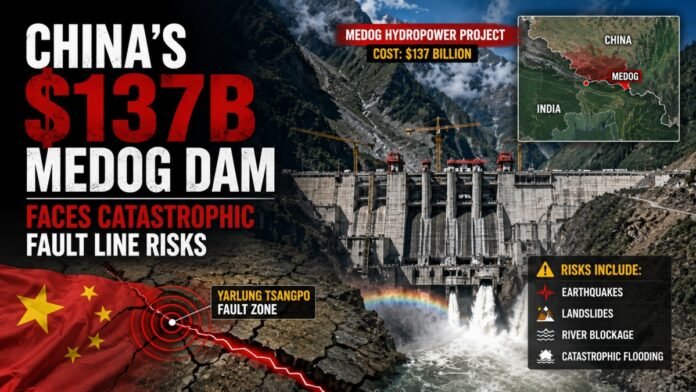
Key Points
- Geological Peril: The dam sits directly on the highly active Paizhen fault line, making it vulnerable to devastating earthquakes.
- Unprecedented Scale: The project features a massive 60,000-megawatt projected capacity, costing an estimated $137 billion (1 trillion yuan).
- High-Stakes Timeline: Approved in late 2024, full-scale construction launched in July 2025 with a target completion date of 2033.
- Transboundary Threat: Situated just 50 kilometers from the Indian border, a potential dam failure threatens catastrophic flooding in India and Bangladesh.
The Medog Hydropower Project, set to be the world’s largest, currently under construction in China’s Tibet region, has become embroiled in a major and dangerous controversy. Situated on the Yarlung Tsangpo River, known downstream as the Brahmaputra, the megaproject represents an unprecedented engineering ambition.
China officially greenlit the venture in December 2024, and workers initiated full-scale construction in July 2025. With a staggering price tag of 1 trillion yuan, roughly $137 billion, Beijing has set an aggressive deadline to bring the facility fully online by 2033. However, newly exposed data from China’s own scientific community has cast a dark shadow over the project’s viability and safety.
The Threat of the Active Paizhen Fault
The core of the controversy stems from a recent report issued by Chinese government geologists. Their findings indicate that the dam’s foundations cross the Paizhen fault, a major geological fracture that has been highly active since the Pleistocene epoch.
Geological Evidence: Analysis of ancient lake sediments confirms that the fault was active as recently as 9,500 years ago. More alarming to engineers is recent history: in 2017, a powerful 6.9-magnitude earthquake struck the northern section of this exact fault line in Tibet.
Scientists have issued stern warnings to Beijing, explicitly labeling the infrastructure as a highly volatile hazard. Any significant tectonic movement along the Paizhen fault could severely compromise the dam’s structural integrity, leading to a catastrophic failure.
Compromised Stability and Landslide Risks
Years of frequent seismic activity and continuous shifting along the fault line have severely compromised the region’s geomorphology. Geologists report that the local rock formations are heavily fractured, lacking the structural soundness required to host a project of this magnitude.
The weight of the 60,000-megawatt facility, combined with the immense pressure of the trillions of gallons of water held in its reservoir, creates an unprecedented structural load. Tectonic triggers are not the only concern; once the reservoir is filled, the surrounding terrain will become deeply unstable. The risk of massive landslides, triggered by fault-line activity or earthquakes, will increase substantially. Such landslides could displace massive volumes of water instantaneously, triggering a sudden, uncontainable dam breach.
Downstream Anxiety: India and Bangladesh on High Alert
The geopolitical fallout of the Medog project is vibrating across South Asia. The dam site is located a mere 50 kilometers from the border of India’s Arunachal Pradesh state, putting downstream nations directly in the line of fire.
Both New Delhi and Dhaka are intensely monitoring the situation. While hydrologists note that China cannot realistically permanently cut off the Brahmaputra River’s entire flow, the threat of an engineered disaster is terrifying. If an earthquake or landslide causes this massive structure to fail, a wall of water would sweep through northeastern India and Bangladesh, resulting in unprecedented loss of life and economic devastation. Striking a balance between structural reinforcement and geological reality remains a critical hurdle as construction pushes forward.