
Key Points
- Mass-Market Shift: Expected to be priced competitively between Rs 1 lakh and Rs 1.25 lakh, targeting the high-volume segment currently led by Ola, TVS, and Bajaj.
- All-New Architecture: The EL-01 marks a clean-sheet design based on the scalable EL platform, built for better production efficiency and diverse future models.
- Steel Unibody Design: Shifting away from premium aluminum, the EL-01 will utilize a full steel unibody frame while keeping weight increases negligible.
- Community Day Event: The production-ready vehicle will headline the fourth annual Ather Community Day in Bengaluru under the theme, “A New Dawn of Magic”.
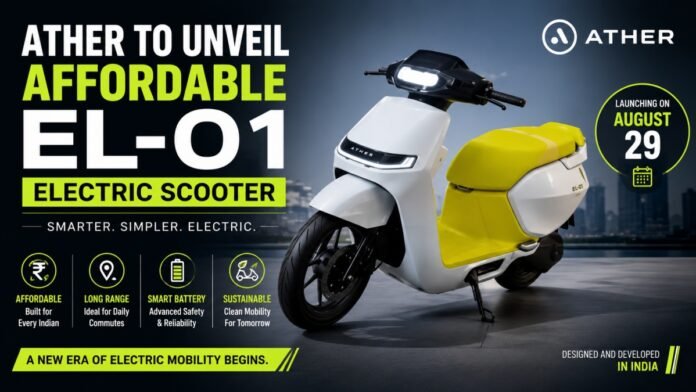
Ather Energy, traditionally a key player in India’s premium electric two-wheeler market, is preparing to make its most significant strategic commercial shift yet. The Bengaluru-based EV manufacturer will officially unveil the production-spec version of the EL-01, its first mass-market electric scooter, on August 29, 2026. Set to debut at the fourth edition of the flagship Ather Community Day in Bengaluru, the launch marks Ather’s formal entry into the high-volume, price-sensitive entry segment. The new model is expected to hit the market with an aggressive ex-showroom price bracket between Rs 1 lakh and Rs 1.25 lakh, placing it in direct contention with the Ola S1 X, TVS iQube, and Bajaj Chetak.
The announcement arrives at a crucial point of business scaling for the company. Ather recently reported strong financial momentum, narrowing its net loss by 57 percent to Rs 100.23 crore in Q4 FY26, driven by aggressive retail expansion and steady demand for its recently launched family-oriented Rizta scooter line.
Understanding the New EL Architecture
The upcoming EL-01 is not merely a trimmed-down version of existing premium models, but rather a clean-sheet development. It represents the inaugural production model built on Ather’s newly engineered EL platform, an underlying architecture completely distinct from the aluminum-heavy structures powering the current Rizta and 450 series lines. Developed with long-term scalability and manufacturing versatility in mind, the modular EL platform is designed to underpin a wider array of future electric two-wheelers, supporting battery capacities ranging anywhere from 2kWh to 5kWh.
For Indian buyers, the structural framing of this platform signals that Ather is building the necessary industrial infrastructure for a broader, lower-cost product lineup rather than a simple, one-off budget fix. A fundamental change in the EL architecture is the transition to a full steel unibody frame, a stark departure from the costly aluminum spaceframes used in Ather’s premium portfolio. Despite the shift in materials, engineering leaks indicate that manufacturing efficiency tweaks have kept the scooter’s overall weight increase negligible compared to its predecessors. Final production is slated to take place at Ather’s manufacturing facility in Sambhaji Nagar, Maharashtra.
Confirmed Features and Market Expectations
While public road testing and recent design patent filings have revealed a family-friendly aesthetic, a spacious flat floorboard, and large under-seat storage capable of housing two helmets, Ather has kept exact powertrain specifications close to its chest. The official battery size, certified range, and motor output remain unannounced. However, the production model is anticipated to carry over features from its initial concept form, including a 7-inch TFT digital console featuring smart navigation, smartphone connectivity, and a chassis setup running 14-inch front and 12-inch rear alloy wheels paired with a front disc brake.
Alongside the vehicle reveal, the company has confirmed that the Bengaluru event will detail fresh updates regarding its charging ecosystem, namely the Ather Grid fast-charging network, and alternative, connected ownership models such as a potential Battery-as-a-Service (BaaS) scheme that could drive the effective acquisition cost even lower. For consumers actively comparing affordable electric options, waiting until the August 29 unveiling may provide critical clarity, especially given Ather’s reputation for software longevity and reliable charging access. Until official order books open, the Rs 1 lakh to Rs 1.25 lakh figure serves as a well-founded market projection rather than a finalized, manufacturer-committed price tag.