Key Points
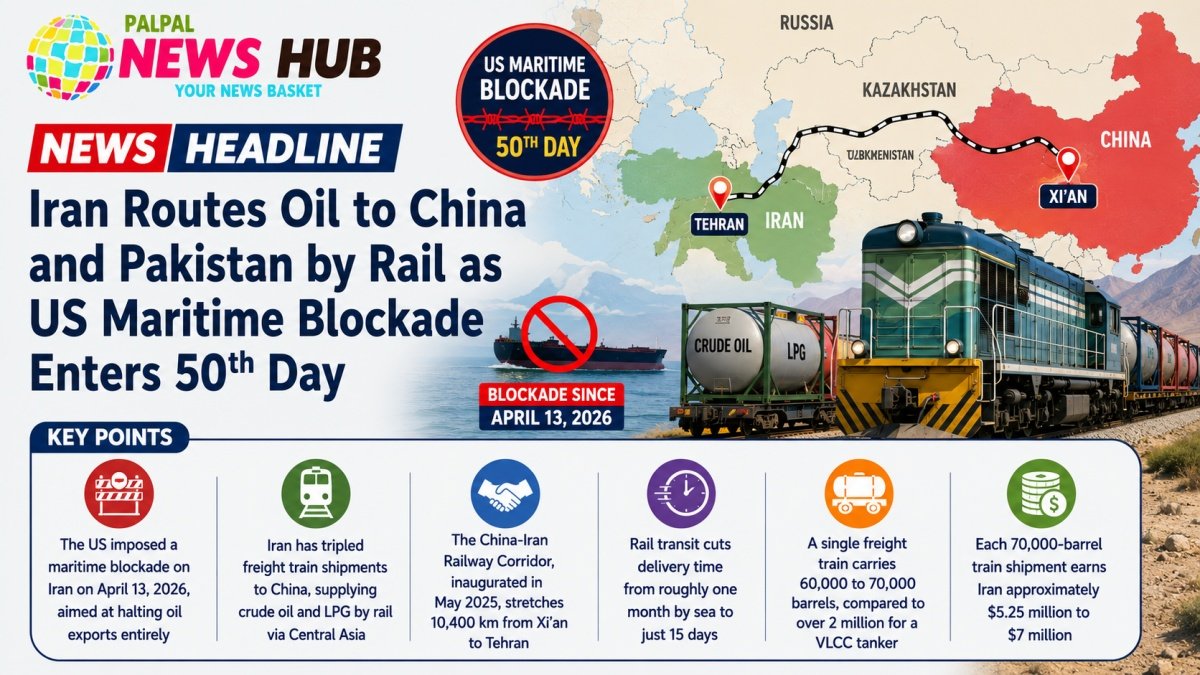
- The US imposed a maritime blockade on Iran on April 13, 2026, aimed at halting oil exports entirely
- Iran has tripled freight train shipments to China, supplying crude oil and LPG by rail via Central Asia
- The China-Iran Railway Corridor, inaugurated in May 2025, stretches 10,400 km from Xi’an to Tehran
- Rail transit cuts delivery time from roughly one month by sea to just 15 days
- A single freight train carries 60,000 to 70,000 barrels, compared to over 2 million for a VLCC tanker
- Each 70,000-barrel train shipment earns Iran approximately $5.25 million to $7 million
Nearly 50 days into the United States’ maritime blockade of Iran, the sanctions are showing signs of falling short of their primary objective. Rather than bringing Iran’s oil exports to a halt, the pressure has pushed Tehran to accelerate the use of an alternative route that bypasses the sea entirely.
According to reports citing Iran’s Fars news agency, long freight trains loaded with oil tankers are now departing under the cover of night, bound for China via a sprawling Central Asian rail network. The number of such freight trains headed toward China has tripled since the blockade began on April 13, 2026.
Iran is also reported to be supplying crude oil and LPG to Pakistan through the same overland channels, further demonstrating the adaptability of its export infrastructure under sanctions pressure.
The 10,400-Kilometer Lifeline
The backbone of Iran’s rail strategy is the China-Iran Railway Corridor, a 10,400-kilometer route inaugurated in May 2025 that connects the Chinese city of Xi’an to Tehran. The corridor passes through Kazakhstan, Kyrgyzstan, Uzbekistan, and Turkmenistan, threading through the heart of Central Asia to link two of the region’s most significant economies.
The route’s most immediate advantage over maritime shipping is speed. While sea transport from Iran to China typically takes around one month, rail delivers the same cargo in approximately 15 days, cutting transit time by half. China has further invested $2.35 billion in the China-Kyrgyzstan-Uzbekistan Railway Project to strengthen the infrastructure underpinning this corridor.
Why Rail Cannot Replace the Sea
Despite providing crucial relief, experts are clear that the railway cannot serve as a permanent or complete substitute for maritime oil exports. The gap in capacity is simply too large to bridge.
A standard freight train can carry between 60,000 and 70,000 barrels of oil per journey. By comparison, a conventional oil tanker moves around 600,000 barrels, and a Very Large Crude Carrier can transport upward of 2 million barrels in a single voyage. Replicating maritime export volumes by rail would require an impractical number of trains operating continuously.
Geography compounds the challenge further. Iran’s major oil fields are concentrated in the south of the country, while China’s primary refineries are located along its eastern coastline. Moving large volumes of crude across thousands of kilometers of rail infrastructure is both expensive and logistically demanding in ways that sea freight is not.
An Economic Lifeline, Not a Full Solution
The financial returns from rail exports, while meaningful, are a fraction of what maritime trade generates. A single 70,000-barrel train shipment to China earns Iran somewhere between $5.25 million and $7 million, depending on prevailing oil prices. That figure is modest when measured against the billions Iran typically generates through tanker-based exports.
Nevertheless, the rail route is serving its most critical function, keeping money flowing into the Iranian economy and keeping the country’s energy export infrastructure active at a time when the US blockade is designed to do precisely the opposite.