Key Points
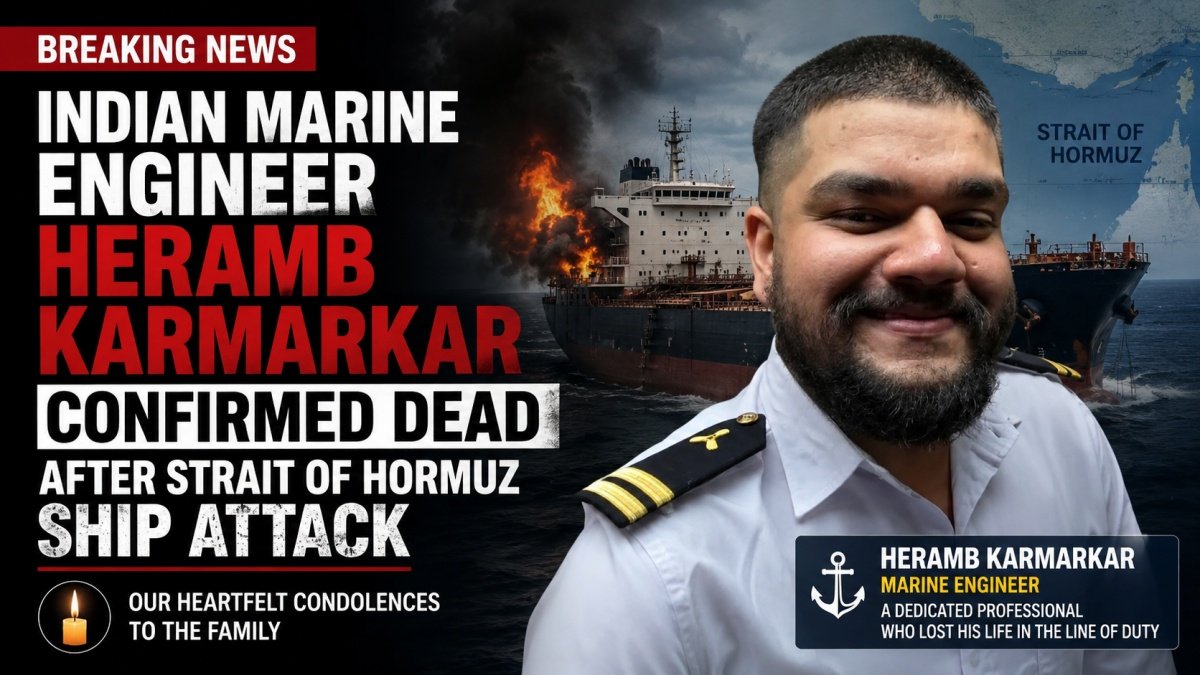
- Tragic Casualty: Pune-based marine engineer Heramb Karmarkar, the only missing crew member from the MV GFS Galaxy, was found dead after a 60-hour search by the Omani Coast Guard.
- Projectile Attack: The Cyprus-flagged container vessel was struck on Sunday morning, causing a severe engine room fire that forced 23 crew members to evacuate into lifeboats.
- Diplomatic Fallout: India’s Ministry of External Affairs strongly condemned the escalation and officially summoned Iranian diplomats in New Delhi to demand an immediate halt to shipping attacks.
- US Retaliation: US Central Command attributed the attack to Iran’s Islamic Revolutionary Guard Corps, launching massive retaliatory strikes across 140 military targets in the region.
A cheerful Indian family has been plunged into deep mourning following a fatal maritime attack in the volatile Strait of Hormuz, near the coast of Oman. Heramb Karmarkar, a 30-year-old marine engineer from Pune who had been missing since Sunday’s strike on the commercial container ship GFS Galaxy, has died. On Wednesday, his grief-stricken family and his father-in-law, Vivek Tandon, confirmed the tragic news after receiving official correspondence from the vessel’s operating company.
Speaking to the media with a choked voice, Vivek Tandon made a painful and emotional appeal to the Indian government, stating that Heramb was their 30-year-old child, not an elderly person, and their only remaining request is that his body be handed over intact and brought home to India. The young engineer, who was more than three months into his sea tour, had last messaged his family at 2:49 AM IST on Sunday to reassure them he had safely entered the strait, unaware that his vessel would be struck moments later. His body remains in the temporary custody of the Omani Navy while repatriation protocols are finalized.
The Engine Room Strike
The MV GFS Galaxy, a Cyprus-flagged container vessel operated by UAE-based Global Feeder Shipping, was sailing eastbound through the Strait of Hormuz with its Automatic Identification System (AIS) deactivated when it was hit by an unidentified projectile. The projectile struck near the stern at approximately 3:30 AM IST on Sunday, instantly igniting a catastrophic fire in the engine room and cutting off the ship’s propulsion.
Karmarkar, serving as the vessel’s third engineer, is believed to have been working near the engine room when the impact occurred. As smoke engulfed the ship, the 24-member crew, which included 11 Indian nationals, successfully dropped anchor and deployed lifeboats. The Royal Navy of Oman executed a swift rescue operation two hours later, pulling 23 crew members to safety, leaving Karmarkar as the sole unaccounted-for mariner until his body was recovered 60 hours later.
New Delhi Summons Iranian Diplomats
The death of an Indian citizen has significantly escalated diplomatic tensions between New Delhi and Tehran. The Forward Seamen’s Union of India (FSUI) forcefully criticized the delay in transmission of information to the family, noting that despite repeated high-level diplomatic assurances and April’s brief ceasefire, Indian seafarers continue to face extreme risks in these primary trade corridors.
In a swift retaliatory diplomatic maneuver, India’s Ministry of External Affairs (MEA) officially summoned senior Iranian diplomats, including Deputy Chief of Mission Mohammad Javad Hosseini, to New Delhi. The MEA issued a firm statement strongly condemning the acts of violence disrupting safe navigation, reiterating that the targeting of civilian infrastructure and commercial shipping must cease immediately so international law and unimpeded maritime commerce can be restored. The Indian Embassy in Muscat remains in constant communication with Omani port authorities and the ship’s management to expedite the release of the engineer’s remains.
Retaliatory US Airstrikes and Energy Disruptions
The incident has further destabilized the Middle East, transforming the maritime highway into an active combat theater. US Central Command (CENTCOM) formally accused Iran’s Islamic Revolutionary Guard Corps (IRGC) of orchestrating the assault, asserting that Tehran was granted an explicit window to adhere to maritime Memorandums of Understanding but chose to bypass warnings. Tehran counter-claimed that the vessel was fired upon as a warning for attempting to navigate an unauthorized route.
Acting under direct orders from the Commander-in-Chief, the US military launched its most potent retaliatory wave of the week, hitting roughly 140 Iranian military targets using a combined force of fighter jets, warships, and combat drones. The precision strikes targeted coastal surveillance radars, missile launch platforms, and drone hangars to degrade Iran’s capacity to easily target ordinary mariners. With approximately one-fifth of the world’s traded petroleum transiting the Strait of Hormuz, the heightened threat level, now raised to ‘Severe’ by regional maritime security centers, continues to threaten global energy security, leaving shipping firms heavily dependent on heavily guarded southern transit lanes.