



































Key Points
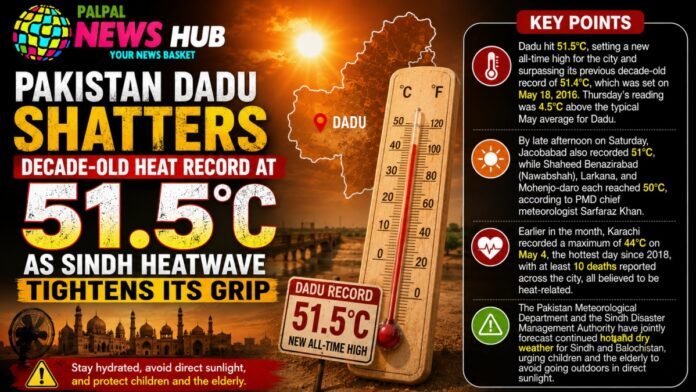
- Dadu hit 51.5°C, setting a new all-time high for the city and surpassing its previous decade-old record of 51.4°C, which was set on May 18, 2016. Thursday’s reading was 4.5°C above the typical May average for Dadu.
- By late afternoon on Saturday, Jacobabad also recorded 51°C, while Shaheed Benazirabad (Nawabshah), Larkana, and Mohenjo-daro each reached 50°C, according to PMD chief meteorologist Sarfaraz Khan.
- Earlier in the month, Karachi recorded a maximum of 44°C on May 4, the hottest day since 2018, with at least 10 deaths reported across the city, all believed to be heat-related.
- The Pakistan Meteorological Department and the Sindh Disaster Management Authority have jointly forecast continued hot and dry weather for Sindh and Balochistan, urging children and the elderly to avoid going outdoors in direct sunlight.
A new maximum temperature record has been set in Dadu, a city in the interior of Sindh province, where the mercury peaked at 51.5°C, surpassing a reading that had stood for a decade. Sarfaraz Khan, chief meteorologist at the Karachi office of the PMD, confirmed the reading, noting that while Karachi itself recorded a maximum of 37.5°C, other locations across Sindh, including Sakrand, Ghotki, and Khairpur, saw temperatures ranging between 46 and 49°C.
In Sindh province, even higher temperatures have been recorded in the past. In 2024, temperatures at the Mohenjo-daro ruins peaked at 53°C.
Extended Forecast and Health Warnings
The PMD has warned that maximum temperatures in numerous districts are likely to remain 4 to 6°C above normal and may rise to between 47 and 50°C across districts including Sukkur, Jacobabad, Larkana, Dadu, Tharparkar, Hyderabad, Khairpur, Mirpur Khas, and several others in the days ahead.
Sibi and Turbat in Balochistan province are also experiencing unusually high temperatures, compounding the strain on communities across southern Pakistan.
Climate Change and the Bigger Picture
The PMD warned at the start of May that El Niño conditions are likely to develop during the 2026 monsoon season in South Asia, accompanied by higher-than-normal minimum and maximum temperatures across most of the region. Below-normal rainfall is most likely during the 2026 southwest monsoon season over large parts of South Asia, particularly across central areas.
The United Nations has warned that global average temperatures are likely to continue at or near record levels this year and for the next four years. According to the World Meteorological Organisation, there is a 75% chance that the 2026 to 2030 five-year mean temperature will surpass the critical threshold of 1.5°C above the pre-industrial average.
Pakistan ranks among the countries most vulnerable to climate change and extreme weather, and has faced intensifying heatwaves, floods, and droughts in recent years, a pattern that experts warn is set to worsen without decisive global action.