Key Points
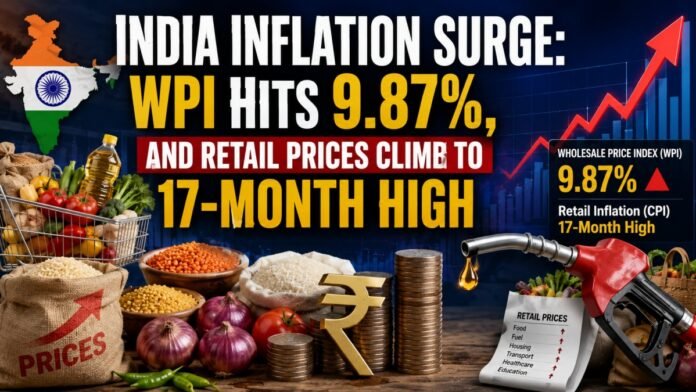
- India’s Wholesale Price Index (WPI) inflation quickened to 9.87 percent in June, up from 9.68 percent in May, exceeding general market expectations.
- Consumer Price Index (CPI) retail inflation accelerated to 4.38 percent, crossing the Reserve Bank of India’s 4 percent medium-term baseline target for the first time in over a year.
- A severe energy shock, triggered by geopolitical conflicts and blockades in the Strait of Hormuz, has directly driven up fuel, production, and transport costs.
- Food inflation remains a primary pain point, with wholesale food prices rising 6.14 percent and retail food costs ticking up to 5.32 percent.
Geopolitical pressures and volatile agricultural supplies have severely impacted India’s economic indicators, causing a simultaneous surge in both wholesale and retail price indexes. According to a report released by the Ministry of Commerce and Industry on Tuesday, the annual rate of inflation based on the All India Wholesale Price Index (WPI), or the wholesale inflation rate, climbed to 9.87 percent on a year-on-year basis in June 2026. This acceleration from the 9.68 percent recorded in May 2026 reflects substantial price pressures accumulating at the factory gate and wholesale levels.
The strain on production costs has extended directly to consumer markets, with retail inflation based on the Consumer Price Index (CPI) rising to 4.38 percent year-on-year in June, up from 3.93 percent in the previous month. This milestone represents a 17-month high for the country’s retail print, elevating the metric above the Reserve Bank of India’s target level of 4 percent.
Major Basket Components and Structural Revisions
Official data reveals contrasting trends within the three core components of the wholesale market basket. Year-on-year inflation for primary articles accelerated sharply to 7 percent in June, compared to 4.99 percent in May. The manufactured products segment, which commands nearly two-thirds of the total index weight, held entirely unchanged at 7.48 percent. In contrast, the fuel and power segment moderated slightly to 27.41 percent from 30.33 percent in the prior month, though it remains a massive contributor to systemic price pressure.
Economists note that this data is compiled under the government’s recently modernized WPI series, which operates with 2022-23 as its base year. This expanded tracking architecture monitors 957 separate commodities, up from 697 items in the previous framework, integrating contemporary items such as solar, wind, and nuclear electricity to provide a far more precise calculation of input costs across industrial supply chains.
Maritime Bottlenecks and Energy Contagion
A primary catalyst for the escalating wholesale index is the ongoing maritime conflict in the Middle East, particularly the effective blockade of the critical Strait of Hormuz shipping lane. Because India depends heavily on this passage to transport a large share of its crude oil imports, localized military clashes have triggered an immediate domestic energy shock. This disruption has directly bloated prices for mineral oils, refined petroleum products, basic metals, and downstream chemical manufacturing.
Simultaneously, food items, which command a heavy 24.99 percent weight in the aggregated WPI structure, have generated significant pressure. Wholesale food index inflation climbed to 6.14 percent in June from 4.49 percent in May, indicating deep supply strains in domestic agricultural transport and logistics.
Consumer Impact: Urban-Rural Divides and Extreme Volatility
The retail data released by the Ministry of Statistics and Programme Implementation underscores an uneven domestic burden, with rural consumers experiencing the highest rate of price increases. Rural retail inflation expanded to 4.74 percent in June from 4.25 percent in May, while urban retail inflation rose more moderately to 3.92 percent from 3.53 percent. At the kitchen table level, the All India Consumer Food Price Index (CFPI) quickened to 5.32 percent, up from 4.78 percent in the previous monthly cycle.
Specific commodity analysis reveals severe micro-level volatility within retail markets. The five items recording the highest year-on-year inflation rates in June were:
- Silver Jewelry: 133.21 percent
- Ginger: 50.41 percent
- Gold, Diamond, and Platinum Jewelry: 36.82 percent
- Tomatoes: 31.92 percent
- Raisins and Dried Grapes: 20.52 percent
Conversely, temporary relief was observed in other staple goods. The five commodities experiencing the sharpest year-on-year price declines included potatoes at minus 20.34 percent, peas at minus 9.67 percent, motor cars and jeeps at minus 6.89 percent, cumin seeds at minus 3.75 percent, and motorcycles and scooters at minus 3.49 percent.
Regional Variations and the RBI Policy Outlook
The geographic footprint of retail inflation shows heavy variation among India’s most populous states. Telangana reported the highest consumer price inflation in the country at 6.36 percent, followed closely by Andhra Pradesh at 5.39 percent, Tamil Nadu at 5.24 percent, Odisha at 5.15 percent, and Madhya Pradesh at 5.09 percent.
The abrupt spike presents a complex puzzle for monetary authorities. During the June Monetary Policy Committee (MPC) meeting, RBI Governor Sanjay Malhotra observed that while general retail inflation has spent months within the broader mandated tolerance framework, external macro headwinds remain a serious concern. Malhotra warned that consumer prices are projected to encounter upward pressure in the coming months, which could bring headline retail inflation close to the central bank’s upper safety ceiling of 6 percent.
Despite these concerns, monetary experts suggest that the RBI will likely maintain a cautious pause on interest rates in the immediate term, closely watching if the energy and food shocks prove transient before deciding on active policy adjustments.