


































Key Points
- Tehran is reportedly unable to locate or remove mines laid haphazardly during the recent conflict.
- Ocean currents have caused explosives to drift, creating unpredictable hazards for all maritime traffic.
- The IRGC is currently charging vessels up to $2 million in cryptocurrency for passage through a narrow “safe” corridor.
- The crisis coincides with high-stakes peace talks in Islamabad between US Vice President JD Vance and Iranian officials.
- Global shipping remains paralyzed, with traffic down 90% and significant impacts on world oil and fertilizer supplies.
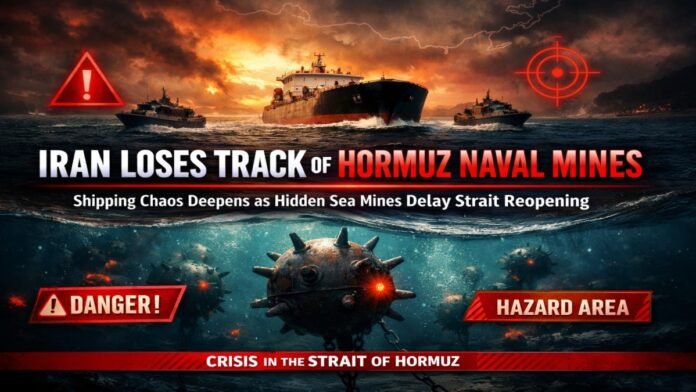
The precarious situation in the Strait of Hormuz has taken a sharp turn for the worse following a report by The New York Times on April 11, 2026. US officials have confirmed that the Iranian government no longer possesses the coordinates for thousands of naval mines deployed in the strategic waterway. This technical failure has emerged just as a Pakistani-mediated ceasefire enters its fourth day, complicating efforts to restore order to one of the world’s most vital trade routes.
The revelation underscores a significant lack of precision in Iran’s recent defensive operations. While the mines were intended to serve as a deterrent against naval incursions, the inability to track them has effectively turned the Strait into a minefield of drifting, unmapped explosives.
The “Drifting Mine” Threat and Technical Gaps
According to intelligence reports, Iran utilized small boats to deploy between 2,000 and 6,000 mines in a scattered, non-systematic fashion during the height of hostilities in March 2026. Many of these devices were equipped with technology that allowed them to ride with ocean currents. Still, Tehran lacks the advanced mine-sweeping capabilities and sonar tracking necessary to recover them.
Because the mines are no longer in their original positions, the Islamic Revolutionary Guard Corps (IRGC) has been forced to restrict all traffic to a narrow, controlled corridor. This “northern route” circles Larak Island and stays close to the Iranian coast, where the IRGC claims to have maintained control. However, navigating outside this sliver of water is considered a near-suicidal risk for commercial tankers.
The “Tehran Toll Booth” and Economic Impact
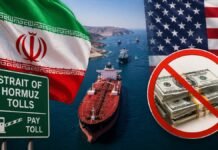
While the Strait is not officially closed, the IRGC has converted the remaining safe passage into a massive revenue stream. In what analysts are calling the “Tehran Toll Booth” protocol, the IRGC is allegedly charging oil tankers and LNG vessels between $1 million and $2 million per transit.
To bypass international sanctions, these payments are reportedly being demanded in Chinese Yuan or cryptocurrencies such as Bitcoin and USDT. This system has targeted ships from “hostile” nations while allowing friendlier states lower rates, though global traffic remains approximately 90% below pre-war levels. For energy-dependent nations like India, the continued disruption poses a catastrophic risk to industrial output and fuel prices.
High-Stakes Negotiations in Islamabad
This maritime emergency is the primary focus of the diplomatic summit currently underway in Islamabad. US Vice President JD Vance, accompanied by a high-level delegation, is meeting with Iranian Foreign Minister Abbas Araghchi under the mediation of Pakistani officials.
The US has proposed a 15-point peace framework that includes the immediate reopening of the Strait and the removal of all naval mines. However, the NYT report suggests that even if Iran agrees to clear the waterway, it physically cannot do so without massive international assistance. Experts suggest that even with the deployment of advanced US and allied mine-clearing technology, it could take several months to guarantee the safety of the entire region.
Until a resolution is reached, the global energy market remains in a state of high volatility, with hundreds of ships currently anchored outside the Gulf, waiting for a breakthrough in Pakistan that may be hindered by the very explosives Iran can no longer find.