





























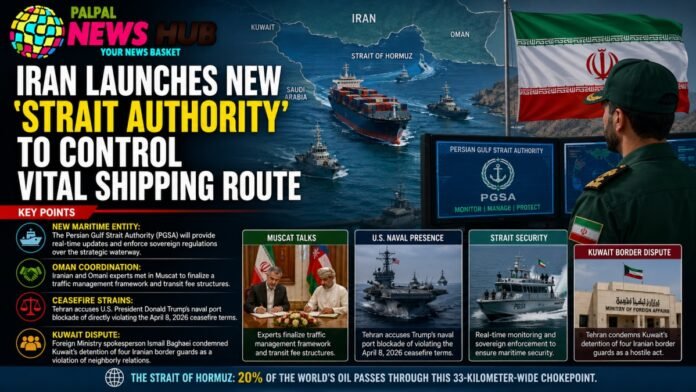
Key Points
- New Maritime Entity: The Persian Gulf Strait Authority (PGSA) will provide real-time updates and enforce sovereign regulations over the strategic waterway.
- Oman Coordination: Iranian and Omani experts met in Muscat to finalize a traffic management framework and transit fee structures.
- Ceasefire Strains: Tehran accuses U.S. President Donald Trump’s naval port blockade of directly violating the April 8, 2026, ceasefire terms.
- Kuwait Dispute: Foreign Ministry spokesperson Ismail Baghaei condemned Kuwait’s detention of four Iranian border guards as a violation of neighborly relations.
In a major geopolitical development, Iran’s Supreme National Security Council has officially announced the establishment of a new administrative entity, the Persian Gulf Strait Authority (PGSA). The newly minted body is tasked with overseeing operations, regulating commercial shipping lanes, and issuing real-time monitoring updates for the Strait of Hormuz.
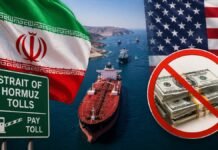
This structural move follows a formal announcement by Ebrahim Azizi, head of the Iranian parliament’s national security committee, confirming that Tehran has finalized a designated maritime route. Under this new mechanism, commercial vessels cooperating with Iran will be permitted transit, but they will be required to pay specialized service fees, a toll system that has drawn intense criticism from Western nations.
Bilateral Talks and the Exclusion of ‘Project Freedom’
Speaking during a weekly press briefing on Monday, May 18, 2026, Iranian Foreign Ministry spokesperson Ismail Baghaei emphasized that the Strait of Hormuz remains an exclusively Omani, Iranian waterway. Baghaei confirmed that expert-level diplomatic delegations from Tehran and Muscat held extensive consultations in Muscat last week to align their maritime policies.
While the Sultanate of Oman has maintained public silence regarding the proposed transit fees and mandatory cargo declarations, Iran maintains that regional coordination is vital for long-term economic stability. Baghaei explicitly mirrored earlier legislative warnings that the new traffic mechanism will completely exclude any operators or naval vessels participating in the U.S.-led maritime initiative known as “Project Freedom,” which Washington established to forcibly escort commercial vessels through the blockaded gulf.
Chronology of Regional Conflict and Ceasefire Fractures
The creation of the PGSA marks a dangerous turning point in a conflict that has severely destabilized global energy markets since early 2026. The geopolitical timeline highlights the fragile state of regional security:
| Date in 2026 | Event Description | Tactical Impact on Maritime Shipping |
|---|---|---|
| February 28 | Joint U.S. and Israeli airstrikes target Iranian command centers. | Iran responds by mining the Strait of Hormuz, dropping tanker traffic by 70 percent. |
| April 8 | Pakistan mediates a comprehensive, temporary ceasefire. | A fragile truce begins, though underlying structural disputes remain unresolved. |
| April 13 | The United States implements a counter,naval blockade on Iranian ports. | Severe economic restrictions limit Tehran’s official trade, though oil exports persist. |
| May 16 | Iranian officials unveil a sovereign “professional traffic mechanism.” | Introduction of mandatory transit toll structures and ship nationality tracking. |
| May 18 | The Supreme National Security Council launches the PGSA. | Permanent bureaucratic control over the global energy choke point is solidified. |
Defending Sovereign Rights and Addressing Regional Disputes
Iran argues that its aggressive regulatory measures are fully compliant with international law, framing them as essential defensive measures in response to foreign interventions. Baghaei declared that repeated military incursions by the United States and Israel left the coastal nation with no choice but to safeguard its territorial integrity. Despite the highly restrictive blockade measures imposed by President Donald Trump, internal shipping reports indicate that vessels carrying Iranian crude oil continue to leave the Gulf uninterrupted.
Simultaneously, Tehran’s diplomatic focus has expanded to address friction with neighboring Gulf states. During Monday’s briefing, Baghaei leveled sharp criticism against Kuwait following a maritime skirmish near a Persian Gulf island, where Kuwaiti forces attacked an Iranian border patrol vessel and subsequently detained four Iranian nationals.
Statement from the Foreign Ministry: Attacking an Iranian border vessel and subsequently leveling accusations against it is not in keeping with the spirit of good neighborly relations. We urge Kuwaiti authorities to ensure the immediate and unconditional release of our citizens.
Baghaei concluded the press conference by warning regional capitals to remain vigilant against “false flag operations” engineered by external actors to derail regional truces, explicitly referencing an unsolved attack on a South Korean-linked cargo vessel earlier this month near the mouth of the strait.