Key Points
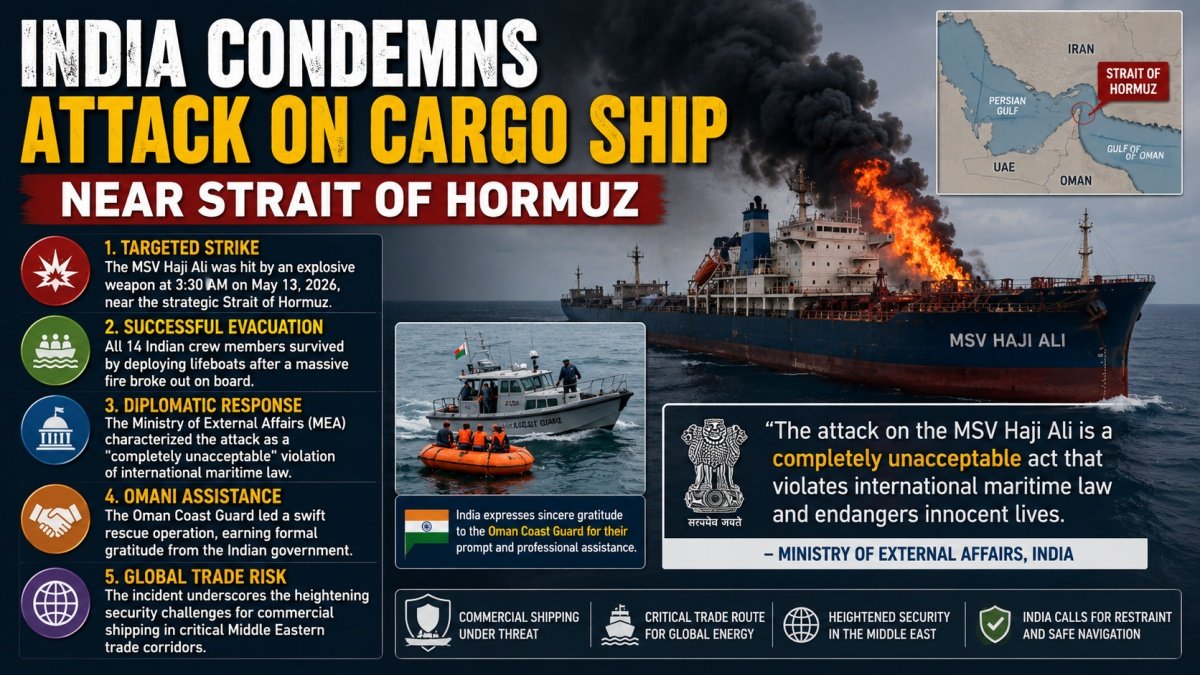
- Targeted Strike: The MSV Haji Ali was hit by an explosive weapon at 3:30 AM on May 13, 2026, near the strategic Strait of Hormuz.
- Successful Evacuation: All 14 Indian crew members survived by deploying lifeboats after a massive fire broke out on board.
- Diplomatic Response: The Ministry of External Affairs (MEA) characterized the attack as a “completely unacceptable” violation of international maritime law.
- Omani Assistance: The Oman Coast Guard led a swift rescue operation, earning formal gratitude from the Indian government.
- Global Trade Risk: The incident underscores the heightening security challenges for commercial shipping in critical Middle Eastern trade corridors.
The Indian government has issued a sharp condemnation following a violent assault on the Indian-flagged cargo vessel, MSV Haji Ali, in Omani territorial waters. Characterizing the incident as a grave threat to maritime freedom, the Ministry of External Affairs (MEA) made it clear that the targeting of commercial vessels and innocent seafarers on international trade routes will not be tolerated.
The attack occurred in the early hours of Wednesday, May 13, 2026, as the vessel was transiting near the Strait of Hormuz, a critical chokepoint for global energy supplies. According to technical reports and crew testimonies, the ship was struck by an explosive projectile, suspected to be either a suicide drone or a precision missile, at approximately 3:30 AM.
The vessel, which hails from Gujarat, was owned by Sultan Ahmed Ansari, a resident of Dwarka. Ansari confirmed that the MSV Haji Ali was en route from Berbera Port to Sharjah when the explosion occurred. Crew members described a deafening blast followed by a rapidly spreading fire that engulfed the main deck, rendering the vessel’s firefighting systems insufficient and forcing an immediate evacuation.
Heroic Rescue and Diplomatic Fallout
Facing the imminent sinking of their vessel, the 14 Indian crew members displayed remarkable composure. They donned life jackets and launched lifeboats into the dark waters of the Gulf of Oman. Upon receiving a distress signal, the Oman Coast Guard mobilized with immediate alacrity, reaching the site to pull all 14 nationals to safety.
In a statement released late Thursday, MEA Spokesperson Randhir Jaiswal lauded the Omani authorities for their swift intervention while issuing a stern warning to the perpetrators. Jaiswal emphasized that obstructing the freedom of navigation and endangering the lives of merchant sailors constitutes a violation of international law that poses a direct challenge to global economic stability.
Maritime Security in Jeopardy
This incident occurs against a backdrop of rising regional tensions in the Middle East, where maritime security has become a primary concern for the international community. The Strait of Hormuz serves as the gateway for a significant portion of the world’s petroleum, and any instability in these waters has an immediate impact on global oil prices and supply chains.
Defense experts in India are particularly concerned, as the majority of India’s international trade and energy imports rely on the safety of these specific maritime corridors. The attack on the MSV Haji Ali has prompted calls for increased naval presence and enhanced escort protocols for Indian-flagged merchant vessels operating in high-risk zones. As of now, Indian naval assets in the region remain on high alert while investigations into the origin of the projectile continue.