































Key Highlights
- Maritime Blockade: Iran has established a “control zone” extending to Umm Al Quwain, halting standard commercial transit.
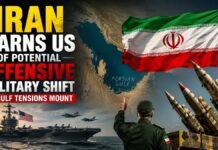
- U.S. Naval Response: Two U.S. destroyers have entered the Persian Gulf as a fragile ceasefire completely dissolves.
- Shipping Collapse: Daily vessel traffic has plummeted from an average of 135 ships to near zero in the wake of recent strikes.
- Casualties in Fujairah: Three Indian nationals were severely injured during an Iranian attack on UAE petroleum facilities.
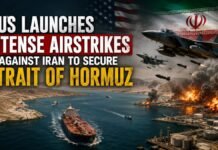
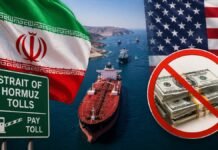
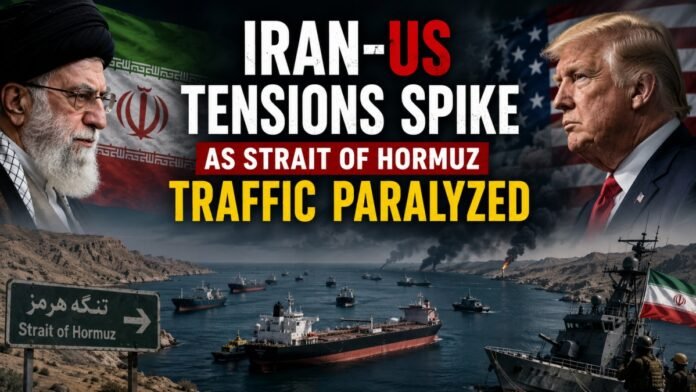
The geopolitical situation in West Asia has reached a critical flashpoint as the Strait of Hormuz, the world’s most critical energy transit route, remains effectively closed to standard commercial traffic. Following weeks of mounting friction, the Islamic Revolutionary Guard Corps (IRGC) has officially enforced a new territorial control zone. This move has compelled hundreds of commercial vessels to seek emergency anchorage near Dubai to avoid being caught in the crossfire.
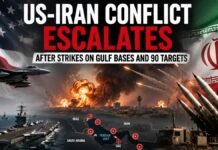
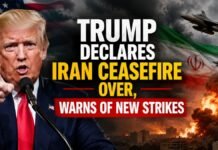
The informal ceasefire previously observed between Washington and Tehran appears to have disintegrated entirely. Reports from the region indicate heavy and sustained exchanges of gunfire between Iranian forces and U.S. naval assets. Despite the volatility, the United States military has asserted that it successfully secured a passage through the strait, punctuated by the high-profile entry of two American destroyers into the Persian Gulf to protect remaining interests.
Impacts on UAE Ports and Regional Logistics
The enforcement of Iran’s new maritime boundaries has been accompanied by direct military action against infrastructure in the United Arab Emirates. The IRGC has issued frequent radio warnings to international crews, signaling that the Fujairah port and surrounding waters now fall under an extended sphere of Iranian control.
The hazardous zone currently extends southward as far as Umm Al Quwain, leaving Dubai as one of the few safe havens just outside the designated perimeter. This shift has caused a logistical nightmare for global trade. Early morning reports indicated that movement through the strait had reached a complete standstill. Historically, approximately 135 vessels transited these waters daily, but nine weeks of intensified conflict, involving strikes by both U.S. and Israeli forces, have reduced that number to a trickle.
International Outcry and India’s Stance
The human cost of the escalation was brought to the forefront following an attack on the Fujairah Petroleum Industries Zone. The strike resulted in severe injuries to three Indian nationals, drawing a sharp rebuke from New Delhi. Prime Minister Narendra Modi and the Ministry of External Affairs have formally condemned the incident, describing the targeting of civilian-heavy industrial zones as “completely unacceptable.”
India has taken a firm diplomatic stance, emphasizing that the safe passage of commercial vessels is a non-negotiable requirement for global economic stability. The Indian government continues to advocate for an immediate cessation of hostilities and a return to the “path of dialogue,” which they maintain is the only viable route to restoring peace in West Asia. As the crisis deepens, India has expressed readiness to assist in any diplomatic efforts to de-escalate the situation and ensure the security of its citizens and maritime interests.