



































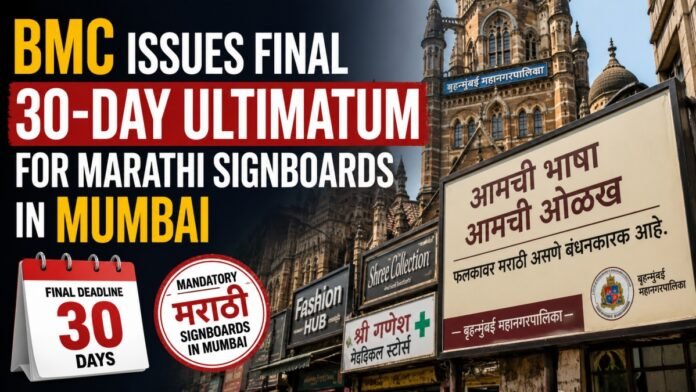
Key Highlights
- One-Month Deadline: All shops, hotels, and offices must comply by mid-June 2026.
- Focus on High-Profile Targets: The BMC is shifting its focus toward major corporate towers, five-star hotels, and celebrity-owned outlets.
- Daily Penalties: Non-compliant businesses face fines of ₹2,000 per employee, per day.
- Enforcement Action: Officials have been warned of “Shiv Sena-style” responses if directives are not met within the grace period.
The issue of Marathi signboards has reached a critical boiling point in Mumbai, the nation’s financial capital. On May 13, 2026, the Brihanmumbai Municipal Corporation (BMC) Law Committee issued a definitive directive to all commercial centers, private offices, and hospitality venues across the city. This latest order grants a final one-month grace period for businesses to install prominent signboards in Marathi, using the Devanagari script.
Unlike previous enforcement rounds, this phase is explicitly targeting larger, high-profile entities. Law Committee Chairperson Diksha Karkar emphasized that taking action against the five prominent five-star hotels and massive corporate offices will send a clear message to the rest of the business community. Karkar has demanded a compliance report from ward officials within the next 15 days, ensuring that the city’s most visible establishments lead by example.
Legal Mandate and “Sena-Style” Warnings
This directive is the latest step in a long-standing legal battle over linguistic identity in Maharashtra. Following a 2022 amendment to the Maharashtra Shops and Establishments Act, the Supreme Court revoked a stay in late 2023, making Marathi signage mandatory. The law stipulates that:
- Script Visibility: The name must be in the Devanagari script.
- Font Proportion: The Marathi lettering must be larger than, or at least as prominent as, text in any other language.
Deputy Mayor Sanjay Ghadi warned that compliance is no longer optional, noting that even international brands and luxury hotels must adhere to the local law. Ghadi signaled a shift toward more robust enforcement, stating that if establishments fail to act within the month, they could face “Shiv Sena-style” action, a term often used to describe direct, street-level advocacy by local political workers.
Inspections and Financial Penalties
The BMC has already conducted extensive inspections, covering nearly 1.58 million establishments across the city. While over 95% of businesses have complied, approximately 5,020 establishments remain non-compliant. To date, the civic body has collected over ₹1.91 crore in fines.
Establishments found in violation after the June 2026 deadline will face aggressive legal action. Municipal officials have warned that fines of ₹2,000 per employee will be strictly applied. This rule applies across the board, from small retail outlets to massive industrial units and corporate towers. The BMC remains firm in its stance, asserting that the objective is to promote the identity of the Marathi language and ensure that the “Marathi Asmita” (pride) of the state is reflected in the city’s public and commercial landscape.