Key Highlights
- Diplomatic Milestone: This marks Trump’s first official visit to China in nine years and his second face,to, face meeting with Xi Jinping since the 2024 election.
- Corporate Heavyweights: A 16-member business delegation, including Elon Musk and Tim Cook, is participating to represent American economic interests.
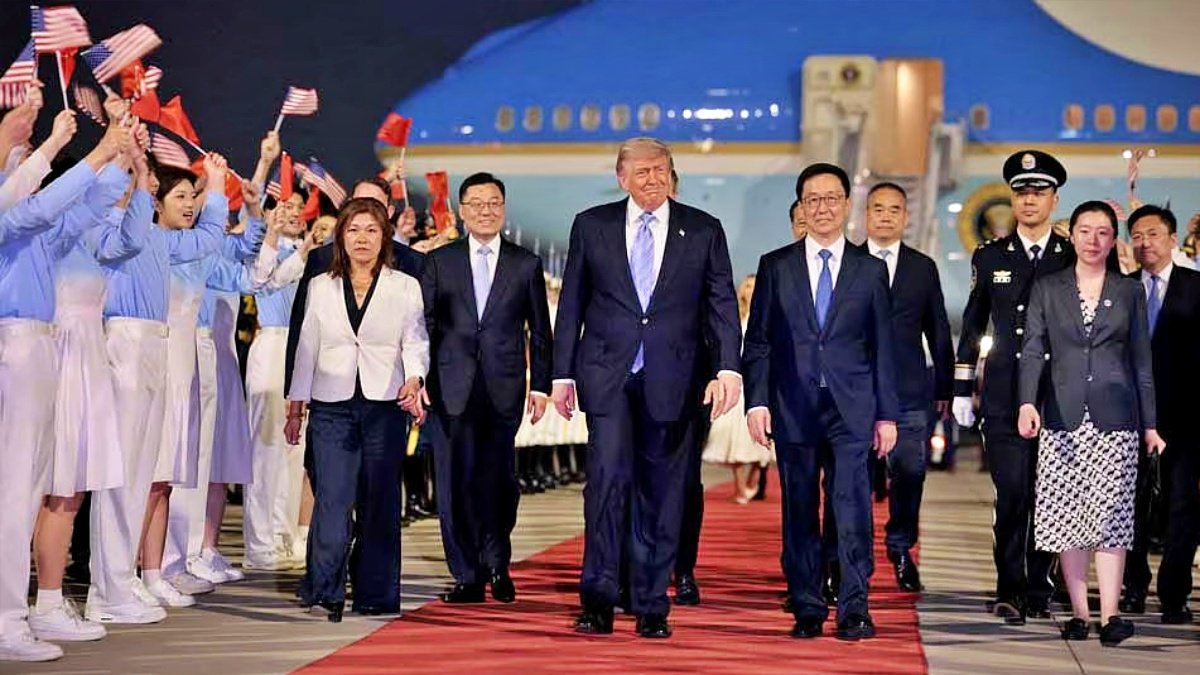
- Grand Reception: Vice President Han Zheng led a regal welcome at the airport, featuring a military honor guard and a 300,youth greeting committee.
- Economic Agenda: Thursday’s bilateral talks will focus on creating new “investment and trade boards” to stabilize markets impacted by the 2026 Middle East crisis.
- Musk’s Return: The visit highlights the reconciled relationship between Trump and Elon Musk, who previously served as a federal bureaucracy advisor.
Nearly a decade after his last official state visit, U.S. President Donald Trump returned to the Chinese capital on Wednesday. The visit, widely viewed as the most significant diplomatic event of 2026, comes at a time when the global economy is reeling from energy shortages and fluctuating trade routes. As the President’s aircraft, Air Force One, touched down on the Beijing tarmac, the meticulous ceremony underscored the “royal” treatment China has prepared for a leader they hope to engage in a renewed economic partnership.
The reception was led by Chinese Vice President Han Zheng, alongside a high-ranking assembly including Ambassador Xie Feng, Executive Vice Minister of Foreign Affairs Ma Zhaoxu, and the U.S. Envoy to Beijing, David Perdue, all of whom greeted the President under strict diplomatic protocol. The scale of the welcome, featuring a disciplined military band and hundreds of enthusiastic youths, suggests that Beijing is prioritizing “spectacle diplomacy” to set a positive tone for the upcoming negotiations.
The “Backbone” Delegation: Musk and Cook Take Center Stage
Perhaps more significant than the political officials is the delegation of 16 corporate titans accompanying the President. This group is being described as the “economic backbone” of the United States. Most notable is the presence of Apple CEO Tim Cook and Tesla’s Elon Musk.
Musk’s inclusion has sparked intense international interest. While he served as a key advisor on federal efficiency early in the second Trump administration, he stepped away last year following public policy disagreements. His presence in Beijing suggests a significant mending of fences and a shared vision for American industrial expansion in Asian markets. Analysts suggest that the presence of these tech leaders indicates that the talks will move beyond standard tariffs to focus on AI, semiconductor supply chains, and green energy logistics.
High-Stakes Negotiations and the “Trade Board” Proposal
The core of the visit will unfold on Thursday during a closed-door bilateral session between Trump and Xi Jinping. Following the talks, a formal banquet will be held, an event intended to provide a more relaxed environment to “thaw the ice” after years of competitive friction.
The primary objective for the U.S. is the proposal for a series of new “investment and trade boards.” These boards would theoretically provide a structured mechanism for resolving disputes and managing joint ventures without resorting to the aggressive tariff cycles that defined the previous decade. With the Middle East crisis placing immense pressure on foreign exchange and fuel prices, both leaders are under domestic pressure to secure a deal that ensures market predictability.
While the rhetoric coming out of the White House is optimistic, the world remains cautious. The outcome of Thursday’s meeting will likely determine the trajectory of global trade for the remainder of the decade, making this Beijing summit a defining moment for the Trump presidency and the 2026 economic landscape.