


































Key Points
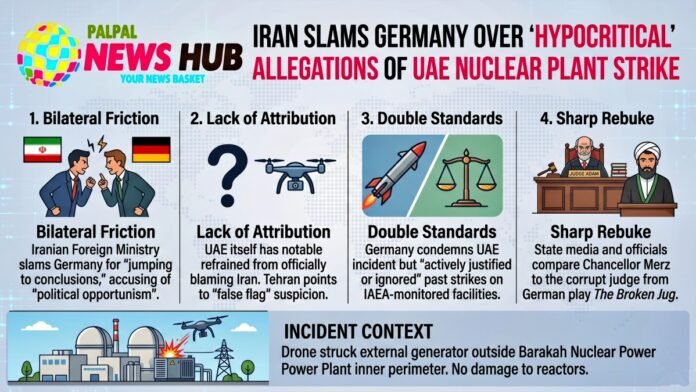
- Bilateral Friction: Iranian Foreign Ministry spokesperson Esmail Baghaei slammed Germany for jumping to conclusions regarding the drone incident, accusing Berlin of political opportunism.
- Lack of Formal Attribution: Tehran pointed out that the UAE itself has notably refrained from officially blaming Iran for the strike, calling the narrative a suspected “false flag” operation.
- Allegations of Double Standards: Baghaei highlighted the hypocrisy of Western nations, noting that while Germany condemned the UAE incident, it actively justified or ignored military strikes on Iran’s sovereign, IAEA-monitored nuclear facilities.
- Sharp Literary Rebuke: Iranian state media and officials invoked Heinrich von Kleist’s classic German play The Broken Jug, comparing Chancellor Merz to the corrupt, self-righteous “Judge Adam.”
- The Incident Context: The diplomatic spat follows a drone attack that struck an external electricity generator outside the inner perimeter of the UAE’s Barakah Nuclear Power Plant, causing no damage to the reactors.
A volatile diplomatic war of words has broken out between Tehran and Berlin following a drone incident in the Persian Gulf. Iranian Foreign Ministry spokesperson Esmail Baghaei came out swinging on Tuesday, delivering a sharp public rebuke against German Chancellor Friedrich Merz. The dispute stems from a social media post by Chancellor Merz, who directly condemned what he termed “renewed Iranian airstrikes against the United Arab Emirates,” warning that targeting nuclear infrastructure threatens the safety of the entire region.
Tehran immediately rejected the narrative, accusing the German government of weaponizing international law to serve selective Western geopolitical interests. Baghaei asserted that Germany and its allies routinely adjust their moral standards based on political opportunism rather than legal consistency.
The “False Flag” Defense and Lack of Attribution
A primary pillar of Iran’s defense relies on the official stance of the United Arab Emirates. While the UAE’s Ministry of Foreign Affairs strongly condemned the drone hit, labeling it a flagrant violation of international law, Abu Dhabi stopped short of publicly assigning direct responsibility or naming Iran as the perpetrator.
“When a supposed false-flag operation takes place, one whose authorship even the UAE has refused to officially attribute to Iran, those same voices suddenly invoke the solemn language of ‘international law’ and ‘regional security,'” Baghaei stated in a message published in German.
The Iranian spokesperson argued that if the protection of peaceful nuclear installations is a sacred international principle, it must apply universally. He noted with bitterness that open military strikes carried out against Iran’s secured, International Atomic Energy Agency (IAEA) monitored infrastructure fail to provoke any condemnation from European capitals, instead receiving excuses and strategic justifications.
Classically German Satire Used as Diplomatic Armor
In an unusually sharp rhetorical maneuver, Baghaei turned to classic German literature to mock Chancellor Merz’s stance. He invoked the infamous character of “Judge Adam” from Heinrich von Kleist’s celebrated 1808 comedic masterpiece, The Broken Jug. In the play, Judge Adam is a deeply corrupt magistrate who sits in pompous judgment over a crime that he himself committed.
Iranian state news agency ISNA amplified the literary jab, directly comparing Chancellor Merz to Kleist’s compromised judge, describing him as a leader whose own international misconduct disqualifies him from acting as an impartial guardian of global justice. The comparison was explicitly intended to paint Berlin as morally compromised, accusing the country of ignoring the aggressive actions of its regional allies while manufacturing crises for Tehran.
Status of the Barakah Nuclear Facility
The core incident behind the multi-national dispute occurred when a drone hit an external electricity generator situated outside the inner perimeter of the Barakah Nuclear Power Plant, located in the Al Dhafra region of Abu Dhabi. The UAE and the IAEA have since confirmed that the core peaceful nuclear energy facilities sustained zero damage and power logistics were swiftly stabilized.
Despite the lack of structural damage, the attack has triggered widespread international concern, drawing separate condemnations from global players, including India, all of whom have called for immediate restraint to prevent a broader escalation of regional violence.