


































Key Highlights
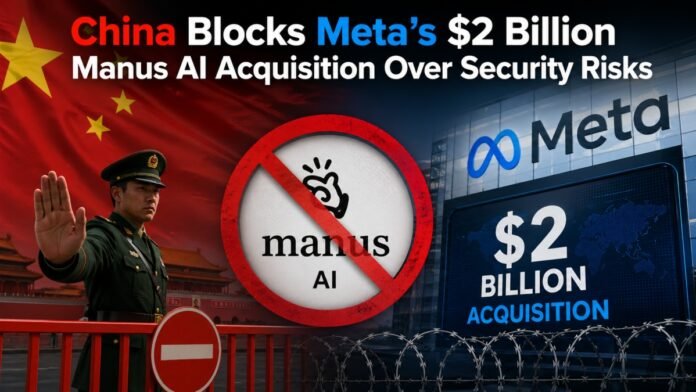
- Regulatory Veto: China’s NDRC officially blocked Meta’s buyout of Manus, marking the first major AI deal vetoed under 2021 investment security laws.
- Jurisdictional Reach: Authorities rejected the startup’s relocation to Singapore as a valid bypass, asserting that the technology and talent remain fundamentally tied to China.
- Exit Bans: Reports indicate Manus founders Xiao Hong and Ji Yichao have been summoned to Beijing and are currently barred from leaving the country.
- Complex Unwinding: Meta must now “disentangle” integrated algorithms and personnel, a process described by experts as technically and legally daunting.
- Global Precedent: The decision establishes a “red line” for Chinese AI startups seeking Western exits, signaling heightened scrutiny for cross-border tech transfers.
The global competition for artificial intelligence reached a dramatic turning point on April 27, 2026, when China’s National Development and Reform Commission (NDRC) dealt a strategic blow to American tech giant Meta. Invoking the “Foreign Investment Security Review Measures” established in 2021, the NDRC ordered the immediate cancellation and unwinding of Meta’s proposed $2 billion acquisition of the AI startup Manus.
The decision centers on the principle of “substance over form,” with Chinese officials arguing that while Manus relocated its headquarters to Singapore in mid,2025, its core intellectual property and engineering talent were developed on Chinese soil. Regulators classified the move as a “wash-out overseas listing,” intended to circumvent domestic oversight, and maintained that the transfer of such sensitive agentic AI technology to a foreign power constitutes a grave risk to national security.
The Complex “Disentanglement” Process
Meta, which sought Manus to bolster its “agentic AI” capabilities, systems capable of autonomously executing complex tasks like market research and coding, now faces the nightmare of reversing a transaction that was already near completion. By March 2026, approximately 100 Manus employees had already integrated into Meta’s Singapore offices, with the startup’s leadership assuming executive roles within the company.
Legal and technical experts compare the required unwinding to “accurately retrieving several thousand bricks from a completed building.” Meta has been given a deadline of several weeks to restore Manus’s assets to their pre-acquisition state and delete all transferred data. Failure to achieve a comprehensive restoration could result in significant fines for both parties.
Exit Bans and Internal Scrutiny
The situation has escalated beyond corporate finance into a diplomatic and legal standoff. Reports from state media and international outlets suggest that Manus CEO Xiao Hong and Chief Scientist Ji Yichao were summoned to Beijing for questioning regarding potential violations of technology export controls. Both founders are reportedly under strict exit bans, preventing them from returning to Singapore or attending international board meetings.
This move underscores Beijing’s determination to prevent “talent flight” in the critical AI sector. The NDRC’s intervention clarifies that regardless of where a holding company is registered, the jurisdiction follows the origin of the research and the citizenship of the key developers.
A Chill in the Global Investment Climate
The blocking of the Meta, Manus deal has sent shockwaves through the venture capital community. Investors, including Benchmark, Tencent, and HongShan Capital (formerly Sequoia China), are now forced to re-evaluate the exit strategies for Chinese-founded tech firms. The traditional path of building a startup in China and selling it to a Western giant like Meta or Google for a high valuation now carries prohibitive regulatory risks.
Analysts predict that this case will lead to a deeper fragmentation of the global AI landscape. International investors may begin demanding that startups decentralize their R&D from the outset to avoid being ensnared by Beijing’s tightening grip on data sovereignty. As the “Special Relationship” between tech innovation and national security deepens, the Meta-Manus failed merger stands as a stark reminder that in the 2026 tech economy, geopolitics often dictates the bottom line.