






























Key Highlights
- Ukraine Standoff: Trump’s pressure on Kyiv to settle has clashed with Europe’s view of the war as an existential security threat.
- Greenland Crisis: U.S. threats to seize Greenland met with Danish military resistance and unified European opposition.
- Trade War: A 10% tariff on eight European nations, including the UK and Germany, has ignited retaliatory measures.
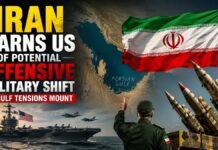
- Iran Neutrality: Europe refused to join the February 28, 2026, U.S. offensive against Iran, leading to accusations of “betrayal.”
- Beijing Pivot: British, German, and Finnish leaders have conducted high-profile visits to China to secure “trade resets.”
- NATO Uncertainty: Unprecedented dialogue has resumed between NATO and China’s military amid threats of a U.S. withdrawal.
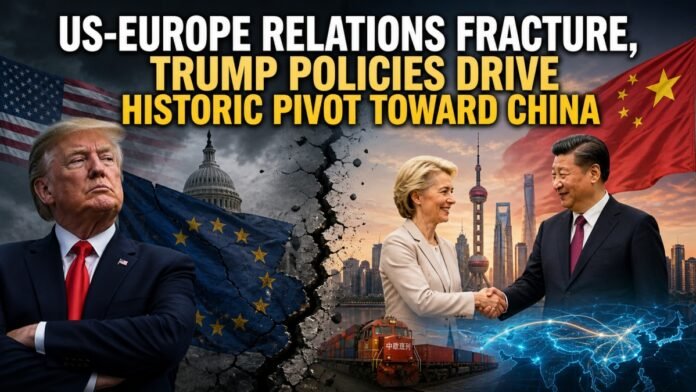
The relationship between the United States and its European allies has reached a historic nadir following President Donald Trump’s second inauguration in January 2025. While tensions existed previously, the divergence over the Russia-Ukraine war, which European nations view as paramount to their continental security, created an immediate ideological rift. While Washington has characterized the ongoing support for Ukraine as a “waste of time and money,” European capitals have doubled down, fearing that a Ukrainian defeat would grant Moscow direct access to the heart of Europe.
The Greenland Dispute and Military Defiance
A second, more radical confrontation emerged over Greenland. Shortly after taking office, President Trump reignited his ambition to acquire or seize control of the territory. This move was met with fierce opposition from Denmark, the nation responsible for Greenland’s defense.
The situation escalated when Denmark warned of forceful retaliation against any U.S. military action, an unprecedented threat between two NATO allies. Contrary to Trump’s expectations that major powers would remain neutral, Britain, Germany, France, and Italy condemned the U.S. stance and deployed a joint military contingent to Greenland. The White House viewed this deployment as an act of open defiance, further isolating the U.S. from its traditional partners.
Economic Warfare and the 2026 Iran Conflict
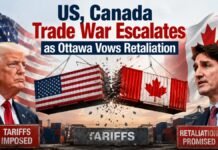
The friction extended into the economic sphere when the U.S. imposed a 10% tariff on eight European countries, accusing them of “exploiting America’s leniency.” This unilateral move triggered immediate condemnation and retaliatory tariffs from the European Union, signaling the end of an era of coordinated trade.
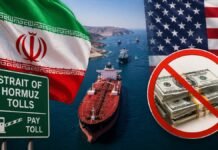
The divide became irreparable on February 28, 2026, when the United States and Israel launched a joint military offensive against Iran. Following Iran’s strategic closure of the Strait of Hormuz, Trump appealed to European allies for military assistance. In a landmark decision, every European nation refused to participate, leading Trump to publicly label the refusal an “act of betrayal.”
The European Tilt Toward Beijing
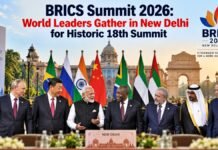
As the U.S. began reducing its troop presence in Germany and questioning its NATO commitments, European leaders looked East. In early 2026, a flurry of diplomatic activity saw Finnish Prime Minister Petteri Orpo, British Prime Minister Keir Starmer, and German Chancellor Friedrich Merz all visiting Beijing.
Starmer’s visit, the first by a British PM in eight years, focused on a “trade reset,” with the Prime Minister acknowledging that Europe cannot afford to ignore China as the world’s manufacturing hub. This pivot was supported by a foundation laid in late 2025, when European Commission President Ursula von der Leyen and French President Emmanuel Macron secured key trade agreements with Xi Jinping.
The Future of NATO and the China Vacuum
Perhaps the most startling development as of May 2026 is the resumption of dialogue between NATO and the People’s Liberation Army (PLA) of China. With Trump repeatedly suggesting a U.S. withdrawal from the alliance, questions are mounting as to whether China will fill the security and economic void left by the United States.
However, a significant hurdle remains: China’s tacit support for Russia throughout the Ukraine war. For Europe, the conflict is a matter of existential survival, and China’s refusal to explicitly distance itself from Moscow remains the primary barrier to a total trust-based partnership. Whether China can bridge this gap to replace the U.S. as Europe’s primary partner remains the defining geopolitical question of the year.