


































Key Points
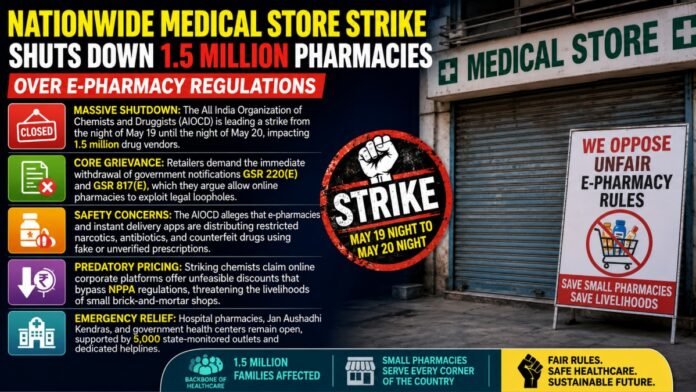
- Massive Shutdown: The All India Organization of Chemists and Druggists (AIOCD) is leading a strike from the night of May 19 until the night of May 20, impacting 1.5 million drug vendors.
- Core Grievance: Retailers demand the immediate withdrawal of government notifications GSR 220(E) and GSR 817(E), which they argue allow online pharmacies to exploit legal loopholes.
- Safety Concerns: The AIOCD alleges that e-pharmacies and instant delivery apps are distributing restricted narcotics, antibiotics, and counterfeit drugs using fake or unverified prescriptions.
- Predatory Pricing: Striking chemists claim online corporate platforms offer unfeasible discounts that bypass NPPA regulations, threatening the livelihoods of small brick-and-mortar shops.
- Emergency Relief: Hospital pharmacies, Jan Aushadhi Kendras, and government health centers remain open, supported by 5,000 state-monitored outlets and dedicated helplines.
A massive healthcare gridlock has taken effect across India as more than 1.5 million pharmacists, chemists, and drug distributors completely shut down operations today, Wednesday, May 20. Organized by the All India Organization of Chemists and Druggists (AIOCD), the absolute umbrella body for the sector, the strike reflects a deep-rooted standoff between traditional brick-and-mortar retailers and the burgeoning e-commerce pharmaceutical sector.
Major metropolitan hubs and states are feeling the immediate impact, with all 15,000 pharmacies in Delhi and approximately 40,000 medical stores in Bihar pulling down their shutters. The 24-hour strike commenced on the night of May 19 and is scheduled to wrap up on the night of May 20, following what organizers describe as the government’s failure to address prolonged statutory demands.
The Fight Against Legal Grey Areas and E-Pharmacies
At the center of the dispute are two recent government notifications, GSR 220(E) and GSR 817(E). The AIOCD strongly asserts that these provisions must be withdrawn immediately. According to the organization, these notifications permit online pharmacy companies to operate inside a highly dangerous legal grey area, lacking comprehensive, binding legislation.
Unlike traditional pharmacies, online platforms currently lack standardized mechanisms to verify medical prescriptions, dictate strict dispensing regulations, or establish clear legal accountability in the event of dangerous health violations.
Rajiv Singhal, General Secretary of the AIOCD, raised serious alarms regarding the operational practices of digital platforms and instant delivery applications. Singhal alleges that these entities frequently dispense critical life-saving drugs on the basis of entirely fabricated or recycled prescriptions.
Traditional chemists are legally obligated to maintain rigorous, auditable registries for restricted substances, including heavy antibiotics, narcotics, and medical pregnancy kits. Traditional retailers argue that e-pharmacies bypass these safety protocols entirely, creating an environment ripe for substance abuse and the circulation of counterfeit medicines, a trend that has drawn past regulatory action from the Drugs Controller General of India (DCGI) and various state-level authorities.
AIOCD Outlines Key Demands for Market Reform
To resolve the impasse, the AIOCD has formally submitted a structured list of demands to the central government, aimed at restoring market equity and ensuring patient safety:
- Curb Predatory Pricing: The government must launch investigations into massive corporate entities and e-pharmacies that disrupt local markets by offering heavy discounts. Because standard retail chemists operate on a fixed 16% margin, the steep discounts provided by online apps are commercially impossible without exploiting systemic loopholes.
- Regulatory Directive: Strict directives for market correction must be issued to the National Pharmaceutical Pricing Authority (NPPA), the DCGI, the Competition Commission of India (CCI), and State Drug Controllers.
- Prevent Prescription Reuse: The AIOCD is demanding the implementation of a centralized, secure government portal rather than private tracking software. This mechanism would utilize a unique QR code-based system, ensuring that once a doctor’s prescription is accessed on a patient’s mobile device, it is permanently locked and cannot be reused at another portal.
- Control Banned Substances: Access to banned or restricted drugs must be heavily monitored through an official, verified registration process mandatory for all practicing doctors and chemists.
The AIOCD has stressed that it stands ready to extend its full administrative cooperation to the government the moment a secure, transparent, and robust digital framework is introduced.
Where Citizens Can Access Emergency Medicines
Recognizing the potential for severe public inconvenience, the AIOCD and state health departments have collectively isolated essential services from the strike footprint. Emergency medical channels will remain open throughout the day, ensuring that critical care patients are not left stranded.
“Arrangements have been strictly monitored to ensure emergency services remain untouched,” stated a representative from the State Drug Control Department. “Approximately 5,000 designated pharmacies across local districts will function normally to bridge any supply gaps.”
Open Facilities and Emergency Channels:
- Internal pharmacies located within government and private hospitals.
- Block-level public health centers and state-run dispensaries.
- Major corporate retail medicine chains and cooperative pharmacies.
- Chief Minister Pharmacy outlets and Pradhan Mantri Bhartiya Janaushadhi Kendras (PMBJK).
To assist the public, the State Drug Control Department has deployed local Drug Inspectors to oversee supply logistics and has established district-wise emergency helpline numbers under the direct supervision of Assistant Directors to address urgent medicine shortages in real time.