






























Key Points
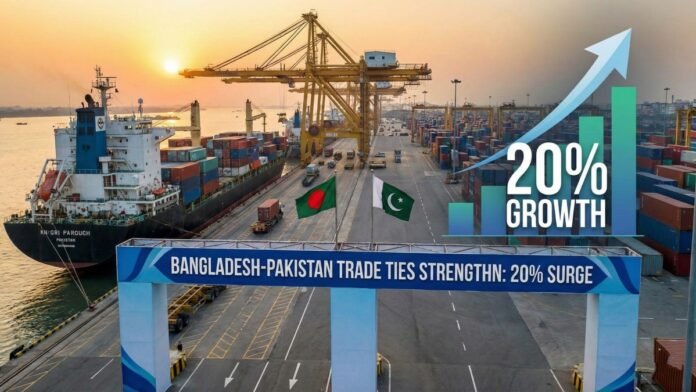
- Bangladesh-Pakistan trade increased by 20% compared to last year, focusing on cotton, textiles, and raw materials
- Direct flights between Dhaka and Karachi expected to begin in January 2026
- Bangladeshi students increasingly interested in Pakistani universities for medical sciences, nanotechnology, and artificial intelligence
- Pakistani hospitals reporting surge in Bangladeshi patients seeking liver and kidney transplants
- Chief Advisor Yunus emphasizes SAARC cooperation and people-to-people contacts
- Strategic move by Bangladesh to diversify supply chain and reduce reliance on Indian imports
Pakistan’s High Commissioner to Bangladesh, Imran Haider, paid a courtesy call on Bangladesh’s Chief Advisor, Professor Muhammad Yunus, at the State Guest House in Dhaka on Sunday, marking a significant warming of ties between the two South Asian nations. The meeting, which lasted approximately 90 minutes, focused on enhancing trade, investment, and aviation cooperation, while also exploring avenues for strengthening mutual collaboration in cultural, educational, and medical fields. SDG Coordinator and Senior Secretary Lamia Morshed was also present at the meeting, underscoring Bangladesh’s commitment to sustainable development goals in its foreign policy framework. This high-level engagement comes at a crucial time when Bangladesh is actively seeking to diversify its international partnerships following the political transition after Sheikh Hasina’s government.
Trade Relations Show Remarkable Recovery
High Commissioner Imran Haider stated that trade between the two countries has increased by approximately 20 percent compared to last year, representing a significant turnaround from the near-standstill during the previous administration. Businesses in both countries are actively exploring new investment opportunities, particularly in textiles, leather goods, pharmaceuticals, and agricultural products. The 20% surge primarily involves cotton, textiles, and raw materials, suggesting that Bangladesh wants to reduce its dependence on India for its supply chain. Pakistani textile manufacturers are finding new markets in Bangladesh’s ready-made garment industry, while Bangladeshi jute and leather products are gaining traction in Pakistani markets. The two sides discussed establishing a joint business council to facilitate trade missions and identify specific sectors for joint ventures, with both countries expressing interest in developing special economic zones dedicated to bilateral trade.
Educational and Medical Cooperation Expands
The Pakistani High Commissioner highlighted a significant increase in cultural exchanges and educational cooperation. He mentioned that Bangladeshi students are showing growing interest in pursuing higher education in Pakistan, particularly in fields such as medical sciences, nanotechnology, and artificial intelligence. Pakistani universities are offering scholarships and streamlined admission processes for Bangladeshi students, with several institutions establishing dedicated admission quotas. In the medical field, Imran Haider said that the number of patients seeking liver and kidney transplants in major Pakistani hospitals has increased substantially, with Bangladeshi patients attracted by Pakistan’s advanced medical facilities and relatively lower costs compared to India and Thailand. Pakistan is ready to offer training and educational opportunities in medical fields related to transplants, with plans for exchange programs between Dhaka Medical College and Karachi’s Sindh Institute of Urology and Transplantation. The two countries are also exploring cooperation in telemedicine and remote diagnostics to serve rural populations.
Aviation Connectivity to Boost Ties
The Pakistani High Commissioner announced that direct flights between Dhaka and Karachi are expected to begin in January 2026, a development that will significantly reduce logistics costs and travel time between the two countries. The direct air service will be operated by Pakistan International Airlines initially, with plans for Biman Bangladesh Airlines to commence services subsequently. This connectivity will allow Pakistani goods to compete more effectively with Indian products in Bangladeshi markets by reducing transportation time from the current 3-4 days via connecting flights to just 3.5 hours direct. The route is also expected to boost medical tourism, with patients and their families able to travel more conveniently for treatment. Both sides discussed the possibility of expanding air links to include Chittagong-Lahore and Dhaka-Islamabad routes in the second phase, which would further integrate the two economies and facilitate business travel.
Strategic Implications for Regional Dynamics
During Sheikh Hasina’s tenure, trade with Pakistan was almost negligible due to her government’s close alignment with India and historical tensions following Bangladesh’s 1971 independence war. However, the 20% surge in trade and the launch of direct air services suggest that Bangladesh wants to reduce its dependence on India for its supply chain and diplomatic positioning. This shift aligns with Chief Advisor Yunus’s vision of a more balanced foreign policy that engages all SAARC countries equally. The development of Bangladesh-Pakistan ties could reshape regional trade patterns, with Pakistani textiles, cement, and surgical goods finding new markets in Bangladesh, while Bangladeshi pharmaceuticals and IT services could expand into Pakistan. The direct air services will reduce logistics costs between the two countries, allowing Pakistani goods to compete more effectively with Indian products in Bangladeshi markets, potentially altering the competitive landscape in South Asian trade.
Chief Advisor Yunus Emphasizes SAARC Cooperation
Chief Advisor Professor Muhammad Yunus welcomed the growing ties between the two countries and emphasized the importance of increasing mutual visits, cultural exchanges, educational cooperation, and people-to-people contacts among SAARC countries. He stressed the need to further increase trade between Bangladesh and Pakistan and expressed hope that during Imran Haider’s tenure, both countries would explore new avenues for investment and joint ventures. Yunus highlighted that SAARC nations must work together to address common challenges such as climate change, poverty, and regional security. He noted that the people of both countries share cultural and historical bonds that should be leveraged for mutual prosperity. The Chief Advisor also mentioned that Bangladesh is keen to learn from Pakistan’s experience in certain agricultural technologies and small and medium enterprise development, while Pakistan could benefit from Bangladesh’s expertise in microfinance and garment manufacturing.
Future Prospects and Diplomatic Trajectory
The meeting concluded with both sides agreeing to establish a joint working group to implement the discussed initiatives, with a follow-up meeting scheduled for February 2026. The Pakistani High Commissioner extended an invitation to Chief Advisor Yunus to visit Islamabad, which was accepted in principle. Both countries are also exploring cooperation in renewable energy, with Pakistan interested in Bangladesh’s solar power initiatives, and Bangladesh keen to study Pakistan’s wind energy projects. The strengthening of Bangladesh-Pakistan relations under Yunus’s leadership represents a pragmatic shift in Bangladesh’s foreign policy, prioritizing national interest over historical grievances. As both countries navigate their relationships with larger neighbors, China and India, this renewed partnership could provide them with greater strategic autonomy and economic opportunities in an increasingly multipolar world.