































Key Points
- Unprecedented Diplomatic Sequence: Beijing achieves a rare post-Cold War milestone by hosting the heads of state of both the United States and Russia within a single week.
- Energy Partnership Acceleration: Moscow is actively pressuring Beijing to finalize the Power of Siberia 2 pipeline, which would redirect 50 billion cubic meters of gas toward Asian markets.
- Economic Lifeline: Since the 2022 invasion of Ukraine, Chinese fuel purchases from Russia have topped $367 billion, securing Moscow’s financial stability and bolstering Beijing’s energy reserves.
- Middle East Context: China’s reliance on Russian crude has intensified as a stabilizing countermeasure against active shipping disruptions in the volatile Strait of Hormuz.
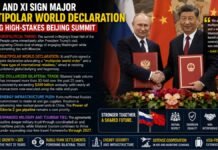
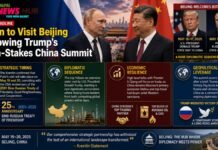
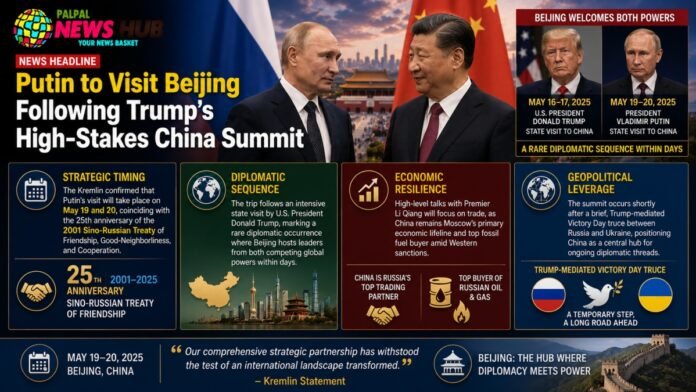
In a historic demonstration of growing geopolitical influence, China is preparing to welcome Russian President Vladimir Putin for a critical two-day summit spanning May 19,20, 2026. The state visit, arranged at the formal invitation of Chinese President Xi Jinping, comes at an extraordinary moment for international relations. Just four days ago, U.S. President Donald Trump departed Beijing after intense security negotiations, meaning the Chinese leadership has successfully positioned itself as the primary mediator between the world’s competing superpowers.
The back, to, back nature of these visits has drawn intense analysis. The state-run Global Times noted that hosting the leaders of both the United States and Russia within a seven-day window is an exceptionally rare occurrence in the post, Cold War era, highlighting that Beijing has rapidly emerged as the definitive focal point of global diplomacy. Ahead of Putin’s arrival, Xi and Putin exchanged warm congratulatory letters on Sunday, celebrating the 30th anniversary of their bilateral strategic partnership and noting that cooperation between the two neighbors is constantly deepening.
The Financial and Energy Architecture of the ‘No Limits’ Alliance
The upcoming talks will mark the latest chapter in a highly synchronized relationship, with the two leaders having met more than 40 times. Since signing a “no limits” strategic partnership agreement in February 2022, economic ties have expanded exponentially. Trapped under heavy Western sanctions, Russia has turned to China as its primary economic lifeline, with Beijing now absorbing more than a quarter of all Russian exports.
According to data compiled by the Centre for Research on Energy and Clean Air, Chinese purchases of Russian fossil fuels have generated hundreds of billions of dollars for the Kremlin, pushing the total value of crude oil, coal, and gas transactions past $367 billion since the outbreak of the Ukraine conflict.
During this summit, Putin is scheduled to hold specialized talks with Chinese Premier Li Qiang to formalize secondary trade agreements. A major priority for the Russian delegation remains the approval of the “Power of Siberia 2” gas pipeline. Moscow is eager to fast-track construction on this massive transit network, which aims to deliver 50 billion cubic meters of natural gas annually to China, effectively replacing the lost volume from its shuttered European markets.
Strategic Stability Amid Middle East Turmoil
For China, the deepening dependence on Russian energy is not merely economic; it is a vital pillar of national security. With the current military crisis in the Middle East threatening total closure or severe disruptions along the Strait of Hormuz, Beijing views overland Russian pipelines and northern maritime oil routes as indispensable safeguards against a sudden maritime blockade.
Western capitals continue to view this relationship with severe apprehension, arguing that China’s sustained economic backing directly fuels Russia’s industrial war machine. However, Beijing has consistently rejected Western criticism regarding its neutral trading status.
Defending the upcoming summit, Chinese Foreign Ministry spokesperson Guo Jiacun stated that the relationship between the two giants serves as a template for modern international governance. Cooperation between China and Russia continues to expand across all sectors, delivering tangible benefits to both nations and their peoples, Guo remarked, adding that the stable alignment between Moscow and Beijing constitutes an essential pillar for upholding global strategic stability and international justice.