



































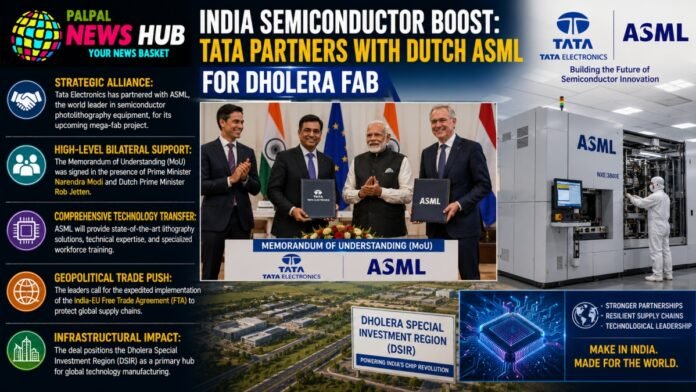
Key Points
- Strategic Alliance: Tata Electronics has partnered with ASML, the world leader in semiconductor photolithography equipment, for its upcoming mega-fab project.
- High-Level Bilateral Support: The Memorandum of Understanding (MoU) was signed in the presence of Prime Minister Narendra Modi and Dutch Prime Minister Rob Jetten.
- Comprehensive Technology Transfer: ASML will provide state-of-the-art lithography solutions, technical expertise, and specialized workforce training.
- Geopolitical Trade Push: The leaders call for the expedited implementation of the India-EU Free Trade Agreement (FTA) to protect global supply chains.
- Infrastructural Impact: The deal positions the Dholera Special Investment Region (DSIR) as a primary hub for global technology manufacturing.
In a watershed moment for India’s technological sovereignty, Tata Electronics has finalized a strategic Memorandum of Understanding (MoU) with Netherlands-based Advanced Semiconductor Materials Lithography (ASML). The landmark agreement, signed in the presence of Prime Minister Narendra Modi and Dutch Prime Minister Rob Jetten, marks a massive step forward in establishing India’s first commercial front-end semiconductor fabrication facility in Dholera, Gujarat.
Building India’s First Semiconductor Fab
The multi-billion-dollar Dholera facility will leverage ASML’s unparalleled expertise in photolithography, the critical process of using light to print microscopic circuits onto silicon wafers. ASML holds a near-monopoly on the world’s most advanced chip-making machinery, making this collaboration essential for India’s entry into high-tech manufacturing.
Expressing his optimism on the social media platform X, Prime Minister Modi highlighted that the pact strengthens international cooperation in futuristic sectors. He emphasized that ASML’s deep integration into the establishment and expansion of Tata Electronics’ upcoming facility will unlock massive career opportunities for India’s skilled youth, turning the nation into a dependable node in the global semiconductor value chain.
Global Leadership Aligning with India’s Priority
ASML Chief Executive Officer Christophe Fouquet hailed the agreement as a historic turning point. He noted that semiconductor manufacturing has clearly become a national priority for India, with the Tata Group uniquely positioned to spearhead the country’s foundational semiconductor factory. Fouquet stated that ASML aims to extend every possible layer of support to Tata, in terms of products, cutting-edge technology, and expert human resources, ensuring that the new fab operates with top-tier lithography infrastructure from day one.
The integration of ASML’s systems into the Gujarat facility provides a major confidence boost to the Indian semiconductor mission, which aims to reduce reliance on East Asian supply chains amid rising geopolitical tensions.
Free Trade and Broader Economic Ties
The bilateral meeting between the two heads of state extended beyond technology infrastructure. Both Prime Ministers stressed the immediate need to finalize and implement the long-negotiated India-European Union Free Trade Agreement (FTA). The leaders noted that a robust FTA would structurally reinforce the India-EU alliance as trusted trade partners, fostering open markets, inclusive growth, and resilient supply lines during global economic volatility.
The session also drew high-level participation from a delegation of CEOs representing leading Dutch corporations across key sectors, including energy, ports, healthcare, agriculture, trade, and technology, who validated India’s ongoing economic reforms and detailed their respective expansion blueprints for the Indian market.