


































Key Points
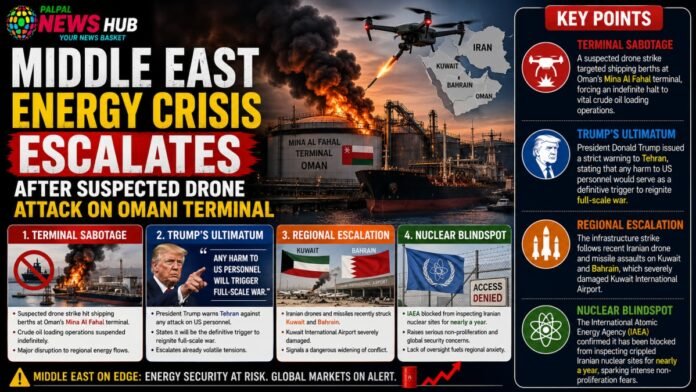
- Terminal Sabotage: A suspected drone strike targeted shipping berths at Oman’s Mina Al Fahal terminal, forcing an indefinite halt to vital crude oil loading operations.
- Trump,s Ultimatum: President Donald Trump issued a strict warning to Tehran, stating that any harm to US personnel would serve as a definitive trigger to reignite full-scale war.
- Regional Escalation: The infrastructure strike follows recent Iranian drone and missile assaults on Kuwait and Bahrain, which severely damaged Kuwait International Airport.
- Nuclear Blindspot: The International Atomic Energy Agency (IAEA) confirmed it has been blocked from inspecting crippled Iranian nuclear sites for nearly a year, sparking intense non-proliferation fears.
Tensions across the Middle East reached a critical flashpoint following a massive explosion at the Mina Al Fahal oil export terminal near Muscat, Oman. The blast, which occurred precisely between Single-Buoy Mooring (SBM) berths 1 and 2, has brought loading operations at one of the region’s most strategic energy hubs to an abrupt and indefinite standstill.
Industry sources and maritime security agencies report that the damage was allegedly inflicted by a coordinated drone attack. Maritime tracking data quickly showed multiple supertankers marooned off the coast as engineers rushed to assess the structural integrity of the offshore moorings. While Oman has traditionally served as a critical back-channel diplomatic mediator between Washington and Tehran, this geographic spillover directly threatens energy corridors outside the immediate Persian Gulf. No state or proxy group has officially claimed responsibility for the sabotage.
Trump Issues Severe “Red Line” Warning to Tehran
Responding to the widening regional chaos from the White House, US President Donald Trump drew an uncompromising “red line” regarding Iranian military maneuvers. Addressing reporters, Trump declared unequivocally that any aggression resulting in harm to US service members would provide a solid reason to instantly reignite a direct military campaign.
Dismissing claims that Tehran was successfully managing the geopolitical standoff, Trump characterized reports of Iranian resilience as “fake news.” He highlighted previous naval engagements to underscore American military dominance in the region.
President Donald Trump on Naval Engagements: “Iran had a navy, 159 boats, now they have none. They’re all at the bottom of the sea. They’re trying to replace them with fast boats, but our destroyers have already knocked out quite a few of them today.”
Retaliatory Strikes and Widening Regional Devastation
The attack on Oman’s infrastructure marks a severe escalation in a rapid sequence of back-and-forth military actions. Earlier, Iran launched a targeted wave of ballistic missiles and explosive drones into Kuwait and Bahrain. The strike on Kuwait was highly destructive, directly hitting Terminal 1 of Kuwait International Airport, killing one individual, and wounding at least 63 others.
Tehran officially defended the strikes, claiming they were justified acts of retaliation after a previous US military strike disabled an Iranian oil tanker. Iranian officials warned that any neighboring nation permitting its territory, airspace, or maritime boundaries to be utilized by US forces would be treated as an active participant in aggression against Iran. In response to the airport assault, US Central Command (CENTCOM) launched immediate self-defense strikes targeting an Iranian drone ground control center on Qeshm Island.
IAEA Warns of Dangerous Nuclear Proliferation Blindspot
Compounding the military crisis, the International Atomic Energy Agency (IAEA) circulated a confidential report expressing grave concerns over an ongoing nuclear verification blackout. UN inspectors revealed they have been completely blocked from accessing Iran’s primary nuclear facilities since they were struck during an intense 12-day conflict last year.
According to data compiled before the inspections ceased, Iran is known to hold a stockpile of roughly 440.9 kilograms of uranium enriched up to 60% purity, leaving the country a brief technical step away from weapons-grade 90% enrichment. IAEA Director General Rafael Grossi warned that standard safeguards have been compromised for nearly a year, leaving international regulators entirely blind to whether the highly enriched material is currently being weaponized.