Key Points
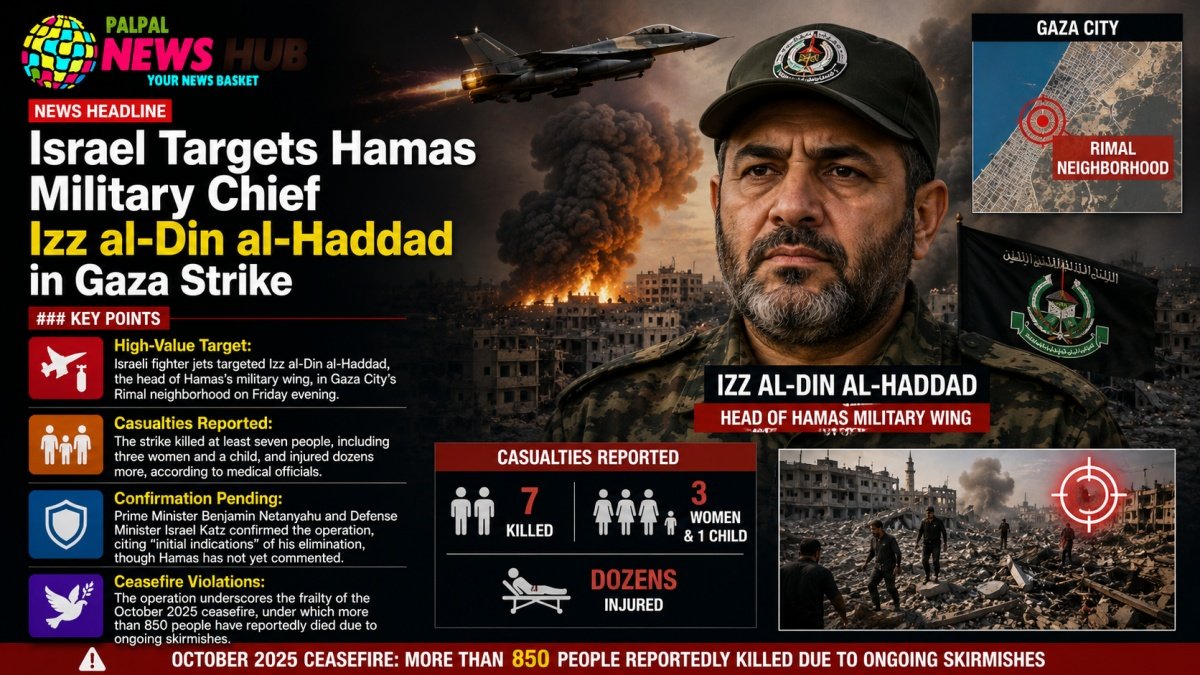
- High-Value Target: Israeli fighter jets targeted Izz al-Din al-Haddad, the head of Hamas’s military wing, in Gaza City’s Rimal neighborhood on Friday evening.
- Casualties Reported: The strike killed at least seven people, including three women and a child, and injured dozens more, according to medical officials.
- Confirmation Pending: Prime Minister Benjamin Netanyahu and Defense Minister Israel Katz confirmed the operation, citing “initial indications” of his elimination, though Hamas has not yet commented.
- Ceasefire Violations: The operation underscores the frailty of the October 2025 ceasefire, under which more than 850 people have reportedly died due to ongoing skirmishes.
In a highly coordinated intelligence operation, Israeli fighter jets launched a series of powerful airstrikes on Friday evening targeting Izz al-Din al-Haddad, the overall commander of Hamas’s military wing, the Al-Qassam Brigades. The operation, which took place in the densely populated Rimal neighborhood of Gaza City, has dramatically escalated tensions across the region and highlighted the extreme volatility of the current security situation.
Israeli Prime Minister Benjamin Netanyahu and Defense Minister Israel Katz immediately released a joint statement confirming they personally authorized the high-value mission. According to Israeli security officials, intelligence teams had been tracking al-Haddad for over a week, deploying three fighter jets and 13 munitions once his precise location inside a residential building was confirmed.
Civilian Toll and Hospital Reports
The precision bombardment struck a multi-story residential building, followed immediately by a secondary missile strike that completely obliterated a vehicle leaving the vicinity. Local health authorities and the Palestine Red Crescent Society reported that the twin strikes resulted in at least seven fatalities, including three women and a child.
Over 50 other individuals sustained severe injuries and were rushed by emergency personnel to Al-Shifa Hospital and the Saraya Field Hospital. At this stage, forensic verification is ongoing, and it remains officially unconfirmed whether al-Haddad is among the deceased or if he managed to survive the blast. Hamas officials have maintained absolute operational silence regarding the status of their commander.
Who is Izz al-Din al-Haddad?
Known within Gaza as the “Ghost of al-Qassam” due to his extreme operational secrecy, al-Haddad rose to the apex of Hamas’s military and political hierarchy in May 2025, succeeding Mohammed Sinwar after his assassination. Israel identifies al-Haddad as one of the principal remaining masterminds behind the October 7, 2023, attacks, which resulted in the deaths of approximately 1,200 people and the abduction of 251 hostages.
According to the joint statement from Netanyahu and Katz, al-Haddad was directly responsible for orchestrating brutal hostage captivity conditions, managing cross-border insurgencies, and actively rejecting the disarmament terms put forth in recent international peace frameworks. “Sooner or later, Israel will reach you,” the leadership warned, reiterating their stance that no individual connected to the October 7 massacre will be spared.
Strained Ceasefire and Humanitarian Context
The high-profile strike comes during a highly fragile, U.S.-brokered ceasefire agreement that was established in October 2025. Despite the formal truce, the agreement has done little to stop localized violence on the ground. Both Israel and Hamas frequently trade public accusations of systemic truce violations, with Israel focusing its efforts on surgically dismantling the remaining Hamas leadership structure.
According to data published by the Gaza Ministry of Health, more than 850 Palestinian citizens have been killed in localized flare-ups since the October ceasefire took effect. Over 72,700 people have lost their lives in Gaza since the outbreak of the war in late 2023. As search and rescue teams continue to clear the rubble in the Rimal district, regional observers fear that this latest operation could trigger an extensive cycle of retaliatory violence, further undermining long-term regional stability.