

































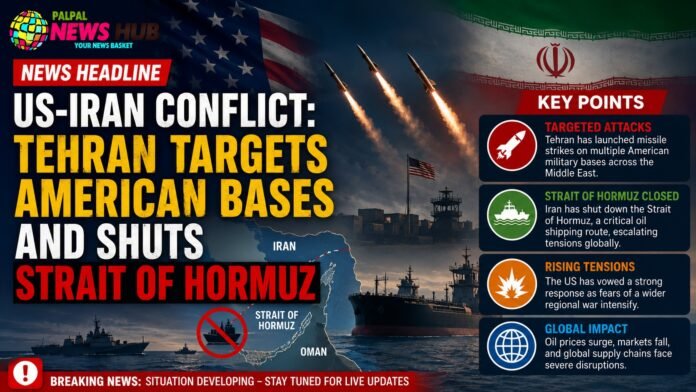
Key Points
- US Bases Attacked: Iranian forces targeted key American installations, including the Ali Al Salem Air Base in Kuwait, the Sheikh Isa Air Base in Bahrain, and the Muwaffaq al-Salti base in Jordan.
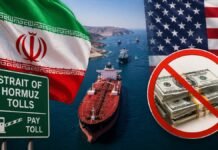
- Strait of Hormuz Blockaded: Tehran declared the vital global energy chokepoint completely closed to all commercial shipping, warning that any violating vessels will be targeted.
- Aviation Disruption: Kuwait civil aviation authorities temporarily grounded all commercial flights and closed their airspace early Thursday, though normal operations have since resumed.
- Ceasefire Collapse: The multi-front escalation marks the definitive collapse of an April truce, sparked by the downing of a US helicopter and subsequent heavy American retaliatory strikes on southern Iran.
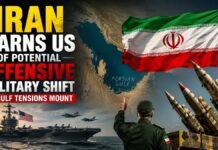
The security environment in West Asia has severely deteriorated following a highly coordinated retaliatory offensive by Iran’s Islamic Revolutionary Guard Corps, or IRGC. Early Thursday morning, the IRGC’s Aerospace Force and Naval divisions deployed a combination of suicide drones and long-range ballistic missiles against a network of interconnected US military installations spanning Kuwait, Bahrain, and Jordan.
According to military statements released out of Tehran, the multi-axis assault successfully struck 18 critical American assets. Local defense sources verified that heavy explosions and warning sirens echoed across the region. In Kuwait, the primary targets included the strategic Ali Al Salem and Ahmed Al-Jaber airbases. Simultaneously, the Sheikh Isa Air Base in Bahrain, which acts as a key operational node for the US Fifth Fleet, suffered targeted drone strikes aimed at its specialized communication arrays and defensive radar elements. Further inland, precision ballistic missiles were recorded transiting Jordanian airspace before striking the Al-Azraq and Muwaffaq al-Salti airbases, both utilized extensively by US forces for regional security operations.
While Iranian state media claimed extensive destruction of equipment, including F,35 maintenance hangars, US defense officials speaking anonymously indicated that the vast majority of incoming projectiles were successfully neutralized by regional air defense umbrellas, reporting minimal structural damage and no American military casualties.
Energy Lifeline Under Siege
The most economically consequential development of the ongoing military confrontation centers on the Strait of Hormuz, the critical maritime chokepoint responsible for the transit of roughly one, fifth of global petroleum consumption. Following a series of heavy US naval bombardments on Iranian coastal radar installations, Tehran’s Khatam al-Anbia Central Headquarters officially declared the immediate and total closure of the waterway.
The IRGC Navy issued an explicit directive warning that all international merchant vessels, particularly oil tankers currently operating within the Persian Gulf and the Sea of Oman, must remain at their respective anchorages. The Iranian high command emphasized that any maritime traffic attempting to traverse the restricted strait would be classified as a hostile target and engaged with kinetic force. Iranian state media subsequently claimed that two commercial vessels attempting an illegal transit had already been fired upon and struck.
In sharp contrast to Tehran’s statements, US Central Command, or CENTCOM, released a public advisory refuting claims of a functional blockade. US military officials asserted that international shipping channels remain open and that commercial vessels continue to actively transit in and out of the Strait of Hormuz under allied maritime monitoring.
Airspace Restrictions and Ceasefire Collapse
The immediate kinetic threat forced local civil aviation bodies to take drastic precautionary measures. The Kuwait Civil Aviation Authority announced a rapid, temporary closure of its sovereign airspace early Thursday morning, resulting in the immediate diversion of all international commercial flights to alternative regional hubs. Following a comprehensive reassessment of the immediate threat vectors, authorities reopened the airspace later in the day, allowing Kuwait International Airport to resume normal flight routing.
The current escalation represents a critical flashpoint that threatens to completely dissolve the regional ceasefire brokered earlier in April. The fragile truce disintegrated rapidly over the last 48 hours. The spiral began when an American Army Apache helicopter was shot down over regional waters, an action Washington directly attributed to Iranian military assets.
Washington Promises Swift Retribution
Responding to the multi-front strikes from the White House, US President Donald Trump adopted an unyielding stance, warning that the diplomatic window has closed. President Trump stated that Tehran had squandered its final opportunities to solidify a sustainable peace agreement, declaring, “We will strike them very hard. We struck them yesterday, and we will strike them again today.”
Reinforcing the administration’s position, US Defense Secretary Pete Hegseth spoke from Central Command headquarters, clarifying that military planning has shifted toward neutralizing high-value infrastructure. Defense Secretary Hegseth confirmed that future American responses will be exceptionally strong and clear, signaling that upcoming operations are prepared to directly target Iran’s primary energy facilities and domestic military commands if the blockades and base attacks persist.