Key Details
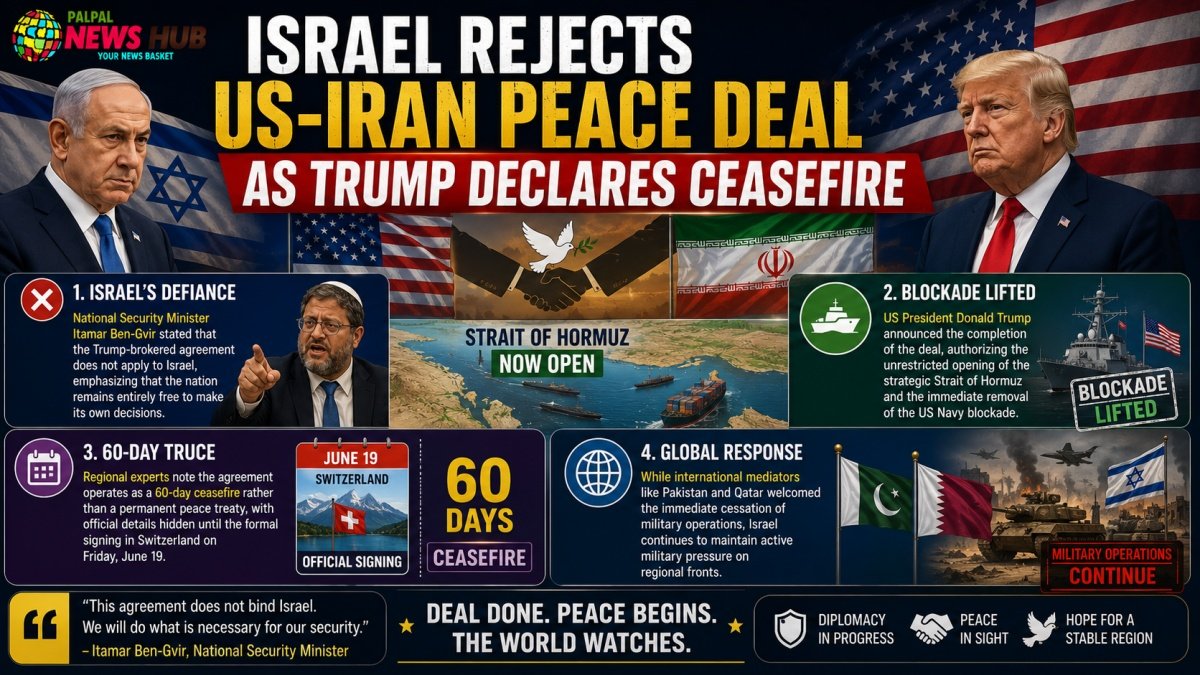
- Israel’s Defiance: National Security Minister Itamar Ben-Gvir stated that the Trump-brokered agreement does not apply to Israel, emphasizing that the nation remains entirely free to make its own decisions.
- Blockade Lifted: US President Donald Trump announced the completion of the deal, authorizing the unrestricted opening of the strategic Strait of Hormuz and the immediate removal of the US Navy blockade.
- 60, Day Truce: Regional experts note the agreement operates as a 60-day ceasefire rather than a permanent peace treaty, with official details hidden until the formal signing in Switzerland on Friday, June 19.
- Global Response: While international mediators like Pakistan and Qatar welcomed the immediate cessation of military operations, Israel continues to maintain active military pressure on regional fronts.
The geopolitical landscape shifted dramatically on Monday as Israel delivered its first official response to the newly brokered peace framework between the United States and Iran. Israeli National Security Minister Itamar Ben-Gvir made it clear that the agreement, heavily pushed by US President Donald Trump, carries no authority over Israeli military or diplomatic operations.
“Trump’s agreement does not bind us,” Ben-Gvir stated, adding that Israel is not subordinate to the United States and remains an independent, sovereign nation. The hardline minister stressed that Israel was not a partner in these negotiations and warned against withdrawing troops from captured territories in southern Lebanon, arguing that containment strategies have historically compromised Israeli security.
Trump Announces End to Strait of Hormuz Blockade
The friction from Jerusalem came immediately after President Trump used his social media platform to announce the completion of the high-stakes deal. The agreement seeks to halt a devastating three-month conflict that erupted in late February 2026, which severely disrupted global energy markets and triggered widespread economic volatility.
In his statement, Trump declared the deal with the Islamic Republic of Iran complete and authorized the unrestricted, toll-free opening of the Strait of Hormuz. He ordered the immediate removal of the US Navy blockade on Iranian ports, which had heavily restricted maritime trade. “Ships of the world, start your engines. Let the oil supply begin,” Trump wrote, signaling relief for a global economy battered by soaring energy prices.
Broader Context and the 60, Day Reality
While international mediators, including Pakistani Prime Minister Shehbaz Sharif, welcomed the move as a permanent cessation of hostilities across all fronts, including Lebanon, regional experts urge caution.
Sagiv Steinberg, Director General and Director of Communications at the Tel Aviv-based Jerusalem Center for Security and Foreign Affairs, cast doubt on the permanent nature of the announcement. Steinberg emphasized that based on preliminary details, the deal is structurally a 60-day ceasefire rather than a finalized peace treaty. Reports from the region indicate that a 14-point memorandum of understanding involves a temporary truce window to allow both nations to facilitate deeper technical talks.
The official texts of the agreement remain under wraps, with both sides waiting for the formal signing ceremony in Switzerland on Friday, June 19. Until then, Israel appears determined to pursue its own security objectives, maintaining operations against local threats despite the diplomatic breakthrough finalized by its Western allies.