

































Key Points
- Strategic Approval: Israel, Qatar, Kuwait, and the UAE will receive advanced missile defense and laser-guided weapon systems.
- Israel’s Package: The State Department cleared $992.4 million for Advanced Precision Kill Weapon Systems (APKWS).
- Qatar’s Lead: Doha secured a massive $5 billion deal for Patriot missile replenishment and APKWS kits.
- War Status: President Trump formally notified Congress that hostilities with Iran have “terminated” following a 60-day combat window.
- Military Claims: The President asserts that Iran’s Navy, Air Force, and nuclear infrastructure have been “completely decimated.”
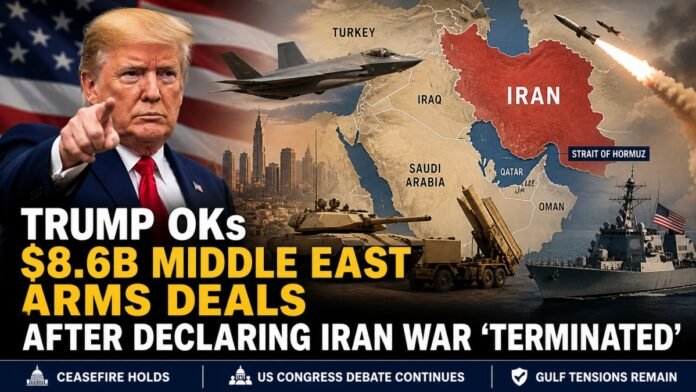
In a decisive move to solidify regional security following two months of intense kinetic conflict, the U.S. State Department has approved a series of massive arms sales totaling over $8.6 billion. The weaponry, earmarked for Israel, Qatar, Kuwait, and the United Arab Emirates, is intended to bolster the defensive capabilities of “frontline allies” as the Middle East transitions into a fragile ceasefire period.
Allocations and Military Hardware
The bulk of the approved sales, facilitated by Secretary of State Marco Rubio, focuses on air defense and precision-guided munitions. Qatar emerged as the largest recipient, securing a $4.01 billion package for Patriot air and missile defense replenishment, alongside $992.4 million for Advanced Precision Kill Weapon Systems (APKWS), which are laser-guided rocket kits.
Israel has been cleared for nearly $1 billion in APKWS units to replenish stocks used during the recent campaign. Additionally, Kuwait was approved for a $2.5 billion Integrated Battle Command System, while the UAE will receive $147.6 million in precision weaponry. Officials noted that these deals bypassed the standard 30-day congressional review period, citing the “urgent national security necessity” of stabilizing the region.
Trump Declares Hostilities Over
The announcement coincides with a formal letter sent by President Donald Trump to House Speaker Mike Johnson on Friday. In the letter, Trump stated that military hostilities with Iran, which commenced on February 28, 2026, have officially “terminated.” This declaration allows the administration to meet the 60-day legal deadline mandated by the War Powers Resolution of 1973.
“There has been no exchange of fire between United States Forces and Iran since April 7, 2026,” the President wrote, signaling a pivot from active combat toward a strategy of containment and “maximum pressure” via naval blockades.
“Treasonous” Criticism and the Nuclear Deterrent
Speaking to a crowd at ‘The Villages’ in Florida, President Trump delivered a stinging rebuke to political opponents who questioned the effectiveness of the U.S. campaign. Labeling critics as “treasonous,” Trump claimed that the U.S. military had achieved total dominance.
“The radical Left says we aren’t winning, when the truth is Iran’s Navy is gone, their Air Force is gone, and their radar systems are wiped out,” Trump told the audience. He compared the operation’s speed to the January intervention in Venezuela, calling it “the greatest military operation in history.”
A key focus of the President’s remarks was the neutralization of Tehran’s nuclear ambitions. Trump credited the use of B-2 stealth bombers and “bunker buster” munitions for destroying underground facilities at Natanz and Isfahan. He asserted that the U.S. had successfully secured Iran’s “nuclear dust,” referring to the enriched uranium stockpiles, preventing a nuclear-armed Iran from threatening Israel or Europe.
Latest Developments: May 2026
While the President has declared the war over, the regional situation remains volatile. The USS Gerald R. Ford is reportedly departing the Gulf, but the U.S. continues to enforce a strict naval blockade to prevent Iran from rebuilding its conventional forces. Stalled negotiations in Islamabad suggest that while the bombs have stopped falling, a permanent peace treaty remains elusive.