



































Key Points
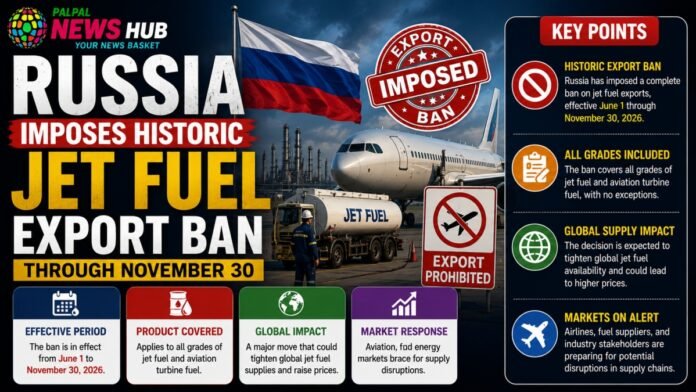
- Unprecedented Embargo: For the first time in its history, Russia has completely prohibited the export of jet and aviation fuel, with the emergency restriction running until November 30, 2026.
- Refining Output Collapses: Persistent Ukrainian drone and missile strikes have knocked out up to 25% of Russia’s refining capacity, pushing average refinery runs down to 4.69 million barrels per day, the lowest since 2010.
- Domestic Market Stabilization: The Kremlin enacted the moratorium to preserve internal aerospace and military fuel reserves ahead of expected seasonal demand surges.
- Targeted Regional Impact: While global markets face minimal disruption due to Russia’s modest jet fuel export volumes, the ban directly halts vital rail shipments to Central Asian nations.
In a historic move to secure its depleting domestic reserves, the Russian Federation announced a complete, temporary ban on the export of aviation fuel. The emergency embargo, implemented by the Russian Cabinet of Ministers, will remain enforced until November 30, 2026. According to official government statements, the drastic intervention is explicitly designed to stabilize the domestic fuel sector, shielding internal markets from severe structural deficits.
The policy follows previous strict caps placed on automobile gasoline exports earlier in the year, signaling a compounding crisis across Russia’s energy framework as the conflict with Ukraine impacts its industrial core.
Infrastructure Damages Push Processing Rates to 16-Year Low
The primary catalyst for this emergency five-month restriction is the severe, cumulative damage inflicted on Russia’s energy infrastructure by a relentless Ukrainian drone campaign. Over the past few months, Kyiv has systematically targeted large-scale oil refineries and cross-country pipeline networks, heavily disrupting Russia’s fuel processing capabilities.
Data from energy analytics firms indicate that the strategy has successfully paralyzed major processing facilities. In April and May alone, six massive complexes, including Lukoil’s “Nizhny Novgorod” refinery and Surgutneftegaz’s “Kirishinefteorgsintez,” were forced to completely or partially halt operations.
Consequently, Russia’s average refinery throughput plummeted to roughly 4.69 million barrels per day, marking a critical 16-year operational low. Oil companies have reportedly lost up to 25% of their total production capacities, leaving the government with no choice but to prioritize domestic defense and aerospace needs over international commerce.
Mitigating Winter Shortages and Protecting Reserves
The decision comes at a critical juncture when domestic demand for oil and gas traditionally experiences a sharp seasonal incline. By executing this protective moratorium, Russian authorities hope to build up sufficient fuel reserves to preemptively buffer its citizens and military infrastructure against potential shortages ahead of the peak winter season.
Following high-level meetings chaired by Deputy Prime Minister Alexander Novak, Russian oil companies were strongly advised to pull back from international markets. Novak emphasized the necessity of constant, coordinated monitoring between federal agencies and energy firms to implement additional defensive market measures if conditions deteriorate further.
Central Asia Affected, Global Ripple Effects Limited
Though Russia stands as one of the world’s premier exporters of refined petroleum commodities, the international impact of this specific jet fuel ban is expected to vary by region:
- Global Markets: Because aviation fuel makes up a relatively modest fraction of Russia’s overall refined exports, energy analysts predict minimal, localized price volatility on the broader global stage.
- Central Asian Markets: The immediate brunt of the ban will be felt by neighboring Central Asian nations, including Kazakhstan, Kyrgyzstan, Tajikistan, and Uzbekistan, which rely heavily on Russian rail shipments for their commercial aviation sectors.
To prevent total diplomatic friction, the Russian administration clarified that the newly enacted suspension will feature critical exemptions. The export ban will not apply to fuel dispatches managed under pre-existing intergovernmental agreements, nor will it impact the technical fuel tanks of transit aircraft or kerosene that had already cleared customs protocols before the mandate took effect.