


































Key Points
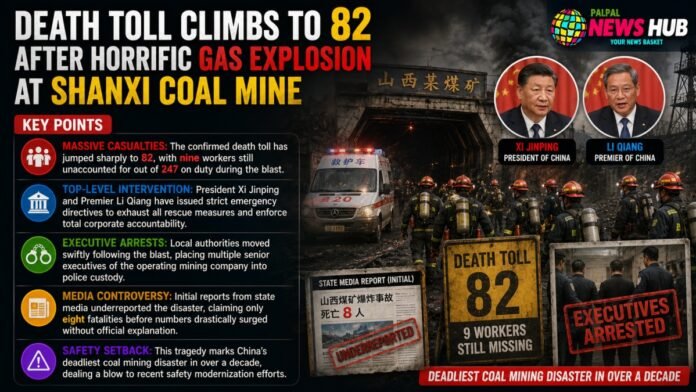
- Massive Casualties: The confirmed death toll has jumped sharply to 82, with nine workers still unaccounted for out of 247 on duty during the blast.
- Top-Level Intervention: President Xi Jinping and Premier Li Qiang have issued strict emergency directives to exhaust all rescue measures and enforce total corporate accountability.
- Executive Arrests: Local authorities moved swiftly following the blast, placing multiple senior executives of the operating mining company into police custody.
- Media Controversy: Initial reports from state media underreported the disaster, claiming only eight fatalities before numbers drastically surged without an official explanation.
- Safety Setback: This tragedy marks China’s deadliest coal mining disaster in over a decade, dealing a blow to recent safety modernization efforts.
A devastating gas explosion ripped through the Liushenyu coal mine in northern China’s Shanxi province late Friday night, resulting in the loss of at least 82 lives. The high-casualty blast occurred deep within the subterranean shafts while a large night-shift crew was actively deployed. Emergency rescue personnel, specialized mine safety units, and medical teams have been working continuously through the night, navigating highly toxic gas pockets and unstable, collapsed tunnels to reach survivors.
At the exact moment the explosion occurred, a total of 247 miners were registered on duty deep inside the complex. While a majority of the workers managed to escape or were evacuated by emergency teams during the initial response, nine miners remain completely unaccounted for. Rescue operations are still active as crews systematically clear debris from the compromised shafts in a desperate race against time.
State Leadership Demands Uncompromising Accountability
The severity of the disaster has drawn immediate responses from the highest levels of the Chinese government. President Xi Jinping issued urgent, strict directives to provincial officials, mandating that no stone be left unturned in locating the missing personnel and ensuring specialized medical care for the hospitalized survivors. Alongside immediate life-saving goals, the President ordered an uncompromised, comprehensive investigation into the root causes of the structural failure and subsequent gas ignition.
Premier Li Qiang echoed these sentiments, asserting that the state will enforce strict accountability with zero tolerance for safety violations. According to reports from the state-run Xinhua news agency, local law enforcement agencies have already taken several senior executives of the mining company into custody for questioning regarding potential regulatory negligence, improper ventilation oversight, and a failure to act on early gas accumulation warnings.
Sharp Discrepancy in Early Casualty Reporting
The disaster has attracted intense scrutiny due to a massive, unexplained shift in early casualty figures. In the immediate aftermath of the explosion, state media outlets initially reported that only eight workers had died and claimed that over 200 miners had been successfully brought to the surface.
However, within hours, local tracking bureaus revised the official death toll upward to 82, a staggering increase that stunned the public. Provincial authorities have not yet provided a clear explanation for this significant reporting error, leaving it uncertain whether the discrepancy was caused by initial communications breakdowns, miscounted shift logs, or an attempt by local management to downplay the scale of the accident before rescue teams uncovered the true extent of the damage.
Worst Mining Accident in a Decade Challenges Regulatory Gains
The Shanxi disaster marks a severe setback for the country’s industrial safety track record. Since the early 2000s, the central government has rigorously implemented strict national safety regulations, shutting down thousands of small, illegal operations and heavily investing in automated gas-detection systems and mandatory ventilation upgrades.
These sustained regulatory overhauls had successfully engineered a significant, steady decline in annual worker fatalities caused by sudden gas explosions, cave-ins, or shaft flooding. This horrific incident at the Liushenyu facility has shattered that trajectory, earning the grim distinction of being China’s deadliest mining catastrophe recorded in over a decade, pushing systemic regulatory compliance back into the national spotlight.