



































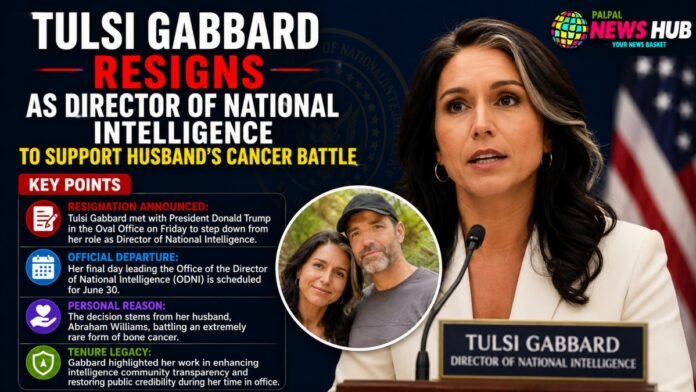
Key Points
- Resignation Announced: Tulsi Gabbard met with President Donald Trump in the Oval Office on Friday to step down from her role as Director of National Intelligence.
- Official Departure: Her final day leading the Office of the Director of National Intelligence (ODNI) is scheduled for June 30.
- Personal Reason: The decision stems from her husband, Abraham Williams, battling an extremely rare form of bone cancer.
- Tenure Legacy: Gabbard highlighted her work in enhancing intelligence community transparency and restoring public credibility during her time in office.
U.S. Director of National Intelligence Tulsi Gabbard has officially tendered her resignation to President Donald Trump, citing urgent family health matters. During an emotional meeting in the Oval Office on Friday, Gabbard informed the President that she will step away from her demanding intelligence role to support her husband, Abraham Williams, who has been diagnosed with an extremely rare form of bone cancer.
Her final day at the helm of the Office of the Director of National Intelligence (ODNI) is projected to be June 30, allowing for a brief transition period as the administration looks for a successor to lead the nation’s 18 intelligence agencies. In her formal resignation letter, Gabbard expressed deep gratitude to President Trump, noting that leading the country’s national intelligence apparatus had been an immense honor.
A Partnership Tested by Health Crisis
Reflecting on her 11 years of married life, Gabbard emphasized that her husband has consistently been her strongest pillar of support. She noted that, whether during her military deployment in East Africa, intense political campaigns, or her service in her current high-pressure role, her husband has stood firmly by her side through every difficult moment.
“His strength and love have given me the power to face every challenge,” Gabbard stated. “Under these circumstances, I cannot expect him to face this difficult battle alone while I continue to hold such a demanding and high-responsibility position.”
Reforms Achieved and Future Outlook for the ODNI
During her tenure at the ODNI, Gabbard focused heavily on institutional reform. She actively worked to enhance transparency within the intelligence community, a sector often criticized for excessive secrecy, and made significant strides toward restoring its domestic and international credibility.
While she acknowledged that several important tasks remain to be completed, the administrative transition will now move forward into the summer. The White House has yet to announce an acting director or a permanent nominee to replace her ahead of the June 30 deadline.