
Key Points
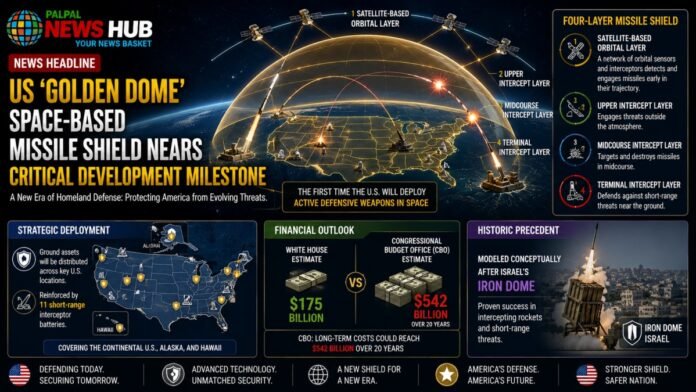
- System Design: The Golden Dome is a highly advanced, four-layer missile shield featuring one satellite-based orbital layer and three active ground-based interception layers.
- Strategic Deployment: Ground assets will be distributed across the continental United States, Alaska, and Hawaii, reinforced by 11 short-range interceptor batteries.
- Financial Variations: While initial White House projections place the project cost at $175 billion, the Congressional Budget Office (CBO) warns long-term costs could reach $542 billion over 20 years.
- Historic Precedent: Modeled conceptually after Israel’s highly successful Iron Dome, this system marks the first time the United States will officially deploy active defensive weapons directly into space.
The United States military is pushing forward with the rapid development of its highly ambitious “Golden Dome” missile defense shield, a multi-layered security infrastructure designed to neutralize advanced global missile threats. First announced by President Donald Trump as a cornerstone national defense policy, the system is engineered to track, target, and destroy incoming adversarial projectiles launched from anywhere on Earth or from orbital space positions.
The initiative marks a paradigm shift in global military doctrine, representing the first time the United States will permanently deploy active, weaponized interceptor capabilities into space. Pentagon officials have established a strict three-year timeline to bring the initial phases of the shield online, aiming for full operational capability to protect the American mainland and its remote territories from next-generation hypersonic and ballistic arsenals.
The Four-Layer Architecture of the Shield
Engineers and military strategists have structured the Golden Dome around a sophisticated, four-tiered defensive web designed to provide overlapping coverage against simultaneous mass-missile salvos.
The first and most revolutionary tier is an entirely satellite-based orbital network. This space layer utilizes a constellation of low-Earth orbit satellites equipped with advanced thermal sensors and laser-targeting systems to detect missile launches instantly and attempt mid-course interceptions while the threats are still traversing the vacuum of space.
The remaining three layers operate as a synchronized ground-based shield. These ground networks are heavily concentrated across three distinct geographic sectors: the continental United States, Alaska, and Hawaii. To maximize terminal defense capabilities near vulnerable entry points, the military is deploying 11 specialized short-range batteries at these strategic installations, providing a final, rapid-response buffer against any low-altitude threats that manage to bypass the space-based tier.
Divergent Projections Over Massive Long-Term Costs
The unprecedented scale of the Golden Dome has ignited intense fiscal debate in Washington. The White House has consistently maintained that the initial price tag for manufacturing and deploying the core infrastructure stands at approximately $175 billion, a sum the administration argues is a necessary investment for absolute national sovereignty.
However, independent economic audits suggest the true financial burden will be far higher. A comprehensive report issued by the US Congressional Budget Office (CBO) indicates that when accounting for long-term satellite replacement cycles, continuous software integration, personnel training, and routine maintenance over a 20-year operational lifecycle, the cumulative expenditure will skyrocket, ranging anywhere from $161 billion on the conservative end to an astonishing $542 billion.
“The Golden Dome represents the most expensive and complex engineering feat in modern military history,” a defense procurement analyst noted. “While the initial deployment costs are massive, maintaining a permanent, combat-ready defensive grid in the harsh environment of space will require a historic, multi-decade financial commitment from Congress.”
Despite the fiscal warnings and diplomatic friction regarding the militarization of space, the administration remains undeterred. As international adversaries expand their orbital capabilities and hypersonic technology, defense officials view the rapid completion of the Golden Dome as an indispensable shield to secure American airspace for generations to come.