































Key Points
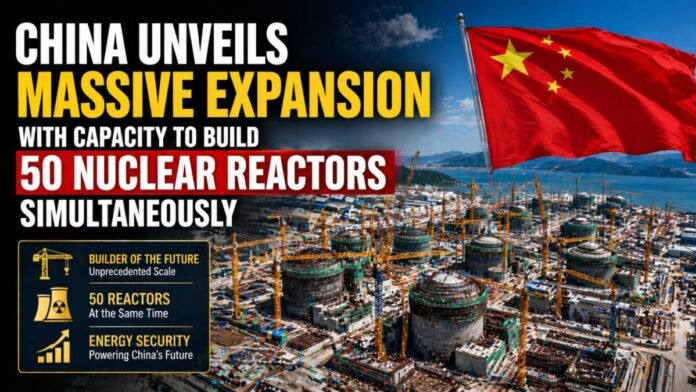
- Record Construction Scale: China can now manage 50 nuclear projects simultaneously, covering the full life cycle from design to final commissioning.
- Global Capacity Leader: With 125 million kilowatts (KW) of total installed capacity, China has secured the top global ranking in the sector.
- Operational Milestones: The nation currently operates 60 commercial reactors, while 36 units are under construction, accounting for over half of all global nuclear builds.
- Strategic Roadmap: Beijing aims to reach 200 gigawatts (GW) of capacity by 2040, driven by urgent energy security needs amid rising Middle East tensions.
To cement its dominance in the global energy landscape, China has achieved a feat that has astonished developed nations worldwide. According to a recent announcement by China’s nuclear authority at the Nuclear Industry China 2026 exhibition, the country has now developed the capability to simultaneously construct and manage 50 nuclear power reactors.
This milestone comes at a time when China is working on a war footing to bolster its energy security and minimize its reliance on fossil fuels. The expansion is increasingly seen as a defensive measure against external supply shocks, particularly as regional conflicts, such as the ongoing tensions involving the U.S., Israel, and Iran, threaten traditional energy corridors.
A Roadmap for Global Leadership in Nuclear Energy
According to a detailed report released by the China Nuclear Energy Association (CNEA), China’s nuclear technology has transitioned from a phase of “following” international standards to “leading” in several critical sectors. The report clarifies that Beijing now possesses a comprehensive roadmap to simultaneously execute dozens of nuclear projects, encompassing every stage from initial design to final construction.
Industry analysts suggest this capability has now surpassed that of most Western nations, where nuclear projects often face prolonged delays and regulatory hurdles. Statistics regarding China’s current nuclear capacity bear witness to its ambitions. According to reports from the CNEA, China’s total installed nuclear power capacity has reached 125 million kilowatts (KW), positioning it at the very top globally.
Currently, 60 commercial nuclear reactors in China are actively generating electricity, while another 36 reactors are under construction. Remarkably, more than half of all nuclear construction currently underway globally is taking place within Chinese borders. Additionally, 16 new units have recently received formal approval to begin the groundwork.
The Goal: Surpassing the U.S. by 2030
Beijing’s objective is not merely to expand its capacity but to emerge as the undisputed global leader in this sector. According to the CNEA, China aims to become a “strong nuclear power” by 2030, at which point it expects to surpass the United States in total installed capacity.
The trajectory does not stop there. By 2040, the country’s installed capacity is projected to reach 200 gigawatts (GW). To sustain this growth, the Chinese government has integrated “controllable nuclear fusion” and “coastal nuclear power” into its 15th Five-Year Plan (2026, 2030), ensuring a steady pipeline of high-tech energy projects.
Strategic and Technological Innovation
China’s aggressive expansion is not limited merely to domestic requirements; rather, it forms an integral part of its response to geopolitical instability and its global commitment to reducing carbon emissions. On the technological front, China is rapidly investing in the development of third and fourth-generation nuclear technologies, including the deployment of high-temperature gas-cooled reactors.
Investment is also surging into Small Modular Reactors (SMRs) and advanced fuel cycles, which offer more flexible deployment options for industrial hubs and remote regions. By diversifying its reactor types, China is positioning itself not only as a massive consumer of nuclear power but as the primary global exporter of advanced nuclear infrastructure.