Key Highlights
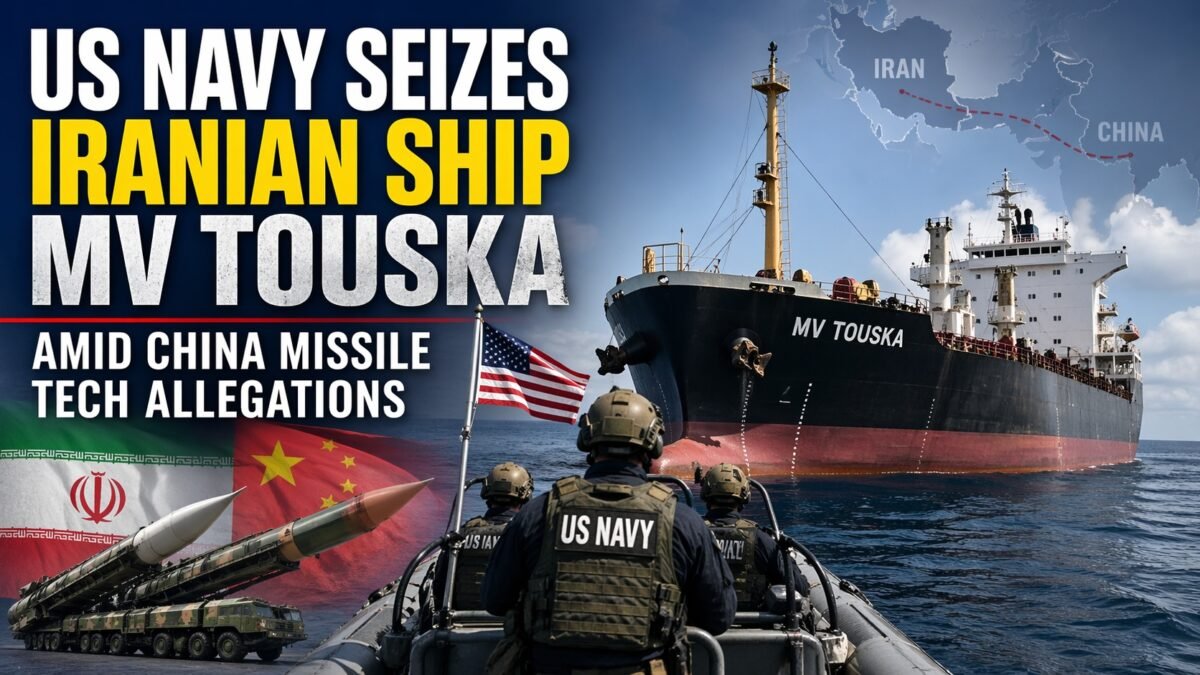
- Strategic Interception: The U.S. Navy guided-missile destroyer USS Spruance seized the MV Touska after the vessel reportedly ignored repeated warnings and attempted to evade the ongoing blockade.
- The China Connection: Former U.S. Ambassador Nikki Haley alleged the ship was transporting Chinese chemicals essential for Iran’s missile program, a claim Beijing has dismissed as “malicious propaganda.”
- Diplomacy in Peril: The seizure has stalled second-round peace talks in Islamabad, with Iranian officials refusing to negotiate until the naval blockade is lifted.
- Ceasefire Countdown: With the temporary truce set to expire on Wednesday night, President Trump has reiterated that no extension will be granted without a comprehensive “new deal.”
The maritime standoff in the Middle East reached a volatile new peak on Sunday when U.S. Marines boarded and seized the Iranian-flagged container ship MV Touska. The operation, conducted by an Arleigh Burke-class destroyer in the North Arabian Sea, involved a six-hour pursuit after the vessel allegedly refused to halt for inspection. President Donald Trump confirmed the action, stating that U.S. forces “stopped them right in their tracks” to enforce the ongoing blockade of Iranian ports.
This seizure is the first major interception since the U.S. implemented a total naval blockade last week. While the U.S. maintains that the blockade is a necessary tool to curb regional aggression, Tehran has labeled the act “armed piracy.” The incident has significantly heightened the stakes for global shipping, as hundreds of vessels remain stranded at either end of the Strait of Hormuz, waiting for the strategic waterway to reopen.
Nikki Haley’s Allegations and the Beijing Link
Adding a complex geopolitical layer to the seizure, U.S. Republican leader Nikki Haley published a series of sensational claims on social media. Haley asserted that the MV Touska was loaded with specialized chemicals destined for Iran’s ballistic missile factories, specifically sourced from suppliers in China. She warned that the evidence of Beijing’s material support for the Iranian military is now “undeniable” and cannot be ignored by the international community.
China’s Ministry of Foreign Affairs, through spokesperson Guo Jiakun, issued a swift and sharp rebuttal. Beijing characterized the allegations as part of a “smear campaign” and maintained that the Touska is a standard commercial vessel engaged in legitimate trade. However, a report by The Wall Street Journal appears to corroborate some of the U.S. concerns, citing maritime data that shows the Touska has made multiple suspicious trips to Chinese ports since the current conflict began, often turning off its transponder to avoid tracking.
Stalled Negotiations in Islamabad
The fallout from the ship’s capture has cast a long shadow over the planned diplomatic summit in Islamabad, Pakistan. Although U.S. Vice President J.D. Vance arrived in the Pakistani capital to lead a second round of face-to-face talks, the Iranian delegation’s participation remains uncertain. Mohammad Bagher Qalibaf, Iran’s chief negotiator, stated that Tehran would not “negotiate under the shadow of threats,” demanding the immediate release of the ship and its crew.
The U.S. administration, however, shows no sign of relenting. President Trump, in a recent interview, signaled that the naval blockade is a “proven success” that provides the leverage needed to secure a lasting agreement. As of Tuesday evening, mediators in Islamabad were still working frantically to bring both sides to the table before the two-week ceasefire officially lapses on Wednesday night.
Legal Status and “Spoils of War”
As the U.S. Navy begins offloading the Touska’s cargo for inspection, military analysts are debating the legal ramifications of the seizure. Former U.S. Navy Captain Carl Schuster noted that if the vessel is proven to be carrying contraband in violation of international sanctions, the cargo could be classified as “spoils of war.” Furthermore, any members of the Iranian Revolutionary Guard Corps (IRGC) found on board could potentially be treated as prisoners of war, a designation that would further complicate any future prisoner exchange or diplomatic resolution.
With the Wednesday deadline looming, the eyes of the world are fixed on the Strait of Hormuz. The next 24 hours will determine if the seizure of the MV Touska was the final blow to a fragile peace or the catalyst that forces a definitive resolution to the regional crisis.