Key Points
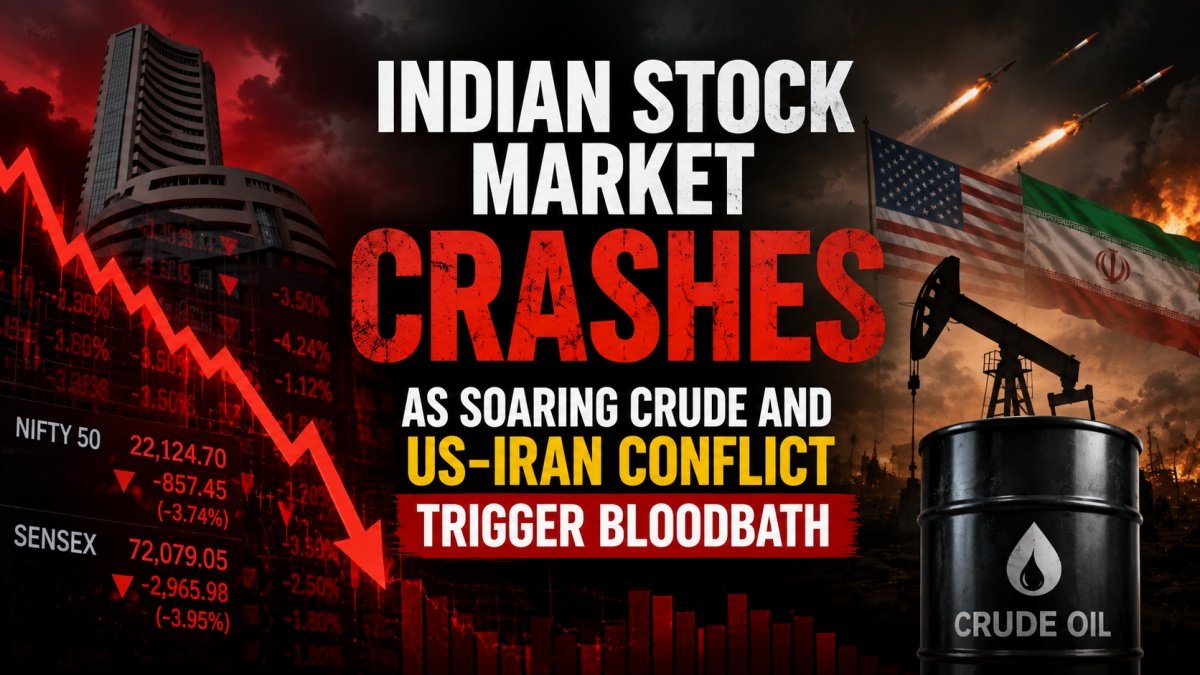
- Market Bloodbath: The BSE Sensex closed 1,677.12 points lower at 76,503.60, while the NSE Nifty50 tumbled 516.65 points to settle well below the crucial 24,000 mark at 23,882.05.
- Geopolitical Trigger: Panic selling intensified across global networks after US President Donald Trump declared the interim peace agreement with Tehran officially over, following extensive US airstrikes on Iranian infrastructure.
- Crude Oil Surge: Renewed threats of prolonged supply disruptions in the critical Strait of Hormuz pushed benchmark Brent crude up past $76 per barrel, later testing the $78 mark.
- Massive Wealth Eradication: The single-day market crash wiped out approximately Rs 8 lakh crore of domestic investor wealth, dragging the combined market capitalization of all BSE-listed companies down to Rs 471 lakh crore.
- Volatility Spike: India VIX, the premier market volatility gauge, surged by nearly 30% to hit 15, signaling a rapid, systemic flight from risk assets.
The five-day consecutive winning streak for Indian equity markets came to a grinding halt on Wednesday. Both major indices opened weak before cascading into an absolute rout by the afternoon session. The primary catalyst was a severe escalation in military engagements between the United States and Iran, which rapidly rattled international financial systems. By midday, all top 30 stocks of the BSE Sensex and every single constituent of the Nifty 50 were trading deep in the red.
Initial selling pressure was evident right from the opening bell, where the BSE Sensex dipped 435.11 points to trade at 77,745.61, and the NSE Nifty dropped 138.70 points to 24,260.00. As institutional liquidation gathered momentum in the second half of the session, the benchmarks recorded their sharpest single-day drops in months, with the Sensex closing down 2.15% and the Nifty finishing lower by 2.12%.
Sectoral Demolition and Broad-Based Capital Flight
The damage extended far beyond large-cap heavyweights, hitting mid-cap and small-cap segments in equal measure. Early in the day, the Nifty Midcap 100 shed 169 points to sit at 62,116, while the Nifty Smallcap 100 dropped 55 points to 19,164, values that deteriorated significantly further by the closing bell.
| Sector / Index | Performance Impact | Key Affected Stocks |
|---|---|---|
| Nifty Oil & Gas | Slipped 2.18% to 25,872.59, dropping 577.48 points | Reliance Industries, ONGC, BPCL |
| Nifty Auto | Broadly lower, losing 3% to 4% across the board | Ashok Leyland, Maruti, MRF, Hyundai, Tata Motors |
| Nifty Bank | Bore the brunt of institutional risk-off selling | Major private and public sector banking equities |
The automotive sector faced structural selling as investors factored in the compounding impact of rising raw material and logistics costs. Shares of commercial vehicle manufacturers like Ashok Leyland and passenger vehicle giants like Tata Motors and Hyundai faced heavy liquidations, closing with distinct losses of 3 to 4 percent.
The Macro Picture: Inflationary Pressures and Oil Volatility
“Sentiment on the domestic bourses turned decisively negative this session, wiping out the recent gains as renewed flare,ups in West Asia sent crude oil prices climbing. Inflationary worries resurfaced as well, pushing bond yields higher both at home and in the US,” noted Vinod Nair, Head of Research at Geojit Financial Services.
The foundational panic stems from the high-stakes military standoff in the Middle East. The US military launched offensive airstrikes on more than 80 targets in Iran, citing retaliation for drone and missile strikes against three oil-laden commercial vessels transiting the Strait of Hormuz. Iran countered almost immediately, targeting American military installations in Kuwait and Bahrain.
This back, and, forth exchange sent benchmark Brent crude rising 2.66 percent to $76.13 per barrel, while West Texas Intermediate (WTI) crude gained 2.64 percent to trade at $72.33 per barrel. For an economy like India, which imports more than 80 percent of its crude requirements, a sustained surge in energy costs threatens to trigger imported inflation, further weakening the Indian rupee and driving foreign institutional investors (FIIs) to withdraw capital in favor of safer-haven assets.