Key Points
- Official funeral proceedings for the late Supreme Leader are scheduled to begin this Saturday in Tehran.
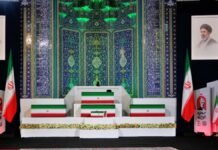
- President Masoud Pezeshkian and senior leadership led an emotional tribute ceremony at the Grand Mosalla complex.
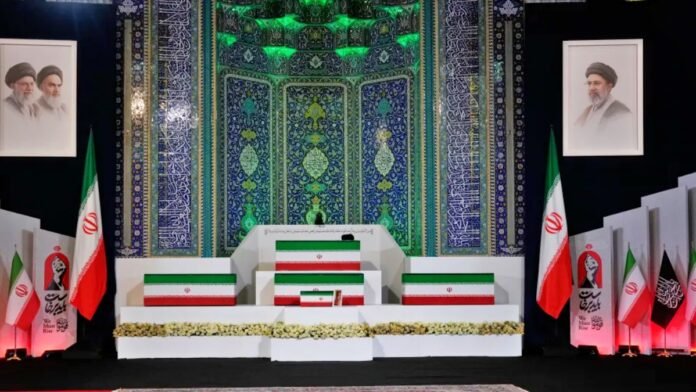
- The coffins of several family members killed in a wartime airstrike were placed alongside the Supreme Leader.
- The event marks the transition of authority to the new Supreme Leader, Ayatollah Mojtaba Khamenei.
- Processions will span several days, moving through major Iranian cities and sacred sites in neighboring Iraq.
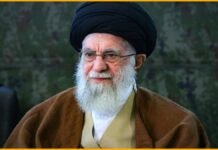
The Iranian capital has completed unprecedented logistical and security preparations ahead of the grand funeral proceedings for late Supreme Leader Ayatollah Ali Khamenei. The state-led ceremonies, set to officially commence on Saturday, began with a highly emotional tribute event in Tehran that brought together the nation’s highest-ranking officials.
During the preliminary service, Iran’s current President, Masoud Pezeshkian, alongside Parliament Speaker Mohammad Bagher Ghalibaf, wept openly before a vast crowd of mourners. The collective grief displayed by the top political and military echelon underscored the gravity of the transition, signaling a profound moment of solemnity for the state.
An immense gathering of ordinary citizens, state delegates, and global dignitaries has converged on the capital. The Iranian government has signaled that the massive gathering is designed to be more than a traditional mourning period; it is a deliberate projection of national solidarity, political resilience, and state endurance in the immediate aftermath of recent military conflict. Streets across Tehran have been lined with massive banners broadcasting messages of unity in Persian, Arabic, and English.
Coffins of Family Members Placed at Grand Mosalla
The flag-draped sacred coffin of Ayatollah Ali Khamenei was positioned with strict military and religious honors at the center of the Grand Mosalla complex in Tehran. In a stark reminder of the recent conflict, his coffin was lined up alongside those of his immediate family members who perished during a devastating airstrike on the opening day of the war.
Among the family casualties honored at the complex were the late Supreme Leader’s eldest daughter, his son-in-law, his 14-month-old granddaughter, and the wife of the newly appointed Supreme Leader, Ayatollah Mojtaba Khamenei. The joint display has intensified the emotional resonance of the proceedings for the thousands in attendance.
Public Rituals and Messages of Strategic Vengeance
A deeply moving scene unfolded as thousands of grieving citizens crowded the sanctuary, touching personal items to the late Supreme Leader’s coffin to receive what is traditionally viewed in Iran as a profound blessing and a symbol of sanctity.
Later in the ceremony, the national flag over Khamenei’s coffin was replaced with a large red flag inscribed with the phrase “Ya Hussain” in Arabic script. In Iranian political iconography, the raising of the red flag serves as a potent symbol of an ongoing struggle against injustice and a formal vow to exact heavy retribution against adversaries.
This message was reinforced by street banners throughout the capital reading “We Must Rise,” aimed at rallying public resolve. The event also saw notable tactical figures re-emerge; General Ahmad Vahidi, a senior commander within the Islamic Revolutionary Guard Corps (IRGC), made his first public appearance in several months to pay his respects.
Multi-Day Procession Path and Security Restrictions
The historic mourning events will extend over several days with full national honors, transitioning from the capital to broader religious geographies. To allow the wider public to offer final respects, the mortal remains of the late Supreme Leader will be transported to multiple major Iranian cities, as well as to prominent holy sites in neighboring Iraq.
In anticipation of the massive crowds and high-profile international attendees, the government has enacted strict security protocols. Key transit routes and major arterial roads throughout Tehran will remain completely closed to civilian traffic, while extensive airspace restrictions have been implemented across the region for the duration of the multi-day ceremonies.