

































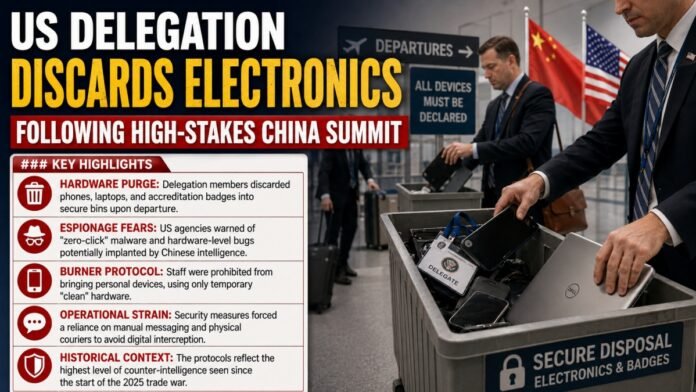
Key Highlights
- Hardware Purge: Delegation members discarded phones, laptops, and accreditation badges into secure bins upon departure.
- Espionage Fears: US agencies warned of “zero-click” malware and hardware-level bugs potentially implanted by Chinese intelligence.
- Burner Protocol: Staff were prohibited from bringing personal devices, using only temporary “clean” hardware.
- Operational Strain: Security measures forced a reliance on manual messaging and physical couriers to avoid digital interception.
- Historical Context: The protocols reflect the highest level of counter-intelligence seen since the start of the 2025 trade war.
As President Donald Trump’s milestone state visit to China concluded on May 15, 2026, a startling visual unfolded within international security circles. Members of the US delegation were observed discarding their mobile phones, laptops, and even plastic accreditation badges into specialized trash receptacles. This “scorched earth” approach to hardware is the standard response to what US counter-intelligence describes as one of the most sophisticated surveillance environments in the world.
The mandate, issued by the FBI and the Secret Service, stems from deep-rooted concerns that any device entering Chinese airspace is subject to covert exploitation. Security agencies feared that surveillance software could have been implanted via public Wi-Fi, localized cellular networks, or even physical tampering during room sweeps. By discarding the hardware before reconnecting to any domestic US government networks, officials ensured that no “Trojan Horse” malware could infiltrate the Pentagon or White House servers.
“Clean Devices” and the Burner Culture
Preparations for the May 13 to May 15 visit began months in advance with a total ban on personal electronics for all traveling staff. Delegation members were required to leave their everyday smartphones and laptops in secure lockers within the United States. In their place, they were issued “clean” or “burner” devices, temporary laptops, and controlled communication tools stripped of all non-essential software.
These devices were designed for single-use, containing no historical data and limited access to cloud services. Despite these precautions, US officials treat all electronic activity in Beijing as “compromised by default.” The discarding of badges is equally critical, as modern accreditation often contains RFID chips or NFC technology that can be cloned or used for proximity tracking of high-level officials.
Technical Challenges and the Return to Physical Intelligence
The rigorous security blanket created significant operational “headaches” for the delegation throughout the three-day summit. Because the temporary devices lacked synchronized access to standard encrypted government apps, routine coordination became a logistical nightmare.
Technical hurdles included:
- Manual Synchronization: All data had to be manually entered or transmitted through heavily throttled, controlled channels.
- Physical Couriers: Highly confidential updates were frequently hand-delivered by security personnel to avoid any digital footprint, reverting to Cold War-era “face-to-face” intelligence sharing.
- Account Isolation: Staff used temporary accounts that were scheduled for immediate deletion upon the delegation’s return to US soil.
Cybersecurity experts noted that the 2026 summit required even stricter protocols than previous years, given the recent breakthroughs in AI-driven malware. Leaving a digital footprint in China is now deemed a permanent risk, as any data captured today could be decrypted by future technologies. For the US delegation, the cost of the hardware was a small price to pay for the security of the nation’s most sensitive diplomatic secrets.