Key Points
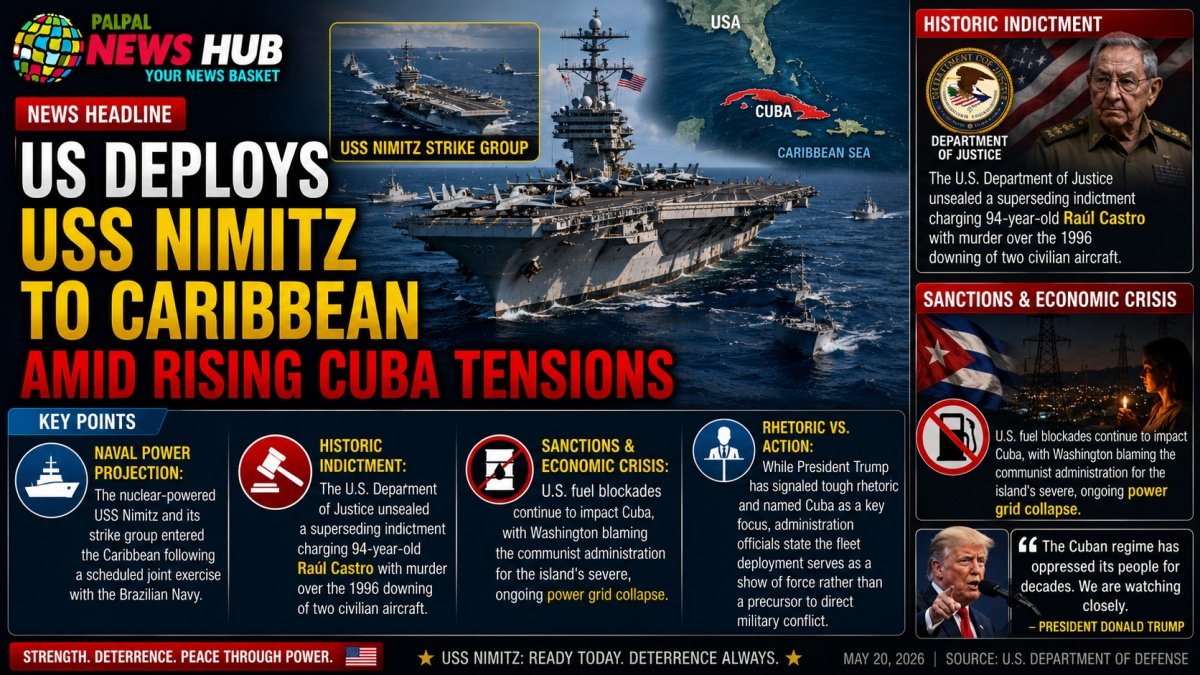
- Naval Power Projection: The nuclear-powered USS Nimitz and its strike group entered the Caribbean following a scheduled joint exercise with the Brazilian Navy.
- Historic Indictment: The U.S. Department of Justice unsealed a superseding indictment charging 94-year-old Raúl Castro with murder over the 1996 downing of two civilian aircraft.
- Sanctions & Economic Crisis: U.S. fuel blockades continue to impact Cuba, with Washington blaming the communist administration for the island’s severe, ongoing power grid collapse.
- Rhetoric vs. Action: While President Trump has signaled tough rhetoric and named Cuba as a key focus, administration officials state the fleet deployment serves as a show of force rather than a precursor to direct military conflict.
The escalating political tension between the United States and Cuba is now taking on a very serious dimension. Adopting an extremely tough stance against Cuba, U.S. President Donald Trump has signaled a clear focus on the island nation, prompting the U.S. Navy aircraft carrier USS Nimitz, accompanied by its entire strike group, to arrive in the Caribbean Sea.
The U.S. Southern Command has described this significant military deployment as essential for upholding democracy and maintaining regional stability. This grave situation has emerged at a time when the U.S. posture in the region has become increasingly aggressive, following recent geopolitical maneuvers involving Venezuela and Iran. Now, the eyes of the entire world are fixed on the serious diplomatic and military developments unfolding between the United States and Cuba.
The USS Nimitz has demonstrated its immense military might across the globe, ranging from the Taiwan Strait to the Arabian Gulf. This strike group comprises Carrier Air Wing 17, which includes highly advanced combat aircraft such as the F/A-18E Super Hornet and the EA-18G Growler. Additionally, C-2A Greyhound aircraft, the Arleigh Burke-class destroyer USS Gridley, and the replenishment oiler USNS Patuxent have been fully deployed.
Prior to entering the Caribbean, the historic warship, commissioned into the U.S. Navy in 1975, completed a series of joint maritime operations. As part of the Southern Seas 2026 mission, the strike group conducted passing exercises and technical exchanges with the Brazilian Navy off the coast of Rio de Janeiro, a fact confirmed by the U.S. Embassy. Through these regional engagements, the United States has underscored its strong presence in Latin America and its full state of combat readiness.
Historic Charges Unsealed Against Raúl Castro
The naval deployment heavily coincides with a major legal escalatory move by Washington. The U.S. Department of Justice has leveled several major and grave charges, including murder, against Cuba’s former President, Raúl Castro. This entire case is linked to the horrific February 1996 incident involving the downing of two unarmed civilian aircraft in international airspace by Cuban military forces.
The aircraft belonged to “Brothers to the Rescue”, a Miami-based volunteer organization that conducted search-and-rescue operations for Cuban refugees in the Florida Straits. That deeply tragic event claimed the lives of four individuals: Carlos Costa, Armando Alejandre Jr., Mario de la Peña, and Pablo Morales. The United States has now significantly intensified its investigation into the matter, unsealing a superseding indictment against the 94-year-old former leader and five other regime co-defendants.
Fuel Sanctions and Escalating Economic Pressure
U.S. President Trump has explicitly stated that his administration is keeping a close watch on every activity within Cuba, calling the timing of the indictment a “very big moment” for Cuban-Americans who wish to see accountability. Meanwhile, U.S. Secretary of State Marco Rubio has also issued a scathing response, taking sharp aim at Cuba’s communist government.
In a special message delivered in Spanish, Rubio openly extended his support to the Cuban public. He defended the stringent U.S. fuel sanctions imposed on Cuba, placing the blame squarely on the local government for the cascading power outages and economic hardship currently plaguing the country.
While the economic crisis and the massive deployment of the Nimitz in the Caribbean Sea have further intensified this entire dispute, President Trump has sought to temper fears of immediate warfare. He noted that the island is facing severe internal stability issues, reducing the likelihood of a localized military escalation despite the heavy show of American naval strength.