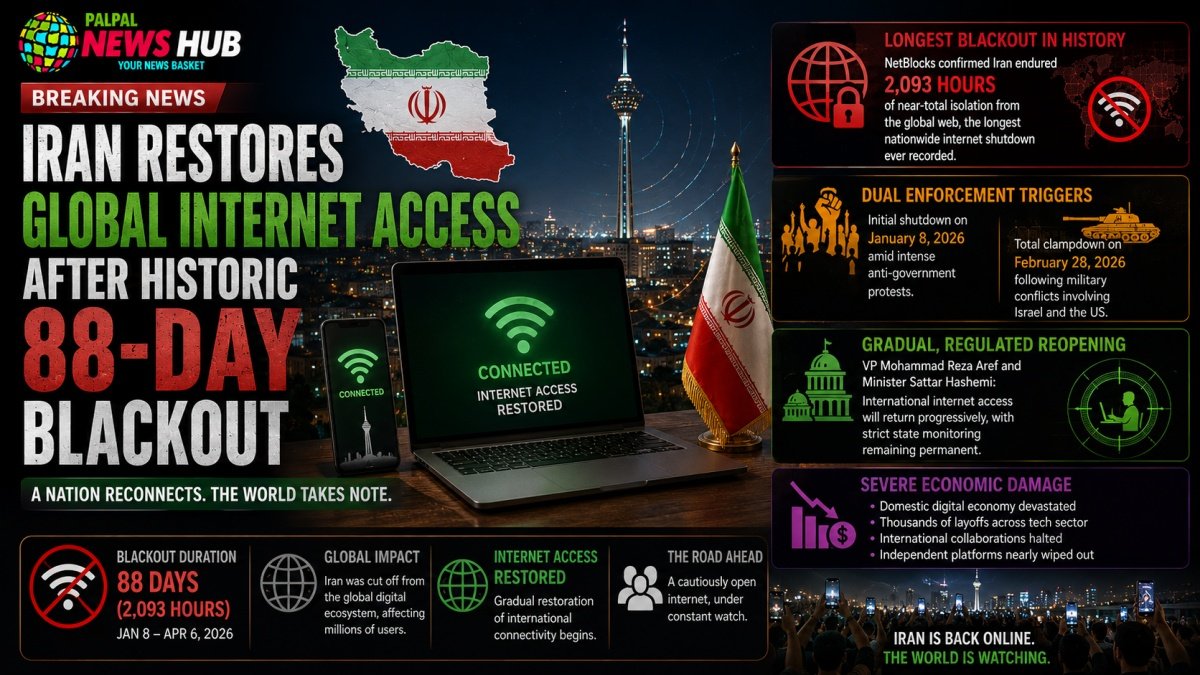
Key Points
- Longest Blackout in History: Digital watchdog NetBlocks confirmed that Iran endured a total of 2,093 hours of near-total isolation from the global web, marking the longest nationwide internet shutdown recorded in modern history.
- Dual Enforcement Triggers: The strict digital blockade was initially triggered on January 8, 2026, amid intense anti-government protests, and clamped down entirely on February 28 following the outbreak of military conflicts involving Israel and the US.
- Gradual, Regulated Reopening: Vice President Mohammad Reza Aref and Communications Minister Sattar Hashemi clarified that the return of international web traffic will be rolled out progressively, though strict state monitoring will remain permanent.
- Severe Economic Damage: Prolonged network isolation devastated the country’s domestic digital economy, resulting in systemic layoffs, halted international tech collaborations, and a near-total loss of independent commercial platforms.
In a highly anticipated policy shift, Iranian President Masoud Pezeshkian has officially instructed the Ministry of Information and Communications Technology to begin dismantling the state’s severe international internet restrictions. The presidential directive aims to return web accessibility across Iran to its pre-January state, concluding a dramatic period of total digital containment that severely paralyzed daily life, commerce, and human rights oversight.
According to tracking data from global network monitors, traffic began flowing back to domestic networks on Tuesday, climbing to more than a third of normal operational capacities. Digital rights activists and local internet service providers (ISPs) reported that home fiber-optic networks in the capital city of Tehran, alongside various residential mobile networks, were the first to register live global connections. Government spokespeople pointed to the active return of standard web utilities, like Gmail, as immediate confirmation that the rollback was underway.
A Chronology of Digital Suppression
The unprecedented digital embargo was deployed in two heavily managed phases by the national security apparatus:
- Phase 1 (January 8): In response to nationwide economic and political anti-government demonstrations that spread rapidly across core cities, authorities initiated a sweeping blackout of the World Wide Web. By deactivating mobile network antennas, severing phone lines, and restricting foreign platforms, the state sought to stifle organizational networks.
- Phase 2 (February 28): Following a brief window of easing in mid-February, the National Security Council clamped down on the country’s digital perimeter with maximum force. The total blacking out of international data streams coincided exactly with the commencement of military strikes against Iranian infrastructure by the United States and Israel.
During this extended baseline of total isolation, the country’s 90 million citizens were restricted entirely to a government-managed intranet. While local banking systems, public utilities, and localized delivery apps remained operational, access to the broader global internet became an expensive privilege, restricted only to those utilizing black-market virtual private networks (VPNs) or illicitly smuggled Starlink terminals.
Catastrophic Toll on the Digital Economy
The decision to end the blackout follows intensive internal lobbying by President Pezeshkian, who ran on a progressive campaign platform of expanding digital freedoms. The move reflects growing economic panic within Tehran over long-term financial insolvency, commercial collapse, and mass unemployment.
A comprehensive study executed by the Tehran Electronics Association of more than 900 businesses revealed that companies lost roughly 75% of their vital communication channels due to ongoing blocks on foreign networks like WhatsApp, Telegram, and Instagram. Furthermore, the combined strain of active wartime conditions and the total lack of external data access left over a million freelancers, software engineers, and small commercial startups without viable income streams.
Communications Minister Sattar Hashemi addressed the critical need for structural rehabilitation on Tuesday, stating:
“Internet restrictions in recent months have caused significant damage to the digital economy, online businesses, and the country’s service industries. The continuation of this situation could have led to the weakening of investment, the emigration of elite human resources, and the expansion of communication patterns outside the framework of the country’s official governance.”
Systemic Oversight and Regulated Access
While the administration has framed the reopening as a necessary public right, Vice President Mohammad Reza Aref emphasized that the government is steering toward a framework of “free and regulated” access. This terminology signals that while the baseline pipeline to the global web is returning, rigorous state-level data filtering, content censorship, and strict tracking mechanisms will remain actively enforced.
Though independent watchdogs caution that it will take several weeks to accurately map the depth and consistency of the restoration across more remote provinces, the step marks a crucial turning point for a population striving to rebuild communication channels with the outside world.