































Key Points
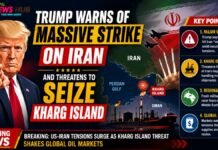
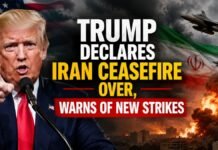
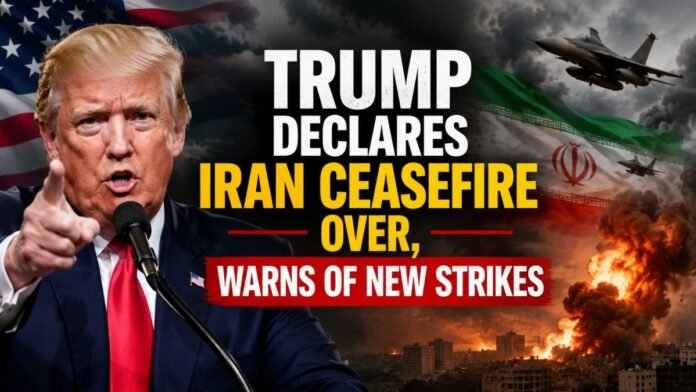
- Ceasefire Terminated: President Trump declared the June 17 memorandum of understanding with Tehran dead, calling ongoing negotiations a waste of time.
- Overnight Escalation: The announcement follows a massive US military operation that struck over 80 Iranian targets in response to drone and missile attacks on commercial tankers.
- Regional Retaliation: Iran’s Islamic Revolutionary Guard Corps countered by targeting 85 US-aligned facilities in Bahrain and Kuwait, expanding the theater of conflict.
- Infrastructure Threats: The US warned it may escalate to targeting Iranian civilian infrastructure, including power grids, water plants, and the critical oil hub at Kharg Island.
- Support for Ukraine: On the sidelines of the summit, Trump met with Ukrainian President Volodymyr Zelenskyy and announced plans to authorize the production of Patriot air defense systems abroad.
The fragile peace in West Asia has disintegrated completely. Speaking on the sidelines of the NATO summit in Ankara, Turkey, US President Donald Trump confirmed that the brief truce between Washington and Tehran has collapsed. When questioned about the status of the 14-point memorandum of understanding signed in June, Trump responded sharply, stating that dealing with the Iranian regime was a waste of time and asserting that the agreement is over.
The collapse of the truce marks a return to open hostilities in a conflict that has severely impacted global energy markets and maritime security. Trump noted that while negotiators could technically keep talking, he remains deeply skeptical of any diplomatic resolution.
Military Engagements and Regional Repercussions
| Force | Actions Taken & Targets Hit | Operational Context |
|---|---|---|
| United States (CENTCOM) | Struck 80+ military sites, destroyed 60 IRGC small boats, revoked oil sanctions waivers. | Retaliation for maritime attacks in the Strait of Hormuz. |
| Iran (IRGC) | Targeted 3 commercial tankers, launched retaliatory strikes against 85 allied facilities. | Active engagement in the Strait, Bahrain, and Kuwait. |
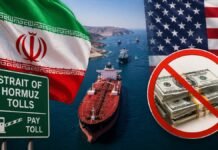
The immediate catalyst for the renewed fighting was a series of Iranian drone and missile attacks against three commercial tankers transiting the Strait of Hormuz: the Marshall Islands-flagged M/T Al Rekayyat, the Saudi Arabia-flagged M/T Wedyan, and the Liberian-flagged M/T Cyprus Prosperity.
In swift retaliation, US Central Command launched a massive wave of offensive strikes on Tuesday night. The operation successfully degraded Iranian capabilities by striking air defense networks, command-and-control hubs, coastal radar installations, and dozens of IRGC fast-attack craft. Simultaneously, the US Treasury Department canceled a critical license that had allowed Iran to sell crude oil, reinstating a tight economic blockade temporarily.
President Donald Trump says the US will "probably" launch further strikes on Iran, raising the prospect of a return to all-out war https://t.co/onYUfYA3zk pic.twitter.com/i96ioAR9gC
— Bloomberg (@business) July 8, 2026
Iran responded immediately on Wednesday morning. The IRGC claimed responsibility for launching an initial wave of retaliatory strikes against 85 US and allied military facilities located across Bahrain and Kuwait, triggering air defense alarms throughout the Gulf region.
Threats to Civilian Infrastructure and Kharg Island
“We hit them very hard last night, and we will probably hit them hard again tonight. I will give them a little warning. We are going to hit them hard tonight,” Trump told reporters.
Washington has signaled that it is prepared to broaden its target list if Iran continues to disrupt commercial shipping corridors. Trump warned that the US is currently holding back from maximum-level attacks but could soon target Iran’s primary civilian infrastructure, including bridges, desalination facilities, and electricity plants. Furthermore, the US has raised the possibility of seizing Kharg Island, a highly strategic maritime facility that handles roughly 90% of Iran’s crude oil exports.
Balancing Commitments to Ukraine
Despite the rapidly deteriorating situation in the Middle East, President Trump sought to reassure European allies of the US’s continued commitment to continental security. Before entering a bilateral meeting with Ukrainian President Volodymyr Zelenskyy, Trump announced a strategic initiative to authorize the production of Patriot air defense systems abroad. This measure is intended to directly assist Ukraine in countering ongoing Russian missile and drone attacks, ensuring that Washington’s defense manufacturing capabilities can handle simultaneous global pressures.