



































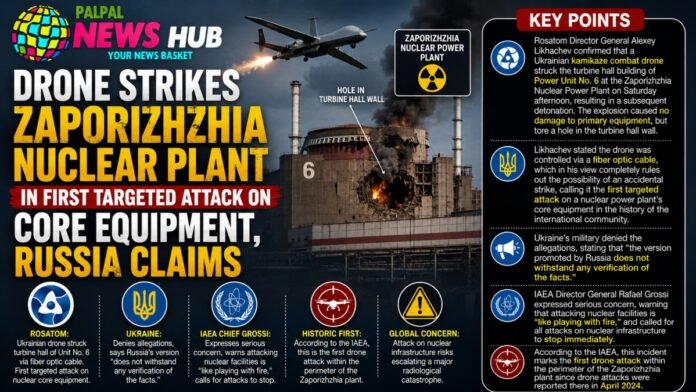
Key Points
- Rosatom Director General Alexey Likhachev confirmed that a Ukrainian kamikaze combat drone struck the turbine hall building of Power Unit No. 6 at the Zaporizhzhia Nuclear Power Plant on Saturday afternoon, resulting in a subsequent detonation. The explosion caused no damage to primary equipment, but tore a hole in the turbine hall wall.
- Likhachev stated the drone was controlled via a fiber optic cable, which in his view completely rules out the possibility of an accidental strike, calling it the first targeted attack on a nuclear power plant’s core equipment in the history of the international community.
- Ukraine’s military denied the allegations, stating that “the version promoted by Russia does not withstand any verification of the facts.”
- IAEA Director General Rafael Grossi expressed serious concern, warning that attacking nuclear facilities is “like playing with fire,” and called for all attacks on nuclear infrastructure to stop immediately.
- According to the IAEA, this incident marks the first drone attack within the perimeter of the Zaporizhzhia plant since drone attacks were reported there in April 2024.
Rosatom’s Likhachev stated: “This afternoon, a Ukrainian combat drone hit the turbine hall of power unit 6, causing a subsequent detonation. The explosion did not damage the main equipment, but it did create a hole in the turbine hall wall.”
According to Likhachev, the use of fiber-optic guidance indicates the strike was deliberately aimed at the plant’s main equipment. He warned, “Today, we are one step closer to an incident that will most likely affect even those living far beyond Russia and Ukraine, who still think they are completely safe.”
Likhachev pressed further: “The Ukrainian armed forces repeatedly cross not just red lines, but the boundaries of common sense. What should we expect next? Strikes directly at the turbine? The reactor hall? The reactor and its safety systems?”
Ukraine Denies Responsibility
Ukraine’s military pushed back against the Russian account, rejecting Rosatom chief Likhachev’s allegations. Ukraine has repeatedly maintained that it is Russia’s occupation of the plant that poses the greatest threat to nuclear safety, not only in Ukraine but worldwide.
IAEA Demands Access and Calls for Restraint
The IAEA confirmed it had been notified of the attack, with the plant itself stating on social media that such strikes are “extremely irresponsible and pose grave threats to nuclear security,” and that “any attack on a nuclear plant’s infrastructure may trigger unpredictable consequences and endanger regional safety.” No casualties or serious damage were reported.
The IAEA team stationed at the plant requested access to the affected turbine building to conduct a firsthand assessment of the damage.
A Pattern of Escalating Incidents
Earlier in May 2026, the IAEA warned that increased drone activity near the plant had intensified the risk of a nuclear accident. The plant also lost both landline and internet connections for about 12 hours on May 27, the longest such outage at the facility since the start of Russia’s full-scale invasion, which violated one of the seven core principles for maintaining wartime nuclear safety.
Earlier this month, the Zaporizhzhia plant’s external radiation monitoring laboratory was also attacked by a drone, compounding concerns about the safety of the site.
The plant has been under Russian control since March 2022. Since the outbreak of the Russia-Ukraine conflict, the IAEA has repeatedly warned of the risks posed by military activities around the site and called for the protection of nuclear infrastructure. With the latest strike targeting unit-level infrastructure inside the perimeter for the first time in over two years, international pressure on all sides to halt military activity near the facility is growing more urgent by the day.